- Guides
- Pet-safe plants for homes with cats and dogs
Guide
Pet-safe plants for homes with cats and dogs
Two of our nine plants are on the ASPCA's non-toxic list, and here is how to handle the other seven.
Pet-safe plants, checked against the ASPCA list
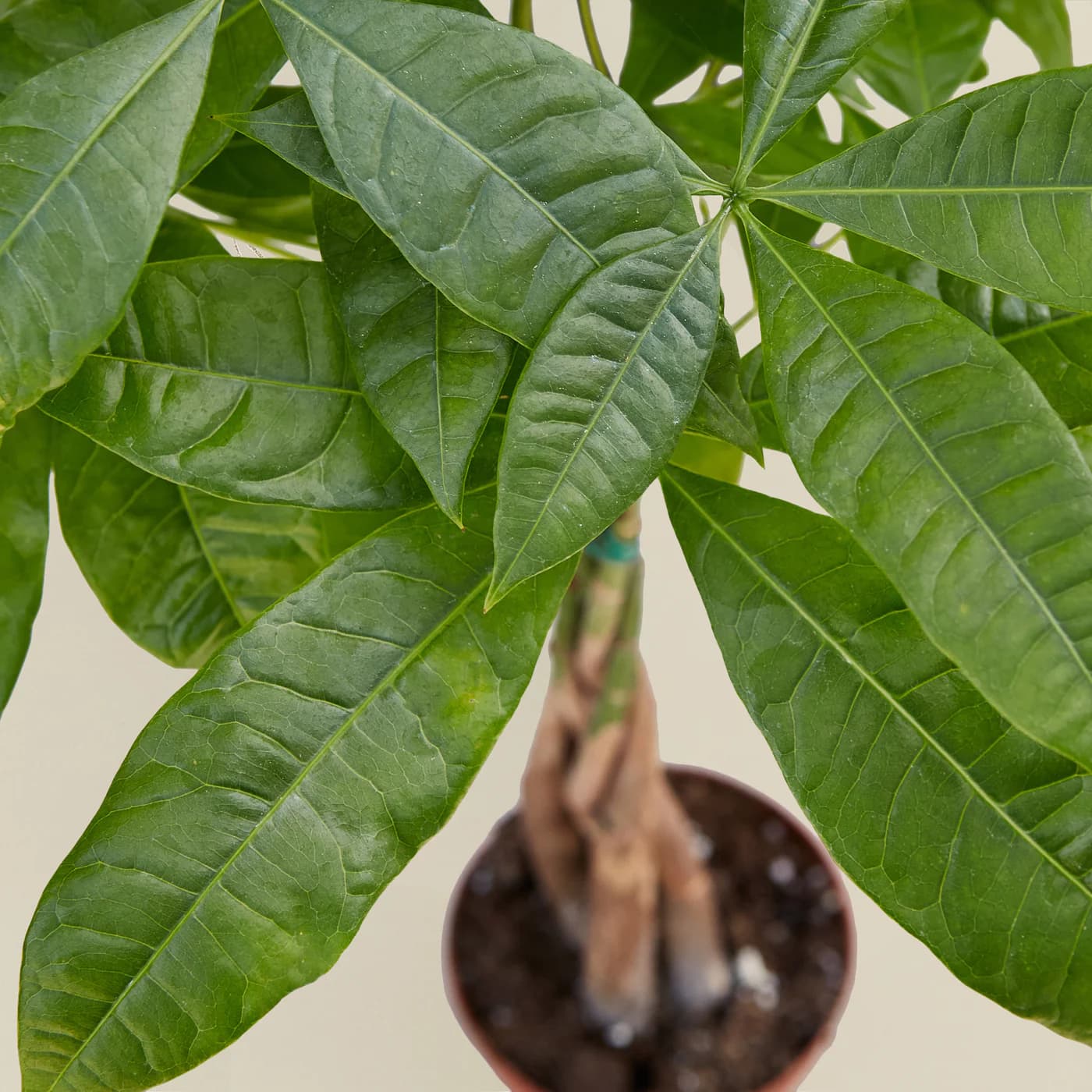
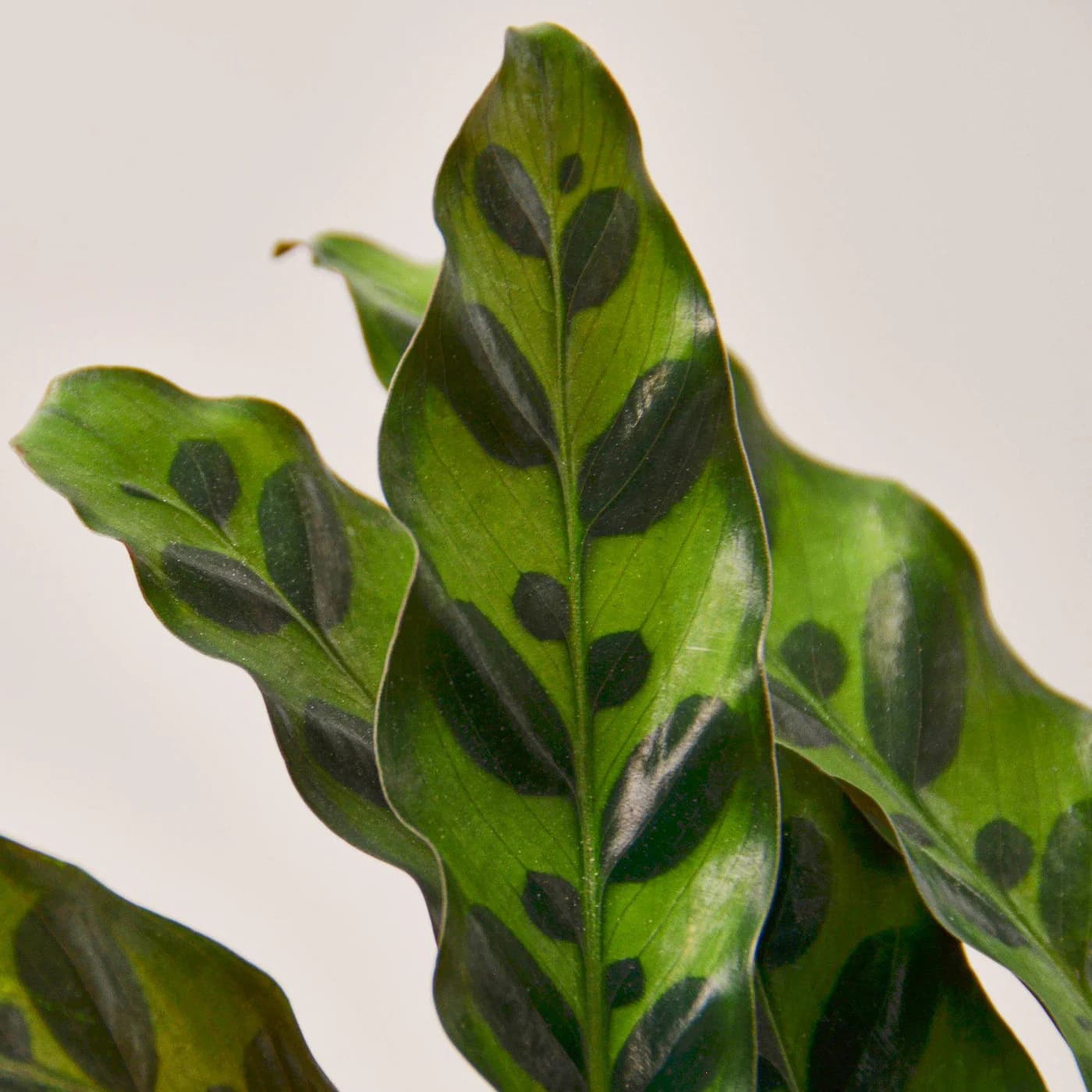
If you share your home with a cat or dog, the most reliable pet-safe (or pet-friendly) plants are the ones the ASPCA lists as non-toxic. Two of the nine plants we sell meet that bar: the rattlesnake plant and the money tree. The ASPCA lists both as non-toxic to cats and dogs. We would rather give you a short, honest list than pad it with plants that are only probably fine.
We checked all nine against the ASPCA list by botanical name as well as common name, because the list often files a plant under an older name. The rattlesnake plant, now called Goeppertia insignis, appears there as Caeroba, under its old name Calathea insignis. The list also has non-toxic entries under Calathea lancifolia, the name it is often sold as, and a general entry for calatheas. The money tree appears under Pachira aquatica.
One caveat on the money tree. The ASPCA's entry is for Pachira aquatica, the name ours is sold under, but Wikipedia notes that most money trees sold as P. aquatica are really a close relative, Pachira glabra. The ASPCA doesn't list P. glabra by name. We follow the ASPCA listing, and we would rather you know about the mix-up than find out later.
Both plants arrive already potted at the greenhouse, so there's nothing to repot on day one. Each one's guide covers where to put it and how to water it.
The plants
Rattlesnake Plant
Goeppertia insignis
If you want a boldly patterned leaf in a home with pets, start here. The ASPCA lists it as non-toxic to cats and dogs, filed under its old name, Calathea insignis, and under Calathea lancifolia, the name it is often sold as. It sits at cat height on a low table, so give it a stand if your cat likes to nibble.
Pet safeLow to medium lightMoney Tree
Pachira aquatica
The pick if you want a small tree shape in a home with pets. The ASPCA lists Pachira aquatica as non-toxic to cats, dogs and horses, though its entry notes that eating some can still cause nausea, vomiting and loose stool. Many braided money trees are thought to be the close relative Pachira glabra, which the ASPCA doesn't list by name, so we flag it here rather than leave it out.
Pet safeMedium to bright light
What does non-toxic mean for cats and dogs?
The ASPCA Animal Poison Control Center keeps a widely used list of plants that are toxic and non-toxic to pets. A non-toxic rating means the plant isn't known to poison cats or dogs. It doesn't mean the plant is a snack. The ASPCA notes that eating any plant material can cause vomiting and stomach upset, and even its money tree entry lists nausea, vomiting and loose stool as possible signs. Plants listed as non-toxic aren't expected to be life-threatening.
The ASPCA also says its list covers the most frequently encountered plants and isn't all-inclusive, so a plant missing from it hasn't been cleared or condemned. Check plants by botanical name as well as common name, because common names overlap in ways that matter:
- Rattlesnake plant and snake plant are different plants. The snake plant, also called mother-in-law's tongue (Sansevieria trifasciata), is toxic to cats and dogs according to the ASPCA. The rattlesnake plant, a calathea, is not.
- Money tree can mean two plants. The ASPCA lists Pachira aquatica as non-toxic, but the jade plant (Crassula ovata), which it lists as toxic, also goes by money tree and money plant. The Chinese money plant is a third plant again, covered below.
- Swiss cheese plant can mean two plants too. The ASPCA's Swiss cheese plant entry is Monstera deliciosa, which it lists as toxic. Our Swiss cheese vine is a different species, Monstera adansonii, covered further down.
- Satin pothos isn't a true pothos. It is Scindapsus pictus, a different genus from golden pothos (Epipremnum aureum), but the ASPCA lists it as toxic to cats and dogs as well.
Is a Chinese money plant safe for cats and dogs?
Our Chinese money plant is Pilea peperomioides, and it isn't on the ASPCA's toxic and non-toxic plant list. A 2021 ASPCA article on succulents does name the Chinese money plant among non-toxic succulents, and the list itself rates relatives such as the aluminum plant (Pilea cadierei) and the friendship plant (Pilea involucrata) as non-toxic to cats and dogs. But Pilea peperomioides has no entry of its own, and a relative's rating doesn't carry over, so we don't call it pet safe, and we don't call it toxic either.
Despite the name, it isn't related to the money tree or the jade plant. If you want a plant with an ASPCA non-toxic listing, choose the rattlesnake plant or the money tree. If you keep a Chinese money plant anyway, put it where a pet can't chew it, since any plant can upset a pet's stomach.
Which of our plants are toxic to cats and dogs?
Five of the nine are on the ASPCA list as toxic to cats and dogs: golden pothos, neon pothos, satin pothos, heartleaf philodendron and Dieffenbachia 'Camille'. Neon pothos has no entry of its own, but it is a form of golden pothos, Epipremnum aureum, so the same listing covers it. The ASPCA lists dieffenbachia, also called dumb cane, for the whole genus.
Clemson Extension notes that all parts of philodendrons, pothos and monsteras contain calcium oxalate crystals. When a pet chews a leaf, they cause burning and irritation of the mouth, lips and tongue, along with heavy drooling, vomiting and trouble swallowing. It is a miserable experience for the animal, even when it passes.
Our Swiss cheese vine, Monstera adansonii, is a sixth plant to keep away from pets, even though the ASPCA doesn't list it. The ASPCA's Swiss cheese plant entry covers its larger cousin, Monstera deliciosa, which it lists as toxic, and Clemson Extension says monsteras contain the same calcium oxalate crystals and are toxic to pets. Unlisted doesn't mean safe here: treat it like the five above.
Keep all six in a room your pets don't use. A high shelf isn't enough on its own, because cats climb and trailing vines hang down within reach.
What should you do if your cat or dog eats a toxic plant?
Stay calm and move quickly:
- Take the plant away and, if your pet lets you, wipe any leaf bits from its mouth with a damp cloth. Don't force it, since a pet in pain may bite.
- Note the plant's name, roughly how much was eaten and when, and your pet's weight. A photo of the plant or its tag helps too.
- Call your vet or the ASPCA Animal Poison Control Center's 24-hour line at (888) 426-4435. The ASPCA notes that a consultation fee may apply.
- Don't try to make your pet vomit unless a vet tells you to.
- Go to an emergency vet right away if your pet has trouble breathing or its face starts to swell.
How to keep cats and dogs off your plants
Even a non-toxic plant suffers when a pet chews the leaves or a cat digs in the soil. These tips protect the plant. They don't make a toxic plant safe to keep within a pet's reach. A few habits help:
- Put plants on a shelf or stand with no chair or bookcase nearby for a cat to jump from, and keep trailing vines trimmed so nothing dangles within reach.
- Give your cat its own pot of cat grass, usually oat or wheat grass, so it has something it's allowed to chew.
- Cover the soil with a layer of large, smooth pebbles to stop a cat digging, but skip this if your dog likes to swallow stones. Lift a pebble or two to feel the soil before you water. Our guide to watering houseplants covers the rest.
- Run a strip of double-sided tape or foil along the shelf edge for a week or two. Many cats dislike the feel and learn to skip that spot.
- For dogs, especially puppies, keep pots off the floor and low coffee tables until the chewing phase passes.
Questions
Is a money tree safe for cats and dogs?
The ASPCA lists the money tree, Pachira aquatica, as non-toxic to cats, dogs and horses. Its entry still lists nausea, vomiting and loose stool as possible signs if a pet eats some, so don't let it become a chew toy. Two cautions: the jade plant is also sold as a money tree and is toxic, and many braided money trees are thought to be Pachira glabra, which the ASPCA doesn't list by name.
Are calatheas safe for cats and dogs?
Yes. The ASPCA has a general entry for calatheas that lists them as non-toxic to cats and dogs, plus several entries under Calathea insignis, the old name for our rattlesnake plant. As with any plant, a pet that eats a lot of leaves may get an upset stomach.
Is pothos toxic to cats?
Yes. The ASPCA lists golden pothos (Epipremnum aureum) as toxic to cats and dogs, and neon pothos is a form of the same species. Satin pothos, Scindapsus pictus, is listed as toxic too. Clemson Extension notes that pothos contain calcium oxalate crystals, which irritate the mouth and cause drooling, vomiting and trouble swallowing.
Is a Swiss cheese plant toxic to cats and dogs?
Yes. The ASPCA lists the Swiss cheese plant, Monstera deliciosa, as toxic to cats and dogs. Our Swiss cheese vine, Monstera adansonii, has no ASPCA entry of its own, but Clemson Extension says monsteras contain calcium oxalate crystals and are toxic to pets, so treat it the same way.
Is dieffenbachia poisonous to cats and dogs?
Yes. The ASPCA lists dieffenbachia, or dumb cane, as toxic to cats and dogs, and the listing covers the whole genus, including our Dieffenbachia 'Camille'. Keep it in a room your pets don't use, and call your vet or the ASPCA Animal Poison Control Center at (888) 426-4435 if you think your pet has chewed it.
Sources
- ASPCA Animal Poison Control: Toxic and Non-Toxic Plant List
- ASPCA Animal Poison Control: Money Tree (Pachira aquatica)
- ASPCA Animal Poison Control: Caeroba (Calathea insignis, Rattle Snake Plant)
- ASPCA: Are Succulents Safe to Have Around Pets? (2021)
- Clemson Cooperative Extension HGIC 1509: Philodendron, Pothos and Monstera
- Wikipedia: Pachira aquatica (on braided money trees sold as P. aquatica that are P. glabra)