- Guides
- Air-purifying plants: do houseplants really clean the air?
Guide
Air-purifying plants: do houseplants really clean the air?
The famous NASA list came from sealed lab boxes, so here is what that means for your living room and how the plants we carry compare.
Do houseplants clean the air? The short answer
Air-purifying plants show up on plant tags and shop listings, and the claim usually traces back to one source: a NASA study from 1989. Do houseplants clean the air in your home? Not by any amount you would notice. The NASA tests ran in small sealed boxes. Later research found you would need a room packed with plants to match what ordinary air exchange already does.
We still think plants are worth owning, just not for that reason. None of our nine plants is on the report's core list of 12. Two of them, golden pothos and heartleaf philodendron, do appear in some of its other results, and two more, neon pothos and satin pothos, share the pothos name. Our other five plants, the Swiss cheese vine, money tree, Chinese money plant, rattlesnake plant and Dieffenbachia 'Camille', don't appear in the report at all. For each plant in this guide, we say how close it comes to what NASA tested.
The plants
Golden Pothos
Epipremnum aureum
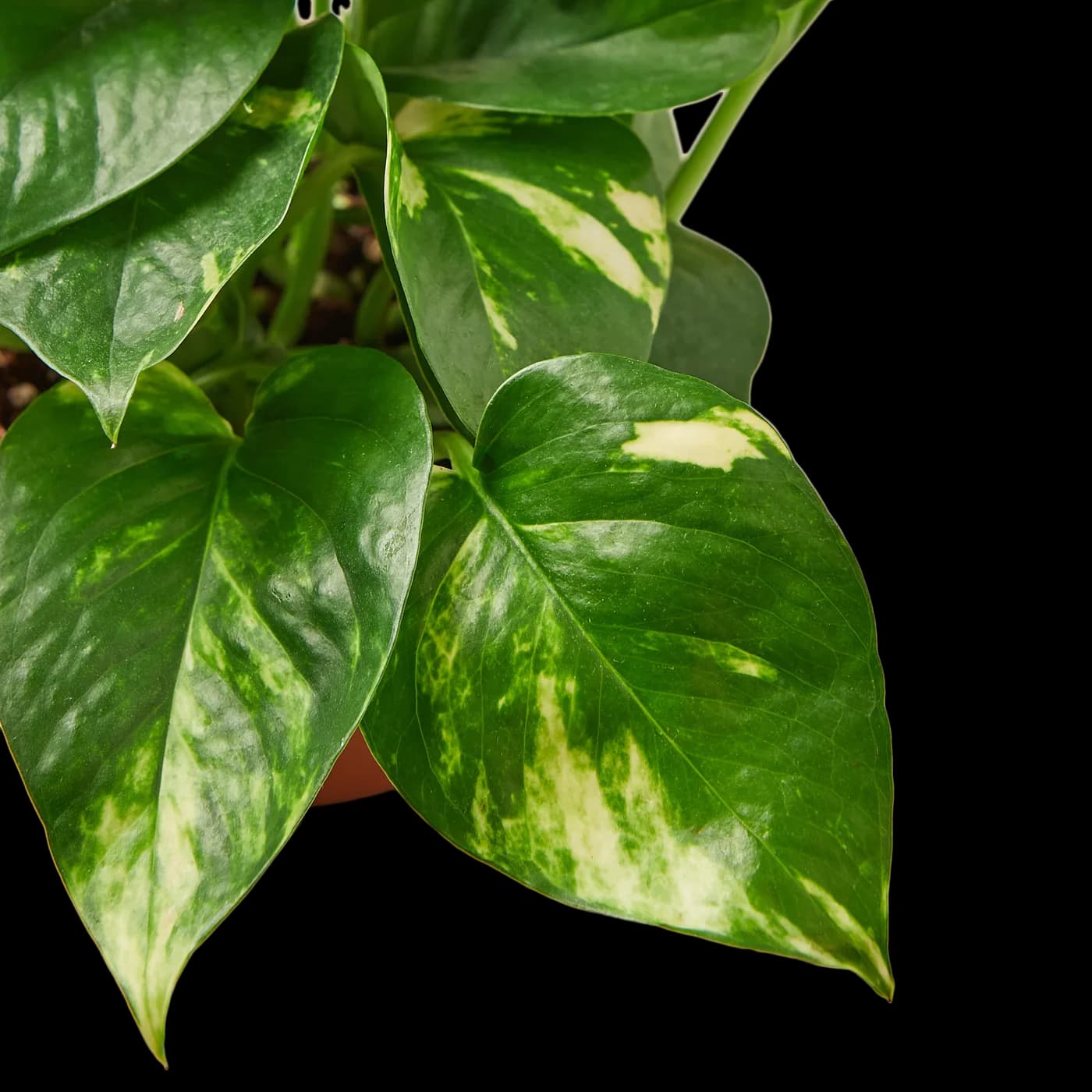
The closest match we sell to a plant in NASA's report. It wasn't on the core list, but golden pothos appears in the formaldehyde, benzene and trichloroethylene results, and it was the plant inside NASA's activated carbon filter design. The report calls it Scindapsus aureus, which NC State Extension gives as an earlier name for Epipremnum aureum. It's worth owning because it's easy to grow and survives long stretches in low light, but the ASPCA lists it as toxic to cats and dogs.
Toxic to petsLow to bright lightHeartleaf Philodendron
Philodendron hederaceum var. oxycardium
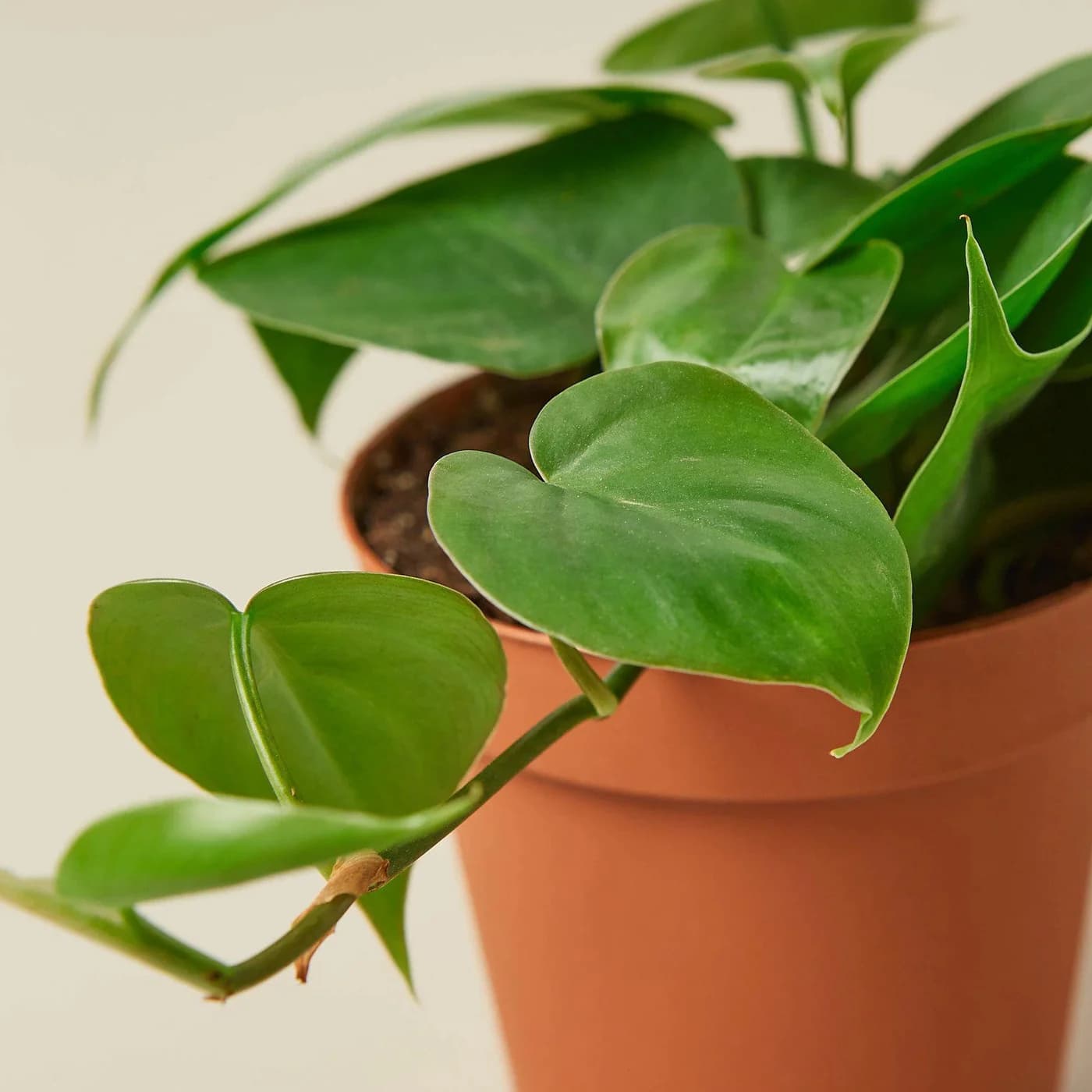
NASA's formaldehyde results include heart leaf philodendron, labeled Philodendron oxycardium, an older name for the plant we carry, now Philodendron hederaceum var. oxycardium. The ASPCA's plant list still carries both names. NASA tested it only with formaldehyde, and only in a sealed chamber. We like it for other reasons, which our guide to low light houseplants explains, but the ASPCA lists it as toxic to cats and dogs.
Toxic to petsLow to bright lightNeon Pothos
Epipremnum aureum 'Neon'
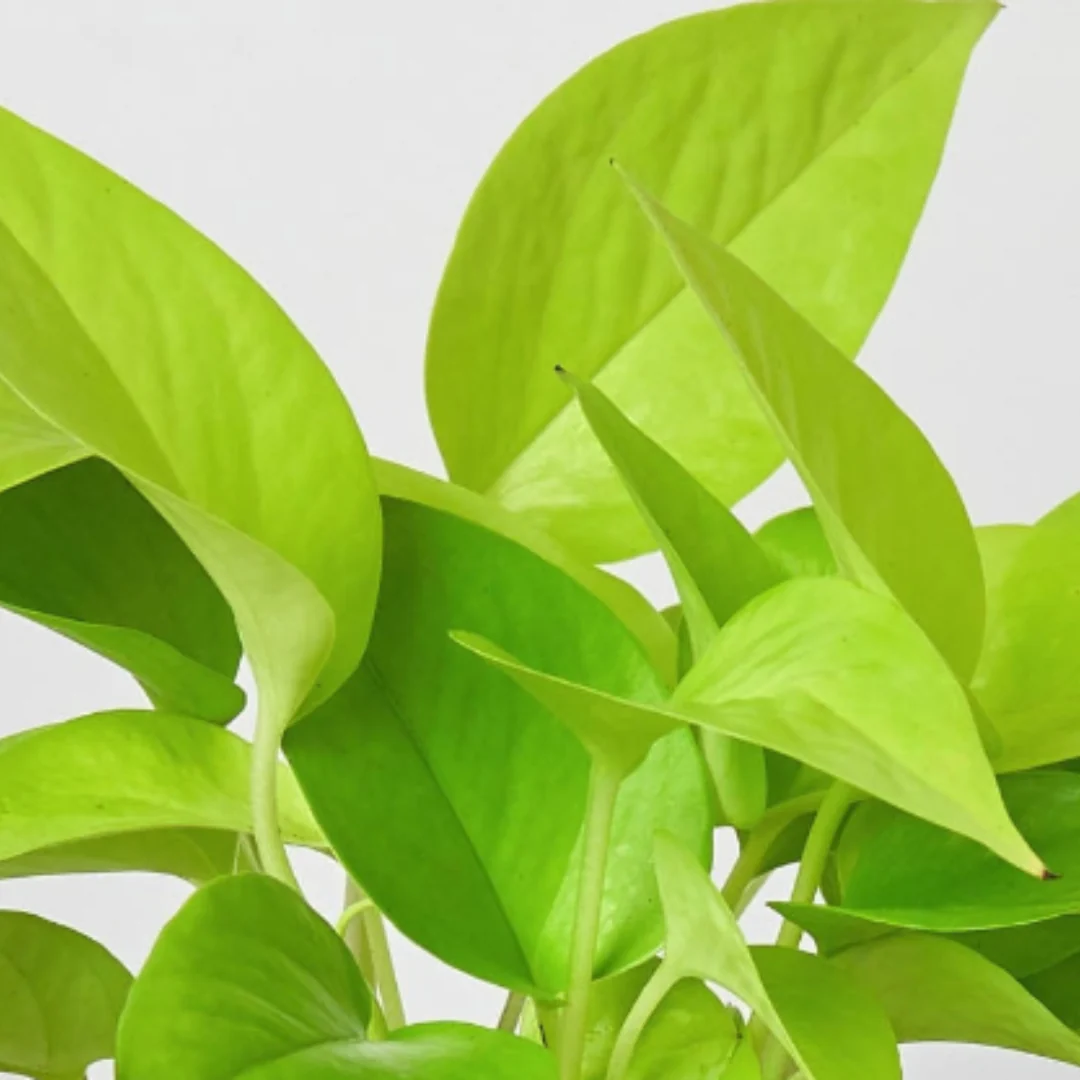
Neon pothos is the same species as golden pothos, Epipremnum aureum, and NC State Extension lists 'Neon' among its named forms. NASA tested golden pothos, not Neon, so the report's numbers don't strictly apply to it, and they wouldn't change much in a home anyway. Choose it for its bright chartreuse leaves. The ASPCA lists Epipremnum aureum as toxic to cats and dogs.
Toxic to petsMedium to bright lightSatin Pothos
Scindapsus pictus
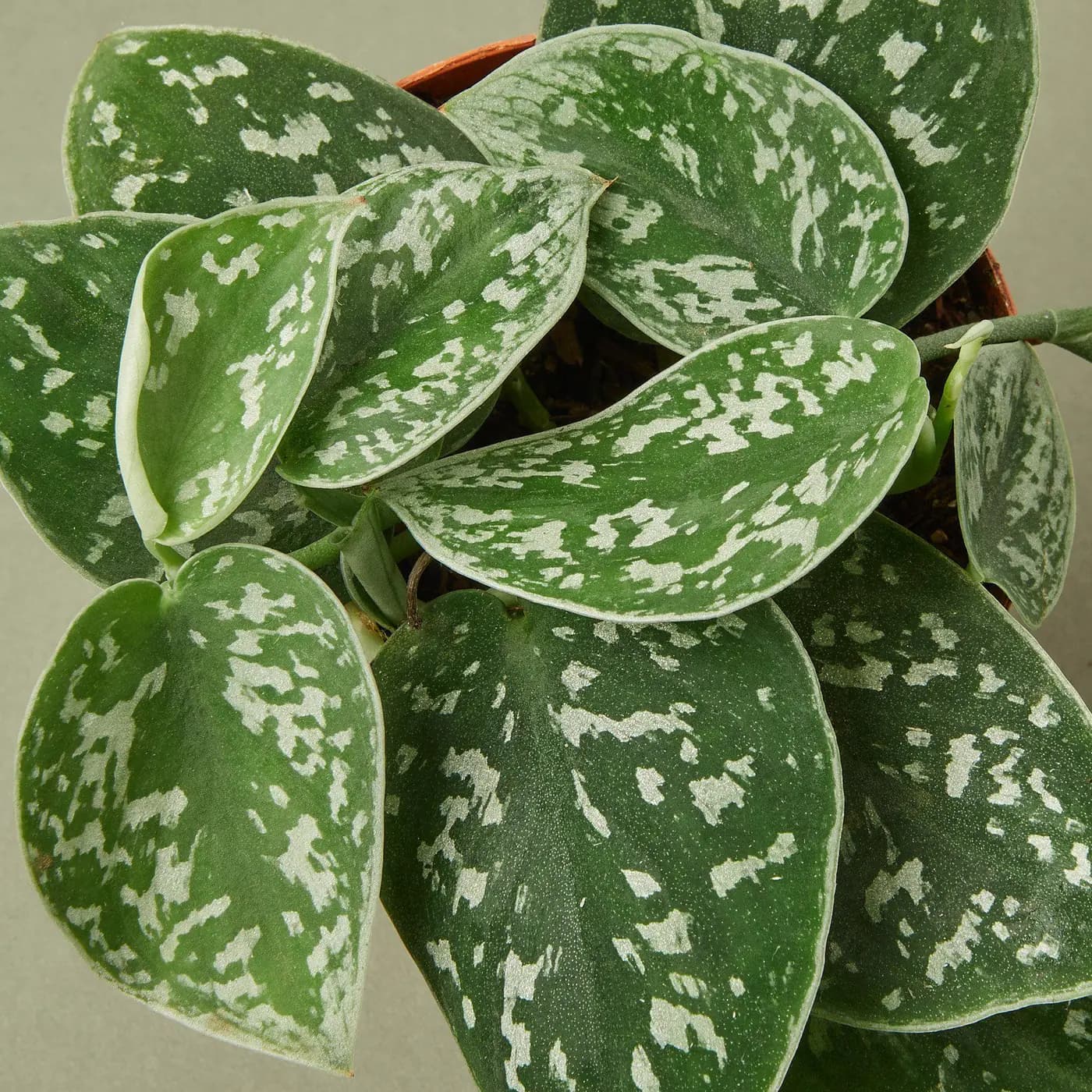
Satin pothos is sold under the pothos name, but it's a different plant, Scindapsus pictus, and the ASPCA lists it separately from golden pothos. That can confuse things, because NASA's report used the name Scindapsus aureus for golden pothos, not for this plant, and satin pothos doesn't appear in the report. We carry it for its silver-splashed, velvety leaves. The ASPCA lists it as toxic to cats and dogs.
Toxic to petsMedium to bright light
What the NASA Clean Air Study actually tested
In 1989, B.C. Wolverton and colleagues at NASA's Stennis Space Center, working with the Associated Landscape Contractors of America, published Interior Landscape Plants for Indoor Air Pollution Abatement. It's the report most lists point to.
The setup was simple. A single plant was sealed inside a Plexiglas chamber. The smallest chambers were cubes 30 inches on a side, about 16 cubic feet, and the largest were twice as tall, about 31 cubic feet. The researchers injected one of three chemicals (benzene, trichloroethylene or formaldehyde) and measured what was left 6 and 24 hours later.
The core list had 12 plants: the peace lily, a Chinese evergreen, the bamboo palm, English ivy, mother-in-law's tongue (snake plant), a weeping fig, gerbera daisy, potted chrysanthemum and four dracaenas.
Chemical levels did fall in those boxes. One detail that often gets left out: the researchers concluded that the roots, the soil and the microbes around them seemed to do much of the work. The final report recommended pairing plants with a fan-driven activated carbon filter, and the plant it used in that filter was golden pothos. A sealed box with one plant and one dose of chemical is a long way from a house. In a home, air moves in and out all day and new pollutants keep arriving.
Do houseplants improve indoor air quality? What later research found
In 2020, researchers Bryan Cummings and Michael Waring asked what the chamber results would mean in an actual building. Writing in the Journal of Exposure Science & Environmental Epidemiology, they gathered 12 published studies covering 196 experimental results. They converted each result into a clean air delivery rate, the same measure used to rate air purifiers.
The median plant cleaned about 0.023 cubic meters of air an hour, which is less than one cubic foot. To match the air exchange a typical building already gets from outdoor air, they estimated you would need 10 to 1,000 plants per square meter of floor. That's roughly 1 to 93 plants per square foot.
Their title sums it up: potted plants do not improve indoor air quality. The US Environmental Protection Agency says much the same. It acknowledges reports that houseplants reduced some chemicals in lab experiments. But there's no evidence that a reasonable number of them remove significant amounts of pollutants in homes and offices.
How to improve indoor air quality
None of this means plants are a bad idea. They just can't stand in for an open window. The EPA lists three basic strategies for better indoor air, and says the first is usually the most effective:
- Source control. Remove or reduce whatever is putting pollutants into the air. Some sources can be sealed off, and others, like a gas stove, can be adjusted to give off less.
- Ventilation. Open windows and doors when the weather allows, and run bathroom and kitchen fans that vent to the outside.
- Air cleaners. Some are very good at catching particles, but most aren't designed to remove gases, and the EPA says most tabletop models are much less effective. We'd treat one as a backup to the first two.
What houseplants can do for you
The case for houseplants is simpler. Many people enjoy caring for them, and a room with something green and growing in it looks softer and more lived in. That's a real reason to own a plant, even without a statistic attached.
Plants also give you a small, steady routine: press a finger into the soil to see if it's dry, water when it is, give the pot a quarter turn so it grows evenly, snip off a yellow leaf. Some people find that kind of small, regular task satisfying, and our care guide covers the basics.
So choose a plant for your light, your schedule and your pets, not for a list. If you're new to this, start with our easy houseplants for beginners, or browse all nine plants.
Questions
Did NASA prove that plants clean the air?
No. The report's abstract describes plants being evaluated "as a possible means of reducing indoor air pollutants." Its closing summary was more upbeat, calling plant systems one of the most promising ways to ease sick building syndrome. But none of the tests measured a real home, and when later researchers scaled the numbers up to ordinary buildings, the effect shrank to almost nothing.
How many plants does it take to clean the air in a room?
Far more than anyone keeps. Cummings and Waring's estimate works out to about 280 to 28,000 plants for a 15-by-20-foot living room. That's just to keep pace with the air that already moves in and out of it. Even the low end means a plant on nearly every square foot of floor.
What is the best air-purifying plant?
At the numbers people keep at home, no houseplant cleans the air enough to notice, so there isn't a best one. If you'd like a plant from NASA's report anyway, golden pothos is the closest match we carry, and NC State Extension calls it very easy to grow. Otherwise, pick the plant that fits your light and your household.
Are air-purifying plants safe for cats and dogs?
Many aren't. The ASPCA lists golden pothos, heartleaf philodendron and satin pothos as toxic to cats and dogs, and neon pothos is the same species as golden pothos. Several plants from NASA's core list are on the ASPCA's toxic list too, including the peace lily, snake plant, English ivy and the Chinese evergreen NASA tested, Aglaonema modestum. For a pet home, the ASPCA lists the rattlesnake plant, a calathea unrelated to the snake plant, and the money tree as non-toxic, though neither appears in NASA's report. Our guide to pet-safe houseplants has more.
Can houseplants make indoor air worse?
Possibly, if the soil stays soggy. The EPA notes that overly damp soil may encourage microorganisms that can bother people with allergies. Check the soil with a finger before you water, and let it dry as much as that plant likes. For golden pothos, that means waiting until the top inch is dry; NC State Extension advises letting the soil dry between waterings. Tip out any water that collects in a saucer or cover pot so the plant never stands in water. Our guide to watering houseplants explains how.
Sources
- Wolverton, Johnson and Bounds (1989), Interior Landscape Plants for Indoor Air Pollution Abatement, NASA Technical Reports Server
- Cummings and Waring (2020), Potted plants do not improve indoor air quality, Journal of Exposure Science & Environmental Epidemiology
- US EPA, Improving Indoor Air Quality
- NC State Extension Plant Toolbox: Epipremnum aureum (pothos; formerly Scindapsus aureus; 'Neon' cultivar)
- ASPCA Animal Poison Control: Toxic and Non-Toxic Plant List, Cats
- ASPCA Animal Poison Control: Toxic and Non-Toxic Plant List, Dogs