- Guides
- Money Tree
Plant guide
Money Tree Care: How to Grow a Braided Pachira
A braided tropical tree that wants bright, indirect light, water when the top inch of soil is dry and a spot it can stay in, and that the ASPCA lists as non-toxic to cats and dogs.
What is a money tree?
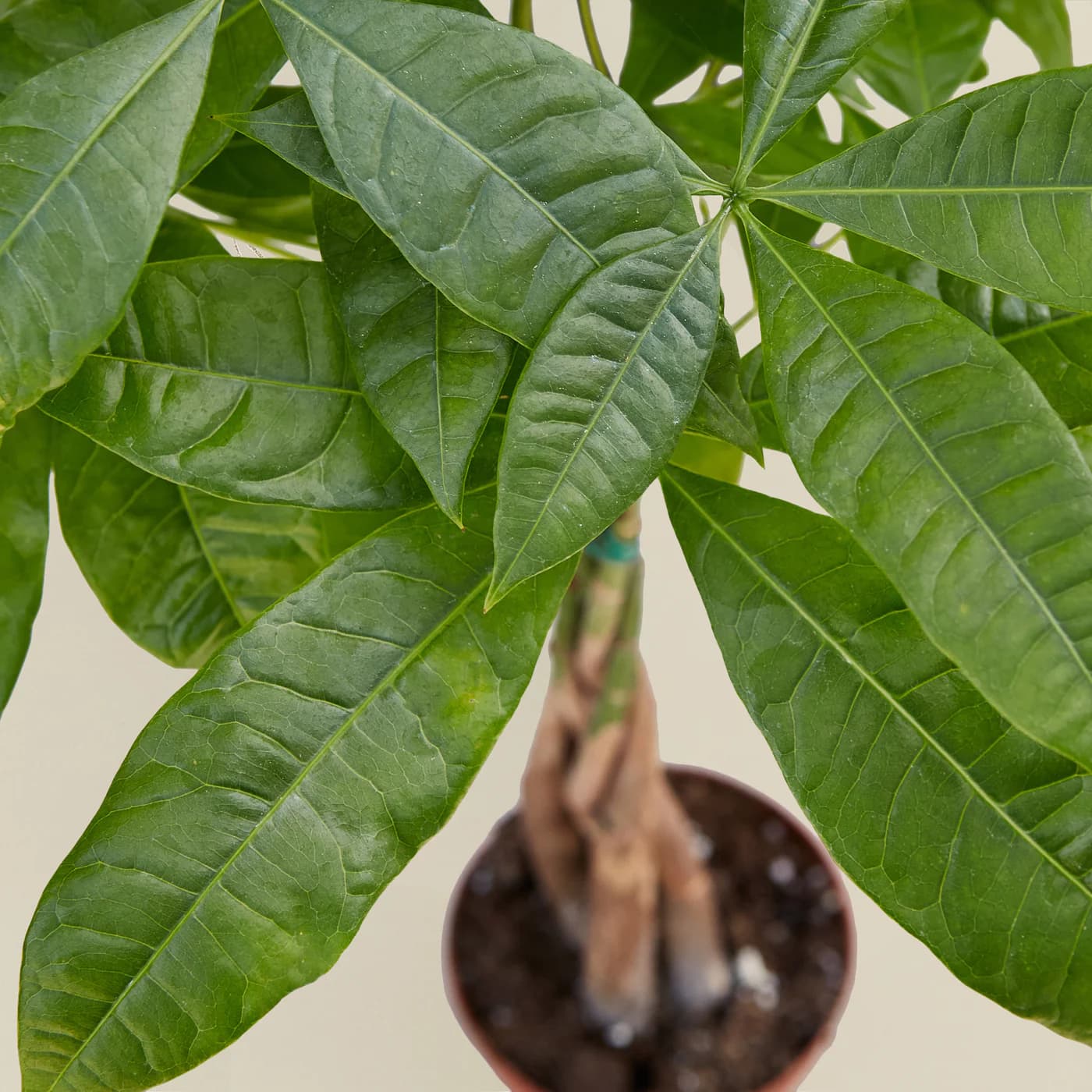
A money tree is a tropical tree grown as a houseplant, usually sold with several slim trunks woven into a braid under a crown of glossy leaves. Each leaf splits into 5 to 9 leaflets that fan out like an open hand.
In the wild, Pachira aquatica grows in freshwater swamps and along riverbanks from southern Mexico to Bolivia and northern Brazil, and it can reach 60 feet. Indoors it stays far smaller: NC State Extension says a houseplant rarely tops 6 to 8 feet, and the New York Botanical Garden (NYBG) puts most at 3 to 6 feet. It also goes by Guiana chestnut and Malabar chestnut.
A note on the name. We sell ours as Pachira aquatica, the name money trees usually carry. Wikipedia says most money trees grown as houseplants are really a close relative, Pachira glabra, and, citing the Taiwanese plant author Wang Jui-min, traces the mix-up to an early misidentification in Taiwan. The two are told apart by flowers and fruit, which houseplants rarely produce. The care advice from NC State and NYBG is written for money trees as they're sold, so it applies either way.
Care comes down to three habits: bright, indirect light, water when the top inch of soil is dry, and a spot it can stay in. NYBG notes that money trees dislike being moved and drop leaves in protest.
Why are money trees braided, and does the braid bring luck?
A braided money tree isn't one tree with a twisted trunk. It's several young plants in one pot, their stems woven together while still green and bendy. NC State says the trunks are flexible enough to braid, and that braiding seedlings began in Taiwan, where the tree became popular in the 1980s. Growers do the braiding; the tree wouldn't grow that way on its own.
The money and luck story is folklore. According to NC State, the tree was valued in feng shui for bringing prosperity to a home, its name comes from a tale of a poor man who grew rich selling its edible nuts, and braiding was thought to lock in luck. It's a nice story, but good light and careful watering are what keep it healthy.
Keep the braid as it is. Don't try to unwind it, and follow NYBG's advice never to cut into the braided section when you prune.
If a tie, band or piece of tape holds the top of the braid, check it a couple of times a year. UC Master Gardeners warn, about staked trees, that tight, non-elastic ties can girdle a trunk as it grows, damaging bark and restricting the flow of water and nutrients. If a tie is pressing into the bark, loosen it or swap it for a wide, soft tie in a loose loop. Never tighten it to make the braid look neater.
Is a money tree a good houseplant for you?
A money tree gives you the look of a small tree in very little floor space, and it has a few practical strengths:
- The ASPCA lists it as non-toxic to cats and dogs.
- It grows quickly in good light. NC State rates its growth as rapid.
- Once it's in the right spot, NYBG calls it low in care needs.
- It fits a desk or shelf while young. Our Small comes in a 4 in pot and our Medium in a 6 in pot.
It has limits. NYBG says it drops leaves when it's moved, when its roots are disturbed or when it sits in a draft, so it's a poor pick for a spot you rearrange often. It slowly declines in dim light and almost never flowers indoors. If you've seen it sold as an air-cleaning plant, read what the research says about plants and indoor air before you count on it.
It suits a bright room where it can stay put, and the good-luck story makes it an easy gift. Skip it if your only spot is dim; our guide to low-light houseplants covers the plants in our range that cope better.
Is a money tree safe for cats and dogs?
The ASPCA lists the money tree, Pachira aquatica, as non-toxic to cats, dogs and horses, and gives money plant as another name. When we checked in November 2026, it was on the ASPCA's non-toxic lists for both cats and dogs.
Non-toxic doesn't mean a pet should graze on it. The same ASPCA entry lists nausea, vomiting and loose stool as possible signs if a pet eats it, and NC State notes mild to moderate stomach upset in cats. Keep it out of reach of a chewer, and if your pet eats some and seems unwell, call your veterinarian or the ASPCA Animal Poison Control Center at (888) 426-4435. NC State also says the seeds may be toxic, but a money tree indoors almost never sets seed.
One honest caveat: the ASPCA's entry is filed under Pachira aquatica, and its lists have no separate entry for Pachira glabra, the close relative many braided money trees may actually be. Ours is sold as Pachira aquatica, and we follow that listing. Our guide to pet-safe houseplants covers the other plants in our range the ASPCA lists as non-toxic.
How much light does a money tree need?
Bright, filtered light. NYBG suggests a room that gets sun for most of the day, with the plant set back from the window rather than right in it. NC State says it prefers indirect light or a mix of sun and shade.
Strong direct sun scorches the leaves, both sources warn. In the wild a young money tree grows in the shade of taller plants, NYBG explains, so a sheer curtain or a few feet of distance from a sunny window suits it.
It puts up with some shade, but in poor light it slowly declines and loses its full, leafy look. Turn the pot each time you water so it grows evenly, as NYBG suggests.
Keep it warm and steady. NYBG puts the ideal at 65 to 85°F, and NC State says a money tree should come indoors before temperatures drop to 45°F. Keep it away from drafty doors and heating or air conditioning vents.
How often should you water a money tree?
Water when the top inch of soil is dry, not on a schedule. NYBG's advice is to let the soil almost dry out between waterings without letting the roots dry out completely, and to err on the side of dryness. In practice, push a finger into the soil and water when the top inch feels dry, rather than waiting for the whole pot to dry out. A Small dries out sooner than a Medium.
Water slowly at the base until the soil is evenly moist, aiming at the soil rather than the trunk; NYBG links water splashed on the stems to yellow leaves and rot. After about 15 minutes, tip out any water in a saucer or cover pot. Never leave the pot standing in water: NC State says a money tree won't tolerate it, and it can cause root rot.
Don't swing too far the other way. NC State notes that leaves can drop if the soil gets too dry, and NYBG names an uneven watering routine as one cause of crisp, curling leaves. In winter, keep checking rather than counting days; NYBG notes the soil can dry faster in dry indoor air or slower in short days. More in how to water houseplants.
Everyday money tree care: humidity, feeding, pruning and repotting
Money trees come from humid wetlands. NYBG suggests around 50 percent humidity and a tray of wet pebbles to head off crispy leaves in dry winter air. Keep the water below the tops of the pebbles so the roots never sit in it.
Feed from March to September only. NYBG suggests a balanced fertilizer at half strength every two weeks in that season, and none in fall and winter.
Prune in spring, when it's growing strongly. NYBG's method: use clean, sharp shears, cut about half an inch above a leaf or node, and take off no more than half a stem's length. Dead leaves and branches can come off any time, as can new shoots sprouting from the base or trunk. Never cut into the braid.
There's no rush to repot. NYBG says a money tree may need it every two or three years. In spring, move it to a pot just one size larger with a drainage hole and a good houseplant mix that drains quickly. Disturb the roots as little as you can, since that often makes it drop leaves; NYBG says they usually return with the next flush of growth.
What to do when your money tree arrives
Your money tree comes already potted at the greenhouse in a recycled eco pot, in terracotta or black, in one box. Unpack it soon after delivery, stand it upright and remove the packing, including any winter protection.
Decide on its long-term spot first, then put it there and leave it. Money trees dislike being moved, so try not to shuffle it between rooms while it settles.
Feel the soil. If the top inch is dry, water slowly until the soil is evenly moist and tip out any water that collects in a saucer or cover pot. If it's still damp, check again in a few days.
Given how it reacts to change, a few yellow or dropped leaves in the first couple of weeks wouldn't be surprising. Don't water extra or move it to perk it up. Leave it in its pot, hold off on feeding until March if it arrives in fall or winter, and check any tie on the braid. If it arrives damaged or declines in its first 30 days, we replace it. Delivery times are on our shipping page.
Common money tree problems and how to fix them
Most money tree problems come back to water, light or change, so start with the soil and the spot:
- Leaves dropping suddenly: usually a reaction to a move, a draft or disturbed roots, NYBG says. Settle it in one spot away from vents and be patient. Bone-dry soil can cause leaf drop too, NC State notes.
- Yellow leaves with soft stems: too much water, water splashed on the stems, or soil that stays wet, NYBG says. Tip out standing water, let the soil dry further and water the soil, not the trunk.
- Yellow leaves in fall: often the shorter days. NYBG suggests more light if you can manage it, then patience.
- Yellowing in a plant that's watered well: NC State links yellow leaves to low humidity or a lack of nutrients. Add humidity and feed in the growing season.
- Crisp, curling leaves: dry air, too little light or uneven watering, according to NYBG. Check the soil and move it somewhere brighter.
- Scorched patches: too much direct sun. Pull it back from the glass or add a sheer curtain.
- Brown bumps on stems and leaves: scale, a common problem, NYBG says. Move the plant away from your others, dab each bump with a cotton swab dipped in rubbing alcohol, rinse with a strong spray of water and check weekly.
- Cottony clusters, tiny insects on new growth or small black flies around the soil: mealybugs, aphids or fungus gnats, all on NC State's watch list. Wipe or rinse off insects, let the soil surface dry more between waterings, and keep checking.
Every money tree from our shop comes braided, in a Small or Medium size, potted at the greenhouse in a recycled eco pot in terracotta or black, with our 30-day guarantee.
Questions
Is a money tree toxic to cats?
No. The ASPCA lists the money tree (Pachira aquatica) as non-toxic to cats and dogs. Its entry still lists nausea, vomiting and loose stool as possible signs if a pet eats it, so keep it away from a chewer, and call your vet or the ASPCA Animal Poison Control Center at (888) 426-4435 if you're worried.
Is a money tree the same as a Chinese money plant?
No. The money tree is Pachira aquatica, a tropical tree usually sold braided. The Chinese money plant is Pilea peperomioides, a different plant with round, coin-shaped leaves. The ASPCA's money tree entry lists money plant as another name, but it covers Pachira aquatica only. Our Chinese money plant guide covers the pilea.
Should I unbraid my money tree?
No. Growers braid the stems while they're young and flexible, and the braid is meant to stay. Don't cut into the braided section when you prune, and if a tie at the top starts pressing into the bark, loosen it rather than tightening it.
Why is my money tree losing leaves?
Usually because something changed. NYBG says money trees drop leaves when moved, when their roots are disturbed, in drafts, and as days shorten in fall. NC State adds that very dry soil can cause leaf drop. Fix the cause, keep it in one bright spot, and new leaves usually follow.
Is my money tree Pachira aquatica or Pachira glabra?
It's sold as Pachira aquatica, but Wikipedia says most money trees grown as houseplants are Pachira glabra. The two are told apart by flowers and fruit, which houseplants rarely produce. Either way, the care here applies: NC State and NYBG write for money trees as they're sold.
Will my money tree flower indoors?
Almost certainly not. NC State says a money tree won't flower indoors or when braided. Trees planted outdoors flower after 4 to 5 years, with large blooms that are fragrant at night and last one day.
Sources
- ASPCA Animal Poison Control: Money Tree (Pachira aquatica)
- ASPCA Animal Poison Control: Toxic and Non-Toxic Plants for Cats
- NC State Extension Plant Toolbox: Pachira aquatica
- New York Botanical Garden: Money Tree (Pachira aquatica) Research Guide
- UC Master Gardener Program of Contra Costa (UC ANR): Tree Staking
- Wikipedia: Pachira aquatica (cultivation and the Pachira glabra naming note)