- Guides
- Heartleaf Philodendron
Plant guide
Heartleaf Philodendron Care: The Easy Vine for Dim Rooms
A forgiving trailing vine with glossy heart-shaped leaves that copes with dim rooms, likes slightly moist soil and is toxic to cats and dogs.
What is a heartleaf philodendron?
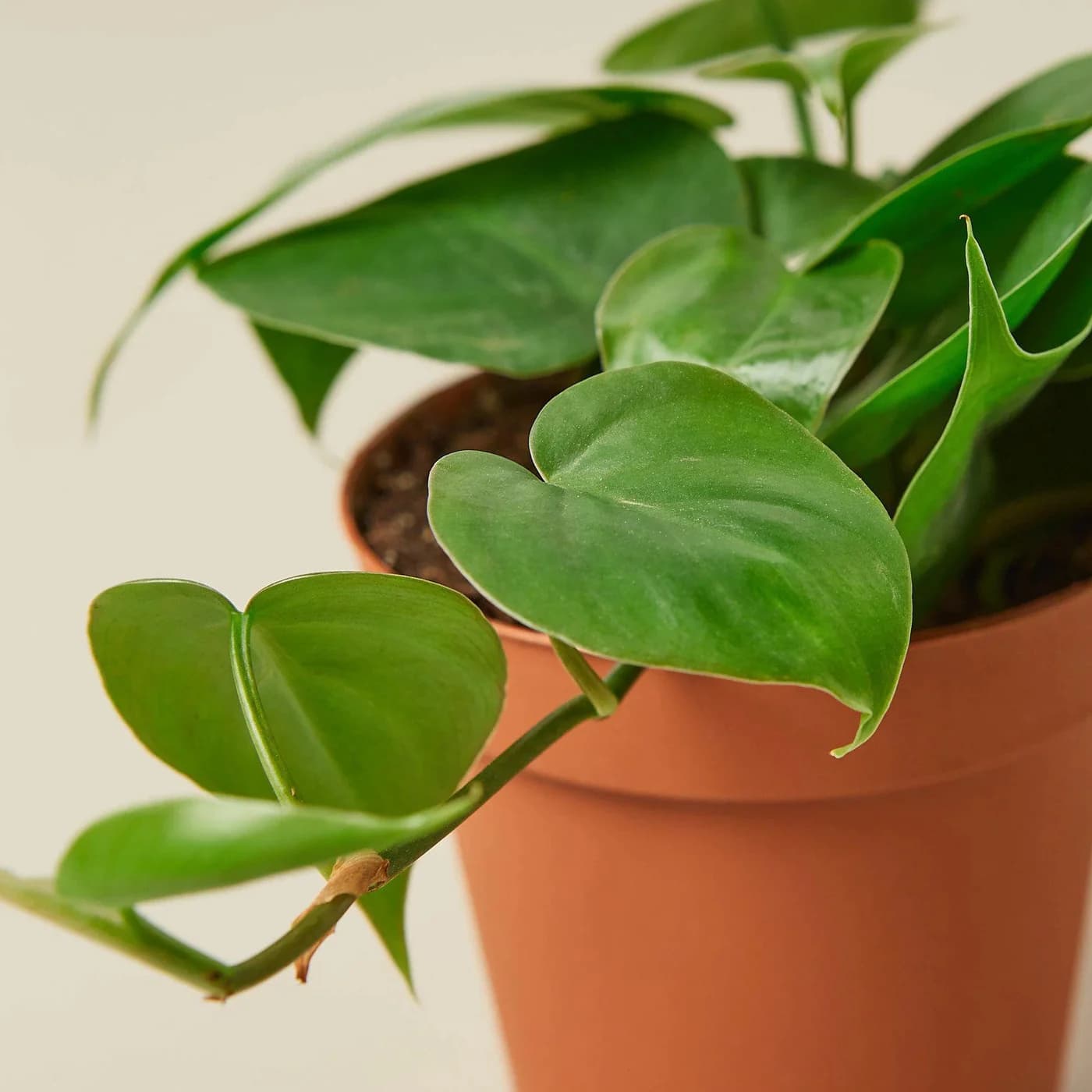
Heartleaf philodendron care is about as simple as houseplant care gets. It is the glossy, heart-leaved vine you have probably seen spilling off a bookshelf at an office or a grandparent's house. Its botanical name is Philodendron hederaceum var. oxycardium. You may also see it sold as sweetheart plant or parlor ivy.
Nurseries often sell it as philodendron cordatum, a name the ASPCA lists among its common names. Older books call it P. oxycardium or P. scandens.
NC State Extension gives its native range as Mexico to tropical America, where it climbs as a vine. Indoors it trails from a shelf or climbs a pole, and its stems can grow 4 feet or more. Each new leaf comes out of a thin sheath that later dries brown and drops off, which is one easy way to tell it apart from golden pothos. People like it because it forgives a lot: a dim corner, a late watering, a clumsy trim.
Why grow a heartleaf philodendron?
It is hard to get wrong, which is why it made our list of easy houseplants for beginners. Here is what it does well:
- It copes with low light. NC State Extension notes it can survive for long periods in extremely low light.
- In medium light it grows quickly, so you see progress within a season. In a dim corner it slows down.
- It roots easily from cuttings, so you can thicken up the pot or share a piece with a friend.
- It stays tidy in a Small pot on a shelf and trims back easily when it gets long.
- It puts up with the dry air of most homes, though NC State says it prefers medium humidity.
Who should grow a heartleaf philodendron?
It is a strong pick if you are new to plants, have only a north-facing window, or want something green on an office desk under ceiling lights. Clemson Extension says it grows well under artificial or ordinary room light. It also shrugs off the odd late watering, which suits people who travel.
Skip it if you have a cat that chews leaves, a dog that investigates everything, or a toddler at floor level. Its trailing stems tend to dangle within reach of curious paws and noses. If you want a plant the ASPCA lists as non-toxic to cats and dogs, look at the money tree or the rattlesnake plant instead, though chewing any plant can upset a pet's stomach. If you want flowers, look elsewhere: this one is grown for its leaves.
Is heartleaf philodendron safe for cats and dogs?
No. The ASPCA lists heartleaf philodendron (Philodendron hederaceum) as toxic to cats, dogs and horses. The toxic principle is insoluble calcium oxalate crystals, and NC State Extension lists every part of the plant, sap included, as poisonous. When a pet chews a leaf, the crystals cause pain and swelling of the mouth, tongue and lips, heavy drooling, vomiting and trouble swallowing.
The popular 'Brasil' and 'Lemon Lime' cultivars are the same species, so treat them as toxic too. NC State rates the severity as low, but that still means a sore, unhappy animal. If you see swelling of the face or any trouble breathing, get your pet to a vet right away.
If your pet chews it, call your vet or the ASPCA Animal Poison Control Center at (888) 426-4435. A fee may apply. With pets in the house, hang it well out of reach and trim stems that dangle low. Cats can reach most shelves, so if yours climbs or chews, pick a plant from our guide to pet-safe houseplants instead.
How much light does a heartleaf philodendron need?
Low to bright indirect light. NC State says it prefers medium light, so a spot a few feet back from an east- or west-facing window is ideal, and Clemson adds that it grows well near a north window too. It will also hang on in an office lit only by ceiling lights, just more slowly.
Keep it out of strong direct sun. A little early-morning sun from an east window is fine, but right in a south- or west-facing window, midday and afternoon sun can bleach and scorch the leaves, so set it a few feet back or behind a sheer curtain.
Long bare stems and small new leaves mean it wants more light. Pale or scorched patches mean too much. If your room is truly dim, our roundup of low-light houseplants compares it with other options.
How often should you water a heartleaf philodendron?
Water when the top inch of soil feels dry, so the rest of the pot stays lightly moist. NC State Extension says to keep the soil slightly moist and to slow down on watering in winter. Clemson Extension puts it as evenly moist but not soggy, and says never to let the plant stand in water.
Check by touch every few days. Push a finger into the soil up to the first joint, about an inch, as Clemson suggests, and water when it feels dry at your fingertip. In winter or a dim room the plant drinks much less, so expect longer gaps between waterings.
When it's time, pour slowly around the base until the soil is evenly moist, then stop. Tip out any water that collects in a saucer or cover pot. Roots sitting in water can't get the air they need, and Clemson calls overwatering the main cause of death in potted plants.
How often that adds up to depends on the spot. Clemson notes that warm, sunny rooms dry soil faster than cool, dim ones, and that a big plant in a small pot needs water more often. As a rough guide, a Small in a bright room in summer may want water every five to seven days, and a Medium a little less often. In winter it can stretch to every week or two.
Plain room-temperature tap water is fine. If your home has a salt-based water softener, use an unsoftened tap, since Clemson says softened water adds sodium to the soil. Our guide to watering houseplants covers the basics for every plant.
Heartleaf philodendron care: feeding, temperature, pruning and repotting
Clemson Extension suggests feeding it regularly with a dilute houseplant fertilizer. Do that in spring and summer, at half the label strength. Skip fall and winter, when growth slows. Clemson notes that too much fertilizer can make leaf tips curl and turn brown.
It tolerates the dry air of most homes. Clemson says it grows well at 70 to 85°F during the day and 65 to 75°F at night, so expect slower growth in a cool room. Keep it away from cold drafts, heating vents and frosty winter glass.
Prune whenever the vines get longer than you like. Snip just above a node, the spot where a leaf meets the stem, and a new shoot usually grows from just below the cut. Wear gloves if your skin is sensitive, since NC State notes the sap can cause a rash. For a fuller pot, root the trimmings: cut a piece with two or three leaves, strip the lowest leaf, and stand it in a glass of water with that bare node submerged. Once the roots are an inch or two long, tuck it back into the pot.
It arrives potted, so there's nothing to repot this year. When roots fill the pot, usually after a year or more, repot in spring: move it to a pot one size up, or trim back the roots and some of the vines and replant in the same pot with fresh mix. Clemson says overcrowded plants can be repotted in any season in general-purpose potting soil, but spring gives it a full growing season to settle. Our care notes cover the routine every Patina plant shares.
What to do when your heartleaf philodendron arrives
Your philodendron is potted at the greenhouse and travels in one box, ready to set down. It usually arrives in about 3 to 8 business days, packed with extra protection in cold weather; our shipping page has the details. Open the box the day it comes. For the first week:
- Lift it out by the pot, unwrap the vines gently, and set it where it will live: medium, indirect light, away from heating vents and cold glass.
- Feel the soil. If the top inch is dry, water slowly until it's evenly moist and tip out anything that collects in a saucer or cover pot. If it's damp, wait a day or two.
- A yellow or creased leaf or two after the trip is normal. Snip them off at the stem.
- If the vines droop and the soil is dry, give it a drink and they should lift within a day or so. If they droop and the soil is wet, hold off on water and let it rest in good light.
- Leave it in its pot. It was potted at the greenhouse and doesn't need moving or feeding while it settles in.
The pot is our grower's recycled eco pot, which they describe as recycled plastic blended with stone powder and wood dust. It comes in terracotta or black. If your plant arrives damaged or declines in its first 30 days, we'll replace it.
Common heartleaf philodendron problems and fixes
Most problems come down to light or water, and the plant tells you early:
- Yellow lower leaves: Clemson says too much water or too little light can cause it. Let the top inch of soil dry before watering again and move the plant closer to a window.
- Long, bare stems with small leaves: not enough light. Move it somewhere brighter, trim the long stems and root the cuttings.
- Curled, brown leaf tips: too much fertilizer. Feed less often and at a weaker strength.
- Pale or scorched patches: too much direct sun. Move it out of the sunbeam.
- Wilting with wet soil, mushy stems or a sour smell: root rot, which Clemson links to soil that drains slowly or watering too often. Let the soil dry, trim off soft brown roots and repot in fresh mix.
- Drooping with dry soil: it went too long between drinks. Water slowly until the soil is evenly moist. The leaves should lift within a day or so.
- Sticky leaves, white fluff, bumps on stems or fine webbing: aphids, mealybugs, scale or spider mites, the pests NC State and Clemson say to watch for. Wipe the leaves with a damp cloth, dab mealybugs and scale with a cotton swab dipped in rubbing alcohol, and treat with insecticidal soap.
Our heartleaf philodendron comes potted in a Small or Medium eco pot in terracotta or black.
Questions
What is the difference between heartleaf philodendron and pothos?
They look alike but are different plants. Pothos leaf stems have a groove along the top and philodendron leaf stems don't, and new philodendron leaves come wrapped in a sheath that pothos leaves lack. Golden pothos leaves are also thicker and streaked with yellow, but some philodendrons, like 'Brasil', are striped too, so check the leaf stem first. Both are toxic to cats and dogs.
Why are my heartleaf philodendron leaves turning yellow?
One yellow leaf at the base now and then is normal aging. Several at once usually mean the soil is staying wet in a spot that's too dim. A yellow leaf won't turn green again, so snip it off at the stem and judge your fix by the next few new leaves.
Can a heartleaf philodendron climb?
Yes. It climbs when it has something to hold on to, so you can train it up a moss pole or a small trellis. Tie the stems loosely at first and the aerial roots will grip over time. Left alone, it trails instead.
Can I leave my heartleaf philodendron while I go on vacation?
For a week or so, usually yes. Water it the day before you leave so the soil is evenly moist, tip out any extra, and move it a few feet farther from the window, since Clemson Extension notes that plants in cool, dim spots use water more slowly. For a longer trip, ask someone to check the soil once a week and water when the top inch is dry.
Is heartleaf philodendron toxic to humans?
Yes, mildly. Chewing a leaf can cause a painful, burning mouth and swelling, and the sap can irritate sensitive skin. Keep it out of reach of small children. If a child chews a leaf, call your pediatrician or your local poison control center.
Sources
- ASPCA Animal Poison Control: Heartleaf Philodendron
- ASPCA Animal Poison Control: Money Tree
- ASPCA Animal Poison Control: Caeroba (Rattle Snake Plant)
- NC State Extension Plant Toolbox: Philodendron hederaceum
- Clemson Cooperative Extension HGIC 1509: Philodendron
- Clemson Cooperative Extension HGIC 1459: Indoor Plants, Watering