- Guides
- Syngonium Black Velvet
Plant guide
Syngonium Black Velvet Care: How to Grow the Velvet Arrowhead
A compact arrowhead vine with dark, velvety leaves and a bright white midrib that wants medium to bright indirect light, lightly moist soil and warmth, and that isn't on the ASPCA list, so treat it as toxic.
What is Syngonium Black Velvet?
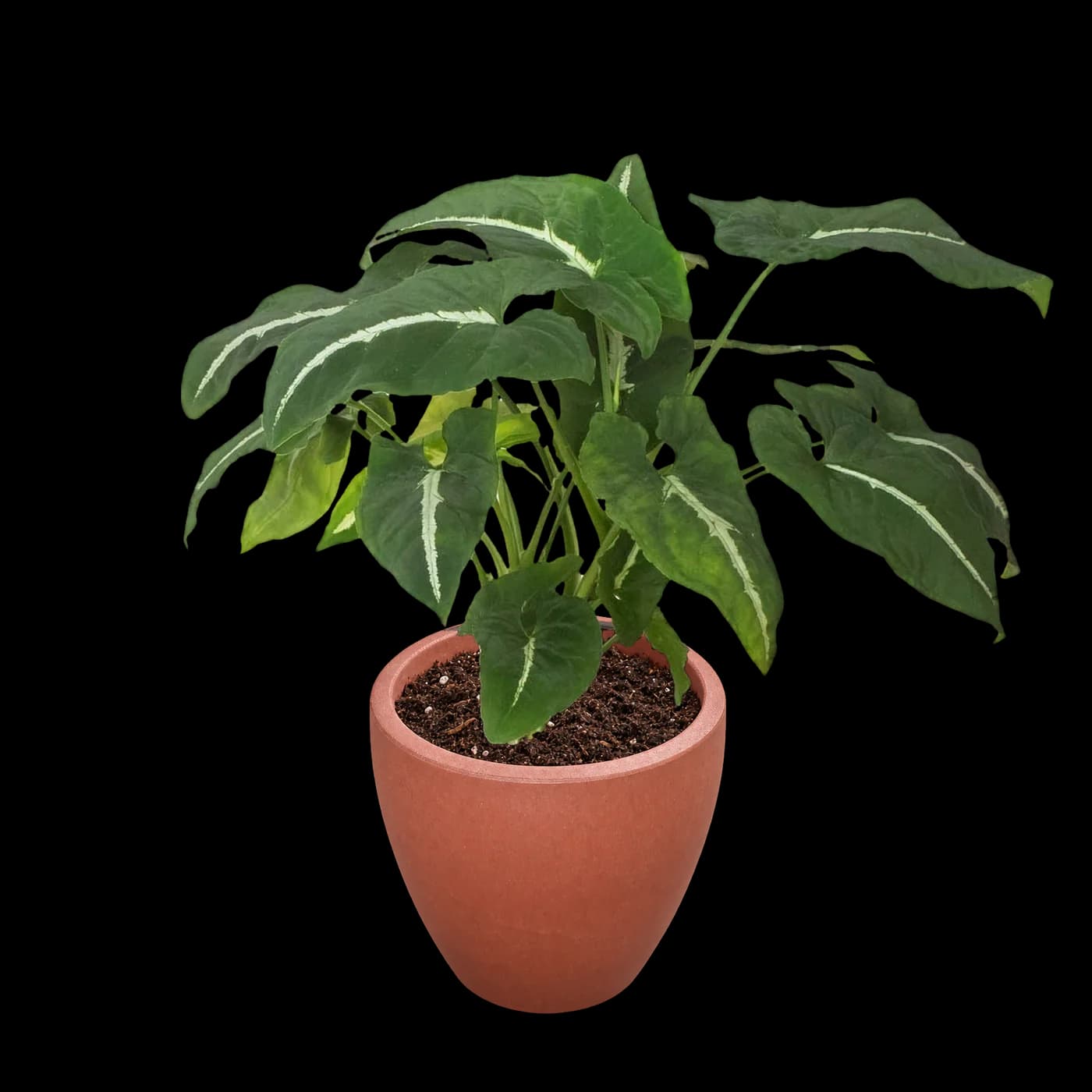
Syngonium Black Velvet is a small arrowhead vine grown for its leaves: slender, pointed arrows in a green so deep it can read as black, each marked by a white midrib that runs out into the veins. The surface has a soft, velvety look, which is where the name comes from.
It's sold as Syngonium wendlandii 'Black Velvet'. Most arrowhead plants in shops are a different species, Syngonium podophyllum, which is behind our Syngonium Milk Confetti and most of the cultivars UF/IFAS Extension lists for Florida growers. S. wendlandii comes from Costa Rica. The flora of Costa Rica compiled by the Missouri Botanical Garden and INBio records it in Puntarenas and San José provinces as a climber that grows pressed flat against its support, with leaves velvety on top. Clemson Extension lists it among the syngonium species grown indoors, describing dark green, velvety, elongated arrowhead-shaped leaves with a prominent white midrib that extends into the veins. 'Black Velvet' is the name this plant is sold under; the botanical sources we use describe the species as a whole.
It stays fairly compact. Singapore's National Parks Board (NParks) describes S. wendlandii as a twining vine about 2 feet tall that climbs with clasping aerial roots and also sends out runners that root where they touch the soil. Its young leaves are about 3 to 5 inches long. Like other syngoniums, it changes shape as it matures, which the section on shape below explains.
Care comes down to four things: medium to bright indirect light, soil that stays lightly moist, warmth and a little humidity.
Is Syngonium Black Velvet a good fit for you?
It's one of our Rare Plants, collector plants grown in small batches that can sell out. It earns the label for its looks rather than for being difficult. Here's what it does well:
- Dark leaves with a crisp white line, a look few houseplants have. It sets off brighter greens like neon pothos.
- It stays small. NParks puts the species at about 2 feet tall, so it suits a desk or shelf. Our Small comes in a 4 in pot, and our Medium, when we have it, in a 6 in pot.
- Two ways to grow it. UF/IFAS notes that syngoniums are often grown in hanging baskets, or given a totem or trellis to climb.
- No direct sun needed. Clemson Extension says arrowhead vines do best in medium to bright indirect light and tolerate lower light.
- Easy to share. NParks lists stem cuttings and runners as ways to propagate it.
It has limits. It isn't on the ASPCA list, and its close relative Syngonium podophyllum is on the toxic list, so it's a poor pick for a home with a cat or dog that chews plants. It also dislikes cold: UF/IFAS says temperatures below 55°F can cause chilling injury in syngoniums, so it won't thrive by a drafty door or a frosty window. If you'd like something even more forgiving, our easy houseplants for beginners are a gentler start.
Is Syngonium Black Velvet toxic to cats and dogs?
Syngonium wendlandii isn't on the ASPCA's toxic and non-toxic plants list. When we checked the cat and dog lists in November 2026, the only syngonium on them was Syngonium podophyllum, filed under arrow-head vine, nephthytis and green gold naphthysis. Black Velvet shares the arrowhead name, but that entry covers a different species.
The ASPCA lists S. podophyllum as toxic to cats, dogs and horses. Its toxic principle is insoluble calcium oxalates, and the signs include irritation, pain and swelling of the mouth, tongue and lips, heavy drooling, vomiting and difficulty swallowing. NC State Extension lists calcium oxalate crystals in every part of that species, and Clemson Extension's guide to arrowhead vines, which covers the whole genus and names S. wendlandii, marks them as not pet safe.
The ASPCA says its list isn't meant to be all-inclusive, so a missing entry tells you nothing either way. We don't call Black Velvet pet safe. Treat it as toxic.
With a pet that chews plants, keep it on a high shelf or in a hanging pot and trim stems that trail low. Cats can reach most shelves, so if yours climbs, our guide to pet-safe houseplants is a better place to start. If your pet chews it, call your vet or the ASPCA Animal Poison Control Center at (888) 426-4435. A consultation fee may apply. The sap can bother people too: NC State lists S. podophyllum as a cause of contact dermatitis and the RHS calls that species irritating to skin and eyes, so wear gloves when you trim.
How much light does Syngonium Black Velvet need?
Medium to bright indirect light. Clemson Extension suggests an east-facing window or a spot a few feet from a west-facing one, and says to avoid direct sun. UF/IFAS puts the best indoor light for syngoniums at 250 to 1,000 foot-candles, a range that sits between a dim corner and a sunny sill.
Keep it out of strong direct sun. NC State says to avoid full sun, which tends to burn or bleach syngonium leaves. A little gentle morning sun is fine; hot afternoon sun is not.
It copes with lower light, Clemson says, but a north window may dull leaf color, and patterned syngoniums can lose their markings on new leaves in a dim spot. UF/IFAS links stretched, weak stems with long gaps between the leaves to light that's too low. If your home runs dark, our low light houseplants guide covers plants that cope better.
Keep it warm. UF/IFAS recommends 65 to 80°F to keep the leaf colors, and Clemson suggests 65 to 75°F. Keep it away from cold glass, drafty doors and heating or air conditioning vents.
How often should you water Syngonium Black Velvet?
Water when the surface of the soil has dried slightly, not on a schedule. UF/IFAS and Clemson Extension both say to let the potting mix dry slightly between waterings, and NParks describes S. wendlandii as needing moderate water in a mix that drains well but still holds some moisture. In practice, feel the soil every few days and water when the top half inch or so feels dry.
When it's time, water like this:
- Pour slowly at the base until the soil is evenly moist all the way through.
- Let it drain, then tip out any water left in a saucer or cover pot after about 15 minutes. Roots left sitting in water rot.
- Use room-temperature water. UF/IFAS links water-soaked spots with collapsed centers to cold water in winter and recommends water at the same temperature as the air.
- Aim at the soil, not the leaves. Clemson lists bacterial blight and bacterial leaf spot among the diseases to watch for.
In winter it grows more slowly and drinks less. UF/IFAS says to water less often then but never let the plant dry out. A Small in its 4 in pot dries out faster than a Medium, so check it more often.
The plant shows you when the balance is off. UF/IFAS links yellowing older leaves to soil that runs too dry or a lack of nitrogen. Soggy soil and limp stems at the base point the other way, to too much water. Our guide to watering houseplants covers the basics for every plant.
Keeping Black Velvet compact: young leaves, climbing stems and trimming
Syngoniums change shape as they grow. Clemson Extension describes three stages. A young plant is compact, with simple arrow-shaped leaves. As it climbs toward more light, its leaves split into three. A mature plant has leaves divided into 5 to 11 leaflets on longer stalks. NParks notes the same of S. wendlandii: young leaves are the most boldly marked, while older plants make larger, three-part leaves that are plainer or even solid green.
Most people want the young look, with the crisp white veins. Clemson says to feed less often if you want to keep a syngonium in its young form, and NC State's advice for keeping the arrowhead leaves is to cut off the stems as they begin to develop. UF/IFAS adds that occasional pruning is needed to keep a syngonium in shape.
To trim, wear gloves and use clean scissors to snip a long or climbing stem just above a node, the point where a leaf joins the stem. The cuttings root easily. NParks lists stem cuttings and runners as ways to propagate S. wendlandii, and UF/IFAS describes rooting a single node with a leaf attached in a warm, moist rooting mix. Tuck rooted pieces back into the pot for a fuller plant.
If you'd rather let it climb, UF/IFAS suggests a totem or trellis for upright growth, and Clemson mentions a moss pole, trellis or stake for mature plants. Expect the leaves to grow bigger and change shape as it goes up.
Everyday care: humidity, feeding, soil and repotting
Humidity helps. UF/IFAS says syngoniums keep their looks best at 40 to 60 percent relative humidity, and Clemson puts the preference at 50 percent or higher while noting it tolerates less. Group it with other plants or set it on a tray of wet pebbles, keeping the water below the tops of the stones. UF/IFAS also says pests are relatively rare when the humidity is kept up.
Keep the leaves clean. UF/IFAS suggests misting and wiping syngonium leaves with a lint-free cloth to keep them free of dust and less inviting to pests. Be gentle with the velvety surface.
Feed lightly. Clemson says arrowhead vines aren't heavy feeders and suggests a balanced fertilizer at a reduced rate once a month in spring and summer, and less often in low light. Skip fall and winter.
It arrives potted and won't need a new pot for a while. When roots fill the pot, repot in spring into one a size larger with a drainage hole. Clemson suggests a mix of equal parts peat moss or coir, vermiculite and perlite. NC State notes you can repot every few years and trim the roots to keep the plant a manageable size. Our care notes cover the routine every Patina plant shares.
What to do when your Black Velvet arrives
It comes already potted at the greenhouse in a recycled eco pot, in terracotta or black, so there's nothing to assemble. In the first week:
- Open the box the day it arrives. Lift the plant out by its pot, not its stems, and remove the packing, including any winter protection. UF/IFAS notes that syngoniums can suffer chilling injury below 55°F, so don't leave the box on a cold porch.
- Feel the soil. If the surface is dry, water until it's evenly moist and tip out the extra. If it's still damp, check again in a day or two.
- Set it in its long-term spot, in medium to bright indirect light and away from vents, drafts and cold glass.
- Expect a creased or yellowed leaf or two after the trip. Snip them off at the base of the stalk.
- Leave it in its pot through its first growing season, and hold off on feeding until spring if it arrives in fall or winter.
If it arrives damaged or declines in its first 30 days, we replace it. Our shipping page covers delivery times.
Common Syngonium Black Velvet problems and how to fix them
Most problems trace back to light, water or cold. Find the symptom:
- Long, weak stems with big gaps between leaves: too little light, UF/IFAS says. Move it closer to a window and trim the stretched stems.
- White veins fading on new leaves: often low light. Clemson notes that patterned syngoniums can lose their markings in dim spots and regain them on new growth in a brighter one. Older leaves also get plainer with age, NParks says, especially on climbing stems.
- Pale, bleached or scorched patches: too much direct sun, NC State warns. Pull it back from the glass or add a sheer curtain.
- Yellowing older leaves: soil running too dry or a lack of nutrients, according to UF/IFAS. Water before the whole pot dries out and feed in spring and summer.
- Water-soaked spots with collapsed centers in winter: cold water, UF/IFAS says. Switch to room-temperature water. Young leaves that look wet can mean warm air over cold roots, so lift the pot off a cold floor or sill.
- Limp stems at the soil line or spots on leaves that stay wet: stem rot or bacterial leaf spot, both on Clemson's list. Let the soil surface dry between waterings, water the soil rather than the leaves and cut off affected leaves.
- Fine webbing, sticky leaves or cottony clusters: spider mites, aphids or mealybugs, the pests Clemson lists. Rinse the leaves, dab mealybugs with a cotton swab dipped in rubbing alcohol and raise the humidity.
When it's in stock, you can get a Syngonium Black Velvet potted at the greenhouse in a recycled eco pot in terracotta or black, covered by our 30-day guarantee.
Questions
Is Syngonium Black Velvet toxic to cats?
It isn't on the ASPCA's list, so we don't call it pet safe. The ASPCA lists its close relative Syngonium podophyllum as toxic to cats and dogs because of insoluble calcium oxalates, and Clemson Extension marks arrowhead vines as not pet safe. Treat it as toxic and keep it out of reach, and call your vet or the ASPCA Animal Poison Control Center at (888) 426-4435 if your pet chews it.
Is Black Velvet the same as an arrowhead plant?
It's an arrowhead vine, but not the usual one. Most arrowhead plants are Syngonium podophyllum, like our Syngonium Milk Confetti. Black Velvet is Syngonium wendlandii, a separate species from Costa Rica with darker, velvety leaves and a white midrib. Care is much the same.
Why are my Black Velvet's new leaves splitting into three?
It's maturing. Clemson Extension says syngoniums move from simple arrow leaves to three-part leaves as they climb toward more light, and NParks notes that older S. wendlandii plants make larger three-part leaves with less pattern. Trim the climbing stems back to keep the young leaves coming.
Can Syngonium Black Velvet grow in low light?
It tolerates it, but it won't look its best. Clemson Extension says arrowhead vines prefer medium to bright indirect light and can lose leaf color in dim spots, and UF/IFAS links stretched, weak stems to low light. A spot near an east window or a few feet from a west window suits it better.
Does Syngonium Black Velvet need a moss pole?
No. It can trail from a shelf or hanging pot, and UF/IFAS notes that syngoniums are often grown in hanging baskets. Add a small pole or trellis only if you want it to climb, and expect bigger leaves with a different shape as it does.
Sources
- ASPCA Toxic and Non-Toxic Plants: Arrow-Head Vine (Syngonium podophyllum)
- ASPCA Animal Poison Control: Toxic and Non-Toxic Plants List
- Clemson Cooperative Extension (HGIC 1573): Arrowhead Vine (Syngonium spp.) Indoor Care, Growing Tips & Plant Guide
- UF/IFAS Extension (EDIS ENH 993): Cultural Guidelines for Commercial Production of Interiorscape Syngonium
- NC State Extension Plant Toolbox: Syngonium podophyllum
- National Parks Board Singapore, Flora & Fauna Web: Syngonium wendlandii
- Missouri Botanical Garden and INBio, Manual de Plantas de Costa Rica: Syngonium wendlandii
- Royal Horticultural Society: Syngonium podophyllum