- Guides
- Syngonium Milk Confetti
Plant guide
Syngonium Milk Confetti Care: How to Grow a Pink-Flecked Arrowhead Plant
A pink-speckled arrowhead plant that needs bright, filtered light to keep its color, soil that dries slightly between drinks and a spot out of reach of pets, since the ASPCA lists it as toxic to cats and dogs.
What is Syngonium Milk Confetti?
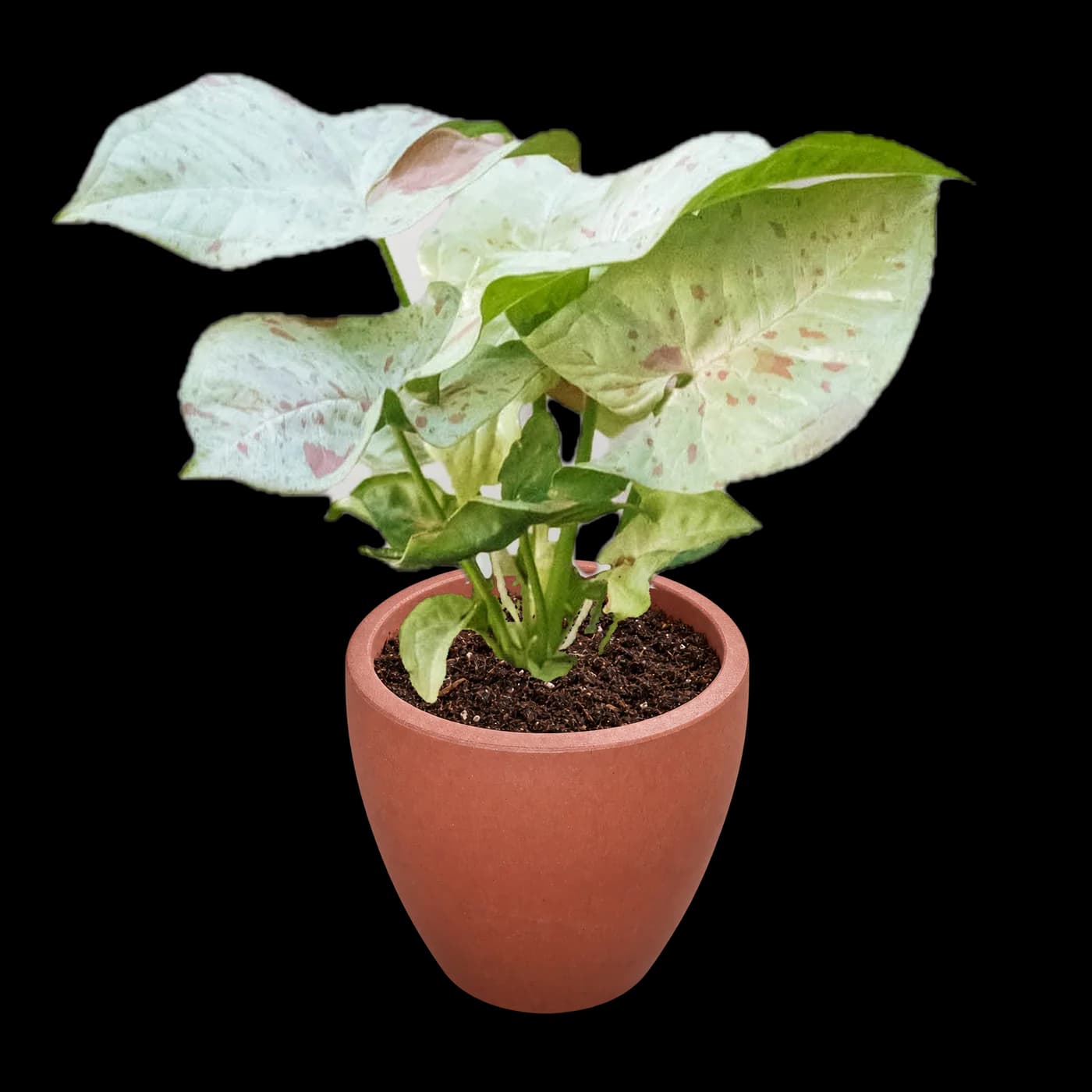
Syngonium Milk Confetti is a variegated arrowhead plant, Syngonium podophyllum, grown for its pale, speckled leaves. Clemson Extension describes them as frosted green with numerous small pink patches and the occasional large pink blotch, and NC State Extension as shades of pink, white and mint green.
The arrowhead plant is an aroid, a member of the Araceae family, native to tropical forests from Mexico to South America. It also goes by nephthytis, African evergreen and goosefoot plant. In the wild it starts out on the forest floor and then climbs trees, and its leaves change as it goes, Clemson explains: arrow-shaped when young, then with three leaflets, then split into 5 to 11 leaflets once mature. Houseplants are usually sold in the young form, NC State says, and you can keep them that way.
Care is simpler than the pink suggests: bright, filtered light to keep the color, water once the surface of the soil is slightly dry and a trim now and then to keep it bushy. The one real caveat is pets, since the ASPCA lists it as toxic to cats and dogs.
Is Syngonium Milk Confetti a good houseplant for you?
Milk Confetti is one of our Rare Plants: a collector plant grown in small batches, so it can sell out. It has a lot going for it:
- Color without fuss. Clemson says the arrowhead plant tolerates average home temperatures and humidity, and it isn't a heavy feeder.
- It grows the way you want. Young plants stay compact on a desk or shelf or in a hanging basket, and older plants can climb a moss pole or trellis, Clemson says.
- It's easy to multiply. UF/IFAS Extension says arrowhead plants root easily from cuttings.
- Our Small comes in a 4 in pot, and our Medium, when we have it, in a 6 in pot.
It has limits. The ASPCA lists it as toxic to cats and dogs, so it's a poor fit for a home with a plant-chewing pet or a toddler who explores with their mouth. It also needs a reasonably bright spot: in a dim corner, new leaves come in plain green. If your rooms are dark, our low light houseplants guide has better picks.
If you want a first plant with no color to protect, start with one of our easy houseplants for beginners.
Is Syngonium Milk Confetti safe for cats and dogs?
No. The ASPCA lists the arrowhead plant, Syngonium podophyllum, as toxic to dogs, cats and horses. It files the plant under both Arrow-Head Vine and Nephthytis, with African evergreen and trileaf wonder among its other names. The toxic principle it names is insoluble calcium oxalates.
Signs the ASPCA lists include oral irritation, pain and swelling of the mouth, tongue and lips, excessive drooling, vomiting and difficulty swallowing. People should take some care too. NC State notes that the plant can cause skin irritation, and the Royal Horticultural Society (RHS) describes it as harmful if eaten and a skin and eye irritant. Wear gloves when you prune or take cuttings, wash your hands afterward and keep it out of reach of small children.
If you think your pet has chewed it, call your veterinarian or the ASPCA Animal Poison Control Center at (888) 426-4435. A consultation fee may apply.
A high shelf or hanging basket helps, but stems trail and fallen leaves land on the floor. If you share your home with a cat or dog that chews plants, our guide to pet-safe houseplants rounds up plants the ASPCA lists as non-toxic to cats and dogs.
How much light does Syngonium Milk Confetti need?
Bright, filtered light. Clemson says arrowhead plants tolerate low light but prefer medium to bright indirect light, such as an east-facing window or a spot a few feet from a west-facing one. The RHS recommends bright filtered light for variegated forms like this one.
Light is what holds the color. Clemson says variegated arrowhead plants need brighter light to keep it, and with too little, new leaves revert to solid green. Moving the plant somewhere brighter brings the variegation back on new growth. A north-facing window can work, Clemson adds, but the color may dull, which is why we list Milk Confetti as medium to bright light.
Keep it out of direct sun, which NC State says burns or bleaches the leaves. A sheer curtain helps in a sunny room.
Watch the stems too. UF/IFAS lists stretched, weak stems with long gaps between leaves as a sign of too little light.
How often should you water Syngonium Milk Confetti?
Water when the surface of the soil is slightly dry, not on a schedule. Clemson and UF/IFAS both say to let the potting mix dry out slightly between waterings. To check, push a finger into the mix up to the first joint, the test Clemson recommends. If it's dry at your fingertip, it's time. A Small in its 4 in pot dries out faster than a larger pot.
When you water, pour slowly until water runs out of the bottom of the pot, then empty the saucer or cover pot. Clemson says not to let a pot sit in the water that drains out, and to use water between 62 and 72°F. UF/IFAS links water-soaked spots with fallen-out centers to cold water in winter, so water at room temperature.
In winter, water less often but don't let it dry out completely, UF/IFAS advises. The RHS agrees: water freely while it's growing and more sparingly in winter.
Overwatering is the bigger risk. Clemson calls it the main cause of death in potted plants, and notes that wilting doesn't always mean a plant needs water. If the soil is wet and the plant droops, let it dry out rather than adding more. More in how to water houseplants.
Keeping it compact, or letting it climb
Arrowhead plants change as they grow. Young plants are bushy, NC State says, and with age they become vines that can reach 3 to 6 feet. As the stems climb, the leaf stalks lengthen and the leaves change shape, first growing three leaflets and then 5 to 11, Clemson explains.
To keep the compact, arrow-leaved look, cut back stems as they lengthen. NC State says cutting stems as they develop keeps a shrub-like habit, and UF/IFAS says occasional pruning keeps the plant in shape. Clemson adds that feeding less often helps keep a plant in its young form. The RHS suggests cutting it back in spring. Use clean scissors and wear gloves.
If you'd rather it climb, give it a moss pole, trellis or bamboo stake, as Clemson suggests. UF/IFAS notes that the stems grow small roots at each node. Or let it trail from a hanging basket.
The trimmings root easily. UF/IFAS says arrowhead plants are propagated from single-node cuttings, tip cuttings or air layers, and the RHS suggests stem-tip cuttings in summer. Take a piece with at least one node and a leaf, set it in moist potting mix and keep it warm, humid and out of direct sun until it roots.
One request: never toss cuttings or an unwanted plant outdoors. UF/IFAS lists the arrowhead plant as an invasive species in Florida, where it smothers the ground and crowds out native plants, and asks that houseplants and cuttings never be dumped outside. Bag trimmings for the trash instead.
Everyday care: humidity, warmth, feeding and repotting
Average home humidity is fine. Clemson says arrowhead plants prefer 50 percent or more but tolerate lower levels, and UF/IFAS says they keep their looks best between 40 and 60 percent. UF/IFAS also notes that pests are rare when the humidity is right, so a tray of wet pebbles or a humidifier nearby helps in dry winter air.
Keep it warm. Clemson suggests 65 to 75°F, and UF/IFAS says 65 to 80°F keeps the leaf color at its best. UF/IFAS warns that temperatures below 55°F can cause chilling injury, so keep it away from cold windows and drafts in winter.
Feed lightly. Clemson says the arrowhead plant isn't a heavy feeder and suggests a balanced fertilizer, such as 20-20-20 or 10-10-10, at a reduced rate once a month in spring and summer, and less often if it grows in low light. Skip feeding in fall and winter.
Wipe the leaves now and then with a soft, lint-free cloth. UF/IFAS says keeping them free of dust also lowers the chance of pests.
Repot when roots fill the pot, going up one size into a pot with a drainage hole. Clemson suggests a mix of equal parts peat moss or coir, vermiculite and perlite. NC State says repotting every few years and trimming the roots keeps it a manageable size.
What to do when your Syngonium Milk Confetti arrives
It arrives already potted at the greenhouse, in a recycled eco pot in terracotta or black, so there's nothing to assemble. A few small steps in the first week help it settle:
- Open the box the day it arrives. Lift the plant out by its pot rather than its stems, which UF/IFAS notes break easily, and remove all the packing, including any winter protection.
- Feel the soil. If the surface is dry, water until it runs from the bottom and tip out the extra. If it's still damp, check again in a couple of days.
- Find it a bright spot out of direct sun, away from heating vents and cold glass, and leave it there while it settles.
- Wearing gloves, trim any leaf that was torn or bent on the way at the base of its stalk.
- Leave the pot alone through its first growing season, and if it arrives in fall or winter, hold off on feeding until spring.
If it arrives damaged or declines in its first 30 days, we replace it. Delivery times are on our shipping page.
Common Syngonium Milk Confetti problems and how to fix them
Most problems come back to light or water. Find the symptom:
- New leaves coming in green: not enough light, Clemson says. Move it somewhere brighter and the pink should return on new growth.
- Long, weak stems with big gaps between leaves: too little light, according to UF/IFAS. Move it closer to a window and cut back the leggy stems.
- Bleached or scorched patches: direct sun, which NC State warns burns or bleaches the leaves. Pull it back from the glass or add a sheer curtain.
- Older leaves turning yellow: UF/IFAS links this to a lack of nitrogen or soil left too dry. Water more evenly and feed in spring and summer.
- Water-soaked spots with dead centers in winter: cold water, says UF/IFAS. Water at room temperature.
- Spots on the leaves or soft, rotting stems: bacterial leaf spot, bacterial blight or stem rot, which Clemson lists among its diseases. NC State also warns of bacterial leaf spots and soft rot. Cut off affected leaves, water the soil rather than the leaves and let the surface dry slightly between waterings.
- Fine webbing, cottony clusters or tiny insects on new growth: spider mites, mealybugs or aphids, all on the pest lists from Clemson and NC State. Rinse the plant in the shower, wipe off any insects and check weekly.
Every Syngonium Milk Confetti from our shop comes potted at the greenhouse in a recycled eco pot in terracotta or black, in a Small 4 in pot and in a Medium 6 in pot when we have it, with our 30-day guarantee. As a collector plant grown in small batches, it can sell out.
Questions
Is Syngonium Milk Confetti toxic to cats?
Yes. The ASPCA lists the arrowhead plant (Syngonium podophyllum) as toxic to cats and dogs. It contains insoluble calcium oxalates, which can cause mouth pain and swelling, drooling, vomiting and trouble swallowing. Keep it out of reach, and if your pet chews it, call your vet or the ASPCA Animal Poison Control Center at (888) 426-4435.
Why is my Milk Confetti losing its pink?
Too little light. Clemson says variegated arrowhead plants need brighter light to hold their color, and in low light new leaves revert to solid green. Move it to a bright spot out of direct sun, and the variegation should return on new leaves.
Why are my arrowhead plant's leaves changing shape?
It's growing up. Clemson explains that young plants have arrow-shaped leaves, and as the plant climbs, its leaves first grow three leaflets, then 5 to 11. To keep the arrow shape, cut back long stems; NC State says cutting stems as they develop keeps the plant bushy.
Should I give Syngonium Milk Confetti a moss pole?
Only if you want it to climb. Young plants stay compact in a pot or hanging basket. Clemson says older plants, with their longer leaf stalks, can be trained up a moss pole, trellis or bamboo stake.
Can I grow new plants from cuttings?
Yes. UF/IFAS says arrowhead plants root easily from cuttings, even single-node ones, and the RHS suggests taking stem-tip cuttings in summer. Wear gloves, since the sap can irritate skin, and bag leftover trimmings for the trash rather than tossing them outside: UF/IFAS lists the plant as invasive in Florida.
Is an arrowhead plant the same as nephthytis?
Yes, in everyday use. Nephthytis is another common name for Syngonium podophyllum, and the ASPCA files the plant under both Arrow-Head Vine and Nephthytis. UF/IFAS lists arrowhead plant, nephthytis, African evergreen and goosefoot plant among its names.
Sources
- ASPCA Toxic and Non-Toxic Plants: Arrow-Head Vine (Syngonium podophyllum)
- ASPCA Toxic and Non-Toxic Plants: Nephthytis (Syngonium podophyllum)
- Clemson Cooperative Extension (HGIC 1573): Arrowhead Vine (Syngonium spp.) Indoor Care
- NC State Extension Plant Toolbox: Syngonium podophyllum (including 'Milk Confetti')
- UF/IFAS Extension (EDIS ENH 993): Cultural Guidelines for Commercial Production of Interiorscape Syngonium
- UF/IFAS Plant Directory: Arrowhead Vine (Syngonium podophyllum)
- Royal Horticultural Society: Syngonium podophyllum
- Clemson Cooperative Extension (HGIC 1459): Indoor Plants: Watering