- Guides
- Spider Plant Bonnie
Plant guide
Spider Plant 'Bonnie' Care: How to Grow the Curly Spider Plant
A compact spider plant with curling leaves that wants bright, indirect light, water when the top of the soil is dry and soft water if its tips brown, and that the ASPCA lists as non-toxic to cats and dogs.
What is a spider plant 'Bonnie'?
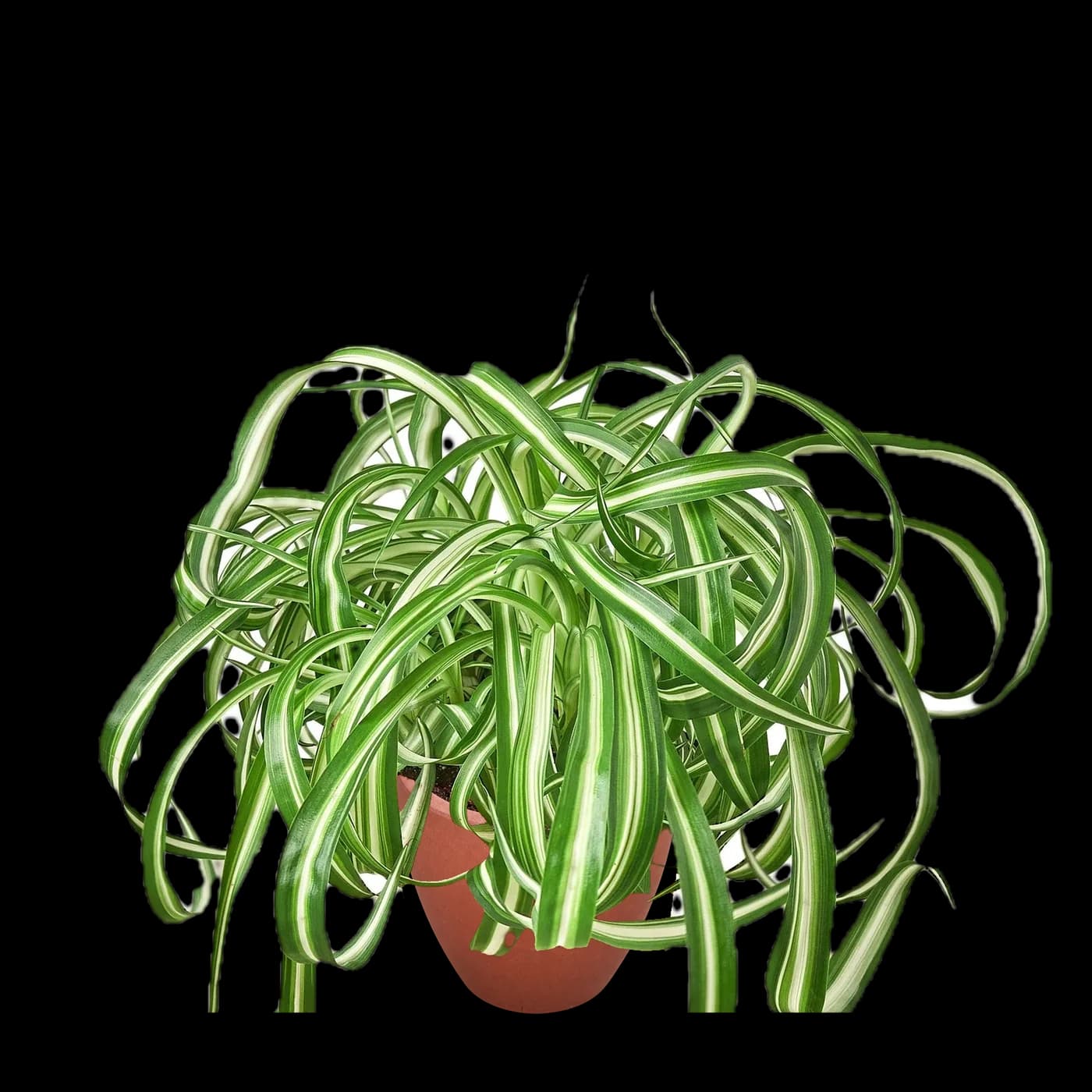
Spider plant 'Bonnie' is a curly-leaved form of the classic spider plant, Chlorophytum comosum. Instead of long, straight ribbons, its leaves curl and twist into loose ringlets, so the plant looks fuller and stays more compact. The Royal Horticultural Society (RHS) describes 'Bonnie' as a compact evergreen with curly leaves, dark green with a creamy stripe down the middle. NC State Extension lists both an all-green 'Bonnie' and a striped 'Bonnie Variegated'.
The species comes from Africa. NC State gives its native range as tropical West Africa to Cameroon and Ethiopia, and south to South Africa. It belongs to the asparagus family, Asparagaceae, and also goes by ribbon plant and spider ivy.
What makes a spider plant a spider plant is what it does once it settles in. A mature plant sends out long, wiry stems carrying small white, star-shaped flowers, and baby plants, often called spiderlings, form along those stems. Each one can be potted up into a new plant.
Care comes down to a few habits: bright, indirect light, water when the top of the soil is dry and soft water if the leaf tips start to brown. UW-Madison Extension notes that its thick, fleshy roots help it tolerate an uneven watering routine.
Is a curly spider plant a good houseplant for you?
Clemson Cooperative Extension calls the spider plant one of the most common houseplants, popular for how easily and quickly it makes new plants. 'Bonnie' has the same easy habits in a tidier shape, and a few practical strengths:
- The ASPCA lists the spider plant as non-toxic to cats and dogs.
- It's forgiving. UW-Madison calls it very easy to grow indoors, and the RHS describes 'Bonnie' as a very tough houseplant that tolerates a wide range of conditions.
- It stays small. The RHS calls 'Bonnie' a compact cultivar, so it fits a desk or shelf. Our Small comes in a 4 in pot and our Medium in a 6 in pot.
- In time it gives you new plants to keep or pass on, which makes it an easy gift.
It has limits. Its leaf tips brown easily: Missouri Botanical Garden says brown tips will appear unless conditions are perfect, and fluoride and salts in tap water are common causes. It won't make baby plants until it's mature, and a dim spot slows it down. If you've seen it sold as an air-cleaning plant, read what the research says about plants and indoor air before you count on it.
It suits a home with pets, and a bright shelf edge or plant stand where the curls can spill over. If you're new to plants, it's a gentle place to start, and our guide to easy houseplants for beginners has more ideas.
Is a spider plant safe for cats and dogs?
Yes, according to the ASPCA. Its plant lists show the spider plant, Chlorophytum comosum, as non-toxic to both cats and dogs, with ribbon plant, anthericum and spider ivy given as other names. When we checked in November 2026, it was on the ASPCA's non-toxic lists for both cats and dogs. 'Bonnie' is a cultivar of the same species, so that listing covers it.
Non-toxic doesn't mean a pet should graze on it. Eating any plant can upset a pet's stomach, and long, dangling leaves and plantlets are easy for a cat to bat at and chew. If your pet eats some and seems unwell, call your veterinarian or the ASPCA Animal Poison Control Center at (888) 426-4435. A consultation fee may apply.
Check the name before you buy any plant for a pet home. Ribbon plant is also a common name for dracaenas, which the ASPCA lists as toxic to cats and dogs. And as UConn's Home and Garden Education Center points out, the purple plants sometimes sold as spider plants are really Tradescantia, a different plant altogether. Go by the botanical name on the ASPCA list rather than a common name. Our guide to pet-safe houseplants covers the other plants in our range the ASPCA lists as non-toxic.
How much light does a spider plant need?
Bright, indirect light suits it best. Missouri Botanical Garden and Clemson both recommend bright indirect light indoors, and NC State says it prefers medium light and puts up with deep shade. A few feet back from an east- or west-facing window, or right beside a north-facing one, works well.
Keep it out of hot direct sun. NC State calls it intolerant of direct sunlight, and Missouri Botanical Garden warns that the leaves scald in it. Clemson says a little direct sun is fine but midday sun can scorch the leaves, and the RHS warns that variegated leaves burn in direct sun.
It copes with low light, which is one reason it turns up in offices; Missouri Botanical Garden says it tolerates artificial light very well. The RHS adds that in low light it grows more slowly, its stripes may fade and it's less likely to make plantlets. If your home runs dark, our low light houseplants guide compares the plants that cope best.
How often should you water a spider plant?
Water when the top of the soil feels dry, not on a schedule. UW-Madison suggests letting the soil dry slightly between thorough waterings, and Clemson says to let it dry out briefly. The RHS aims for potting mix that stays just lightly moist to the touch. Push a finger into the soil up to the first joint, the test Clemson recommends, and water if it feels dry at your fingertip. A Small in its 4 in pot dries out sooner than a Medium.
When you water, pour slowly at the base until the soil is evenly moist, then tip out anything that collects in the saucer or cover pot. The RHS says spider plants dislike standing in water, and Missouri Botanical Garden warns that waterlogged plants are prone to root rot.
Its thick roots hold a reserve of water, so a short dry spell does less harm than soggy soil. Don't push it too far, though. The RHS says pale leaves usually mean a plant needs more water, and very dry soil is one cause of brown tips. Water a little less often in winter, when growth slows.
Water quality matters more with this plant than with most. NC State says chlorine and fluoride in tap water can burn the leaf tips, UW-Madison suggests rainwater or distilled water to prevent it, and the RHS suggests rainwater or filtered water. Clemson adds that too much fertilizer or water high in soluble salts causes tip burn too. Its watering guide advises against softened water, which adds sodium to the soil, and suggests water between 62 and 72°F. More in how to water houseplants.
How to get spider plant babies, and how to pot them up
The baby plants are the spider plant's party trick, but they come on the plant's schedule. The RHS says most plants won't make them until they're at least a year old. NC State, Missouri Botanical Garden and UW-Madison all explain that the flowering stems and plantlets form after the plant gets short days and long, uninterrupted nights for at least three weeks, and Clemson says most appear as the days shorten in fall.
A few things help. UW-Madison says plants make plantlets best when slightly pot bound, and that heavily fertilized plants may make fewer. The RHS lists low light, cool temperatures and a pot that's too big as reasons a plant holds back. So keep it bright, go easy on fertilizer and don't rush it into a bigger pot. Once you have plantlets, there are two easy ways to grow them on:
- In soil: set a small pot of moist potting mix beside the parent and rest a plantlet on the surface while it's still attached. Clemson says plantlets root when they touch soil, and UW-Madison says you can root them on the parent and cut them free once they've rooted.
- In water: snip off a plantlet and stand its base in a glass of water, as the RHS suggests. Pot it into moist mix once its roots have grown.
- Either way, keep new plantlets from drying out while they root. UConn's Home and Garden Education Center warns not to let them dry out in the early stages.
- Clemson says you can start plantlets at any time of year.
Plantlets don't have to come off. Clemson notes you can leave them on for a fuller look, though the RHS suggests trimming old ones if you won't pot them up. You can also divide a mature clump when you repot, keeping at least one growing point in each piece, as the RHS describes.
Everyday spider plant care: temperature, humidity, feeding and repotting
Keep it comfortable. Missouri Botanical Garden puts the ideal at 55 to 70°F and says to keep it above 45°F, while Clemson suggests 65 to 75°F by day and 50 to 55°F at night. Keep it away from radiators, and in winter move it a few feet back from cold, drafty windows, as Clemson advises.
Ordinary room humidity is fine. UW-Madison says spider plants do well in average humidity, and the RHS says they don't generally need high humidity, though very dry air can brown the tips. If that happens, NC State suggests a humidifier or a tray of wet pebbles. Keep the water below the tops of the pebbles so the roots never sit in it.
Go light on feeding. UW-Madison says feeding every 3 to 4 months is usually enough, or more often at half strength, and warns that too much fertilizer can brown the tips and cut down on plantlets. The RHS says feeding is usually unnecessary if you repot regularly, and Missouri Botanical Garden notes that the tuberous roots store reserve food. Clemson suggests waiting 4 to 6 months before feeding a newly potted plant.
Repot when the roots fill the pot. Spider plants grow thick, fleshy roots, and Missouri Botanical Garden and Clemson both warn that they can crack or burst a container if left too long. The RHS says a newly bought plant can stay in its pot for the first year, and its entry for 'Bonnie' suggests repotting and dividing every 2 to 3 years. Use a general-purpose potting mix that drains well, and go up just one pot size, since a snug pot encourages plantlets.
Tidy as you go. Cut yellowed leaves off at the base and trim brown tips with clean scissors. If a plant gets badly damaged, the RHS says you can cut all the foliage back to 2 to 3 in and let it regrow.
What to do when your spider plant arrives
Your spider plant comes already potted at the greenhouse in a recycled eco pot, in terracotta or black, in one box. A few small steps help it settle:
- Open the box the day it arrives. Lift the plant out by its pot and remove all the packing, including any winter protection.
- Feel the soil. If the top is dry, water slowly until the soil is evenly moist and tip out any extra. If it's still damp, check again in a few days.
- Put it in its long-term spot, in bright, indirect light and out of hot direct sun.
- Give the leaves a few days. After time in a dark box, some may be bent or flattened. Trim any that are broken at the base.
- Leave the pot alone. The RHS says a newly bought spider plant can stay in its pot for its first year, and it won't need feeding for a few months.
Don't expect babies straight away. Plantlets come once the plant is mature and the days are short. If it arrives damaged or declines in its first 30 days, we replace it. Delivery times are on our shipping page.
Common spider plant problems and how to fix them
Most spider plant problems come back to water, light or what's in the water, so start there:
- Brown leaf tips: the most common complaint. UW-Madison lists low humidity, dry soil, salt buildup and fluoride or chlorine in tap water as causes, and the RHS adds overwatering and bright sun. Switch to rainwater or distilled water, feed less and trim the brown tips. Damaged tips won't turn green again, so judge progress by new leaves.
- Pale leaves: usually thirst, the RHS says. Check the soil and water if the top is dry.
- Yellowing leaves: the RHS says this is usually low light rather than hunger. Move it somewhere brighter before you reach for fertilizer.
- Faded stripes or slow growth: too little light. Move it closer to a window, out of direct sun.
- Scorched, papery patches: too much direct sun. Pull it back from the glass or add a sheer curtain.
- No babies: the plant may be too young, too dim, too cool or in too big a pot, according to the RHS. UW-Madison adds that heavy feeding cuts down on plantlets.
- Limp leaves and a soggy pot: root rot from soil that stays wet, which Missouri Botanical Garden and UW-Madison both warn about. Let the soil dry further before watering and never leave the pot standing in water.
- Roots pushing out of the pot or bulging its sides: it's root-bound. Repot one size up or divide it.
- Sticky leaves, small brown bumps or white cottony clusters: scale or mealybugs, the main pests UW-Madison names. Missouri Botanical Garden also lists whiteflies, spider mites and aphids. Wipe or rinse pests off and check every week; the RHS suggests washing aphids off as soon as you spot them.
Every spider plant 'Bonnie' from our shop comes in a Small or Medium size, potted at the greenhouse in a recycled eco pot in terracotta or black, with our 30-day guarantee.
Questions
Is a spider plant toxic to cats?
No. The ASPCA lists the spider plant (Chlorophytum comosum) as non-toxic to cats and dogs, and 'Bonnie' is a form of that species. Eating any plant can still upset a pet's stomach, so call your vet or the ASPCA Animal Poison Control Center at (888) 426-4435 if you're worried.
Why are the tips of my spider plant turning brown?
There are several usual causes: fluoride or salts in tap water, dry air and soil that's too dry or too wet. NC State points to chlorine and fluoride in tap water, and Missouri Botanical Garden says some brown tips appear unless conditions are perfect. Switch to rainwater or distilled water, go easy on fertilizer and trim the tips for looks.
Why isn't my spider plant making babies?
It may be too young or too comfortable. The RHS says most plants don't make plantlets until they're at least a year old, and that low light, cool rooms and big pots hold them back. NC State and Missouri Botanical Garden say plantlets form after at least three weeks of short days and long, uninterrupted nights, and Clemson says most form as the days shorten in fall.
What's the difference between 'Bonnie' and a regular spider plant?
Mostly shape. 'Bonnie' has leaves that curl and twist, and the RHS calls it compact. The familiar striped forms, such as 'Vittatum' and 'Variegatum', have longer, straighter leaves. They're all Chlorophytum comosum, so the care is the same.
Can a spider plant grow in an office or a bathroom?
Yes, as long as there's some light. Missouri Botanical Garden says spider plants tolerate artificial light very well and make good office plants. A bathroom with a window works too, but a windowless one is too dark.
Sources
- ASPCA Animal Poison Control: Spider Plant (Chlorophytum comosum)
- ASPCA Animal Poison Control: Dracaena (Ribbon Plant)
- ASPCA Animal Poison Control: Toxic and Non-Toxic Plants for Cats
- NC State Extension Plant Toolbox: Chlorophytum comosum (including 'Bonnie')
- Royal Horticultural Society: How to grow spider plants
- Royal Horticultural Society: Chlorophytum comosum 'Bonnie'
- Missouri Botanical Garden Plant Finder: Chlorophytum comosum
- UW-Madison Extension: Spider plant, Chlorophytum comosum
- Clemson Cooperative Extension (HGIC 1513): Spider Plant
- Clemson Cooperative Extension (HGIC 1459): Indoor Plants: Watering
- UConn Home and Garden Education Center: A Spider Everyone Can Love