- Guides
- String of Hearts
Plant guide
String of Hearts Care: How to Grow the Rosary Vine
A trailing succulent with small, silver-marbled hearts on long purple strings, which wants bright light and soil that dries out completely between drinks, and isn't on the ASPCA plant list.
What is a string of hearts?
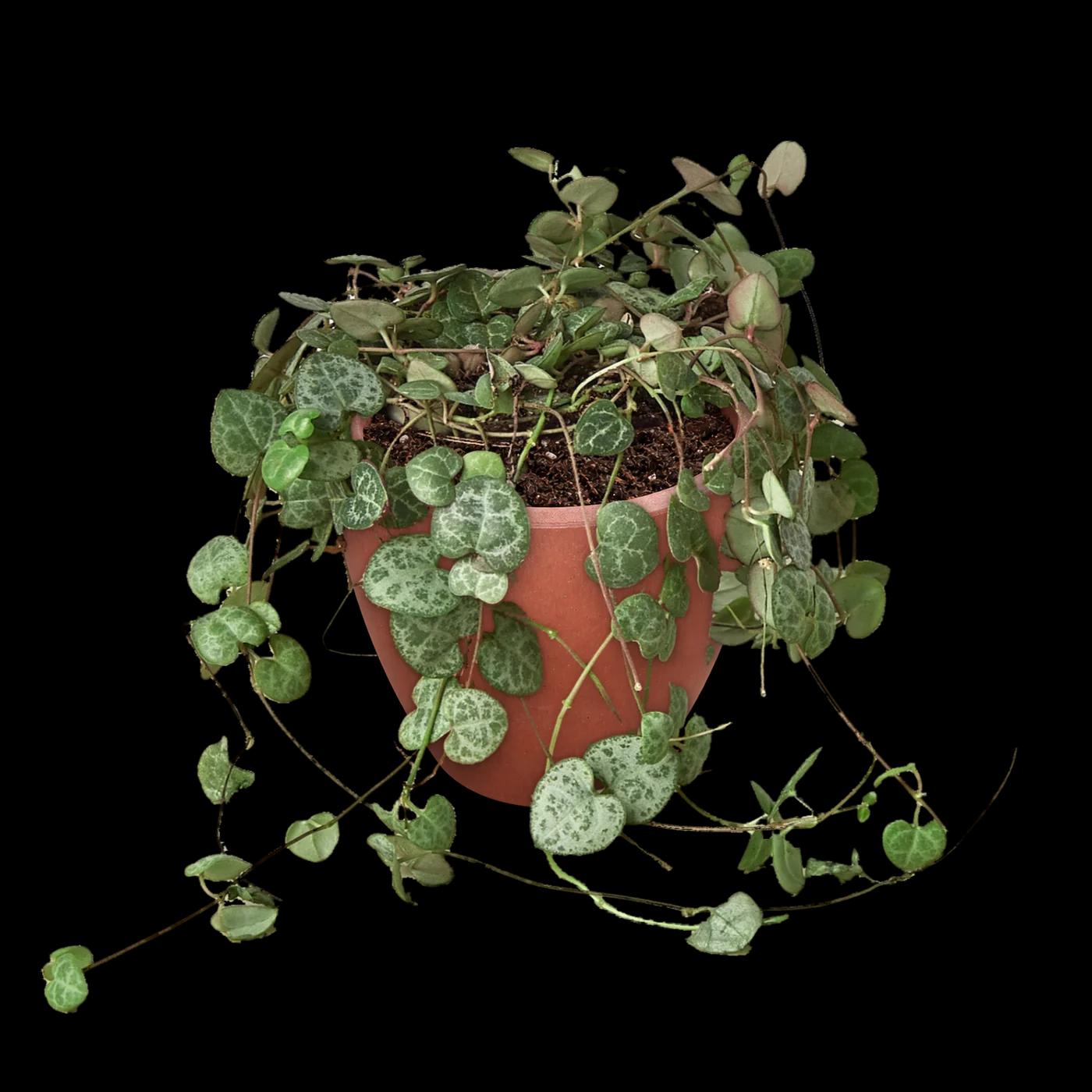
String of hearts is a trailing succulent grown for its leaves. NC State Extension describes small, heart-shaped leaves, dark green and etched with silver on top and purple underneath, spaced along thin, trailing stems. UW-Madison Extension adds that the leaves grow in pairs, half an inch to three-quarters of an inch across, and that the stems are purplish.
Its botanical name is Ceropegia woodii, the name NC State and UW-Madison Extension use. The Royal Horticultural Society (RHS) files it as Ceropegia linearis subsp. woodii and calls it hearts on a string. It also goes by rosary vine, chain of hearts, hearts entangled and sweetheart vine, among other names. It belongs to the dogbane family, Apocynaceae, in the milkweed subfamily, as UW-Madison Extension notes, and NC State and UW say it's named for John Medley Wood, a collector of African plants.
Its home is southern Africa, from Zimbabwe to South Africa. It stays only a few inches tall and grows down rather than up: NC State says the stems drape over a container and hang about 3 feet, and the RHS gives trailing stems to 1 m or more. Small, round tubers form along the stems between the leaves, the beads behind the name rosary vine, and UW-Madison Extension says it also has a swollen base and tubers under the soil that can grow to fill the pot.
What it does well, and where it asks more of you:
- The leaves are the draw: small, marbled hearts that hang in long strings from a shelf or a hanging pot.
- It's easy. NC State rates it easy to grow and low maintenance, and UW-Madison Extension calls it an easy indoor plant.
- It forgives a missed watering far more than an extra one. UW-Madison Extension says it tolerates dry soil much better than soggy soil and is easily killed by overwatering.
- It wants bright light. In too little light, UW says, the leaves turn a light green.
- We don't call it pet safe. It isn't on the ASPCA's plant list under any of its names, as the next section explains.
- It's small. It comes in our Small only, a 4 in pot, and suits the edge of a shelf, a desk or a hanging pot.
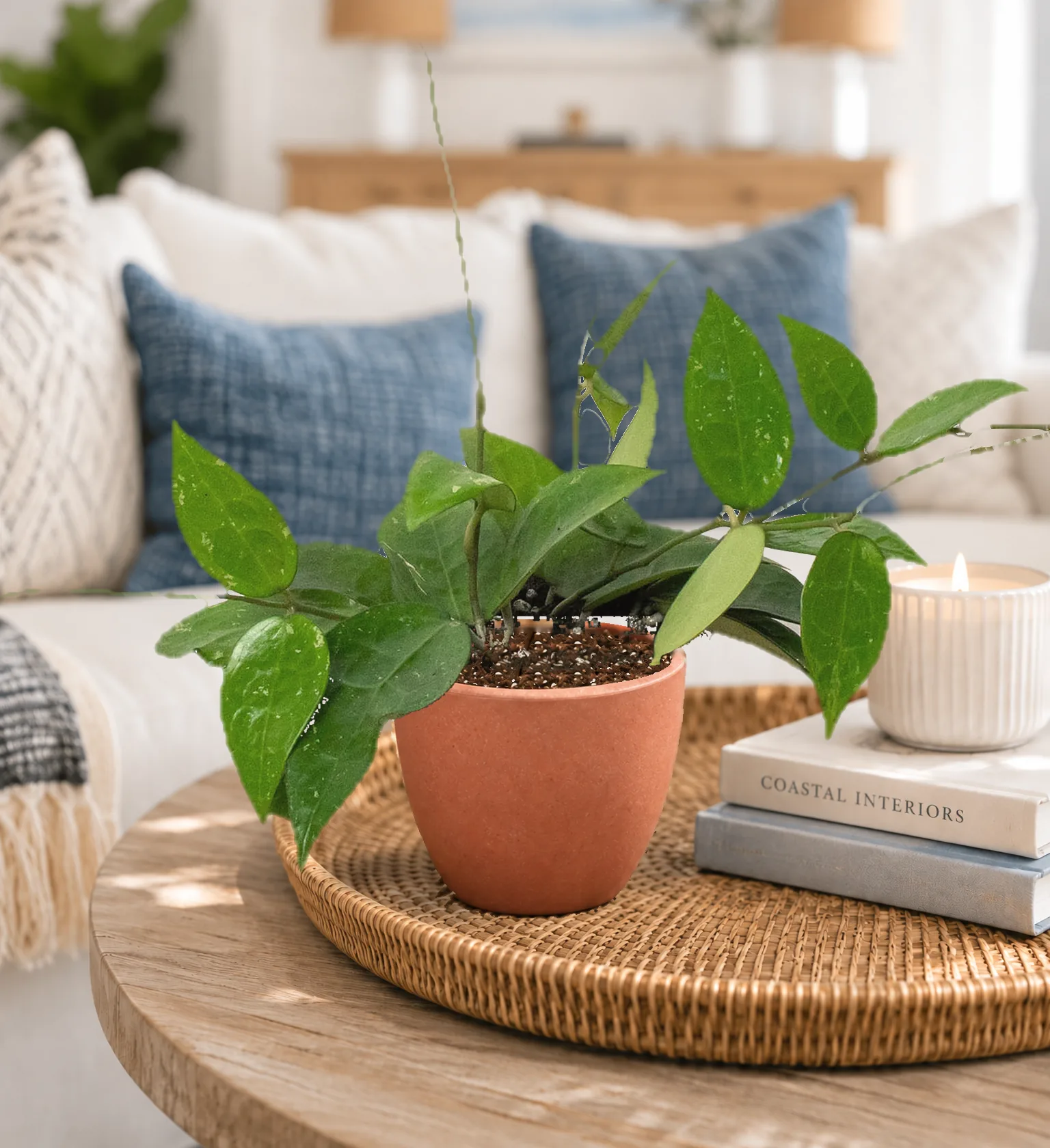
If you have a cat or dog that chews plants, choose one we call pet safe instead. Hoya Black Margin, from our Rare Plants, is a trailing relative from the same family that we call pet safe.
Is a string of hearts safe for cats and dogs?
We can't confirm it, so we don't call it pet safe. When we checked the ASPCA's cat and dog plant lists in November 2026, string of hearts wasn't on them, under its botanical name, Ceropegia woodii, or under common names such as rosary vine, chain of hearts, hearts entangled or sweetheart vine. The ASPCA lists no Ceropegia at all, so it hasn't rated the plant either way. Some websites say the ASPCA lists string of hearts as non-toxic. When we checked, it didn't.
NC State Extension's page for it gives no poison rating, and UW-Madison Extension says nothing about pets. With no listing to go on, we don't call it toxic either, but we show it as not confirmed pet safe.
Don't mix it up with string of pearls, a trailing succulent in a different genus, Senecio, and a different family, the daisy family. The ASPCA lists Senecio species as toxic to cats, dogs and horses. String of hearts isn't one of them: NC State, UW-Madison Extension and the RHS all place it in Ceropegia.
Treat it like any plant you're unsure of, and hang it or shelve it where a cat or dog can't reach the trailing strands. Eating any plant can upset a pet's stomach. If your pet chews it and seems unwell, call your veterinarian or the ASPCA Animal Poison Control Center at (888) 426-4435. A consultation fee may apply. Our guide to pet-safe houseplants covers the plants we do call pet safe.
How much light does a string of hearts need?
Bright light, mostly indirect. NC State recommends bright, indirect sunlight, and the RHS suggests partial shade, facing west or east. UW-Madison Extension and the University of Missouri both say it can grow in a south- or west-facing window, and UC Master Gardeners in San Luis Obispo suggest three to four hours of bright indirect light, then shade in the afternoon.
The leaves tell you how you're doing. UW-Madison Extension says that in strong light they're darkly colored, with distinctive marbling, and in too little light they turn a light green. NC State says large gaps between the leaves mean the plant isn't getting enough light, and that too much sun scorches the leaves, which UC Master Gardeners describe as curled brown leaves.
If it spends the summer outdoors, UW-Madison Extension says to move it into brighter light gradually so it doesn't sunburn, and to bring it back in before the first frost.
If your rooms run dim, our low light houseplants guide has plants better suited to them.
How often should you water a string of hearts?
Only once the soil has dried out. NC State says to let it dry out completely between waterings and to be careful not to overwater, and UW-Madison Extension says it tolerates dry soil much better than soggy soil and is easily killed by overwatering. UC Master Gardeners suggest a thorough watering in spring and summer once the top two to three inches of soil are dry.
There's no fixed schedule. A Small in its 4 in pot dries out faster in a warm, bright window than in a cool room, so feel the soil every week or so rather than going by the calendar. When it's time, water like this:
- Water slowly at the base until the soil is evenly moist. If the pot has a drainage hole, a little water running out is the sign it's had enough.
- Tip out any extra, so the pot never sits in water.
- Leave it until the soil is dry again. Push a finger into the soil, and if it feels cool or damp, wait.
Water even less in winter. NC State says it's dormant over the winter and watering should be reduced even further, and the RHS says to keep it dry outside the growing season, warning that it's prone to rot at the base if it's too wet in winter. Our guide to watering houseplants covers the basics for every plant.
Everyday string of hearts care: soil, warmth, feeding and repotting
Use a fast-draining mix. NC State recommends a well-drained, sandy potting soil, UW-Madison Extension a cactus and succulent mix or a mix with extra perlite, and the RHS cactus compost.
Keep it warm. UW-Madison Extension says to keep it above 60°F in winter, and the University of Missouri and UC Master Gardeners give the same 60°F. NC State calls it tender. Humidity needs no fuss: UC Master Gardeners give 40 to 50 percent as ideal, and none of the other guides asks for misting or a pebble tray.
Feed it lightly. UW-Madison Extension suggests half-strength houseplant fertilizer at most once a month while it's growing, and none in winter, when it rests. The RHS suggests a low-nitrogen liquid fertilizer two or three times in the growing season.
Repot rarely. NC State says it likes to be crowded, so put off repotting until it's needed, and UW-Madison Extension suggests doing it in spring, before new growth starts. Handle the roots gently: UC Master Gardeners warn that damaged roots can cause transplant shock.
The RHS says no pruning is required. If you'd rather it grew up than down, NC State and UW-Madison Extension both suggest training it on a small trellis or topiary frame. Our care notes cover the routine every Patina plant shares.
How to propagate a string of hearts
It's one of the easiest plants to share. The beads along the stems are aerial tubers, and NC State says they root wherever a stem touches soil.
UW-Madison Extension's method: press a bead, still attached to its stem, onto the soil of a small pot set beside the plant, keep that soil moist but not wet, and cut the stem once the bead has rooted.
Stem cuttings work too. The RHS suggests 4 to 6 in cuttings in early summer, in cactus compost kept at about 72 to 77°F (22 to 25°C), and UW-Madison Extension says cuttings root best with bottom heat.
Does a string of hearts flower?
It can. NC State describes small, tubular, purplish flowers under an inch long in summer and fall, and UW-Madison Extension says they come mainly then but can appear at odd times through the year, each like a small, inverted pink vase. The RHS calls them lantern-shaped, pink and purple, about 2 cm long. They're a bonus rather than the point, so don't count on flowers when it arrives.
NC State notes that insects can be trapped inside a flower for a while, but it isn't a carnivorous plant. If the flowers are pollinated, horn-shaped seed pods can follow, with silky seeds like a milkweed's.
What to do when your string of hearts arrives
It comes already potted at the greenhouse in a recycled eco pot, in terracotta, charcoal or cloud white, or in its plain nursery pot, in one box. A few steps in the first week help it settle:
- Unpack it the day it arrives. Lift it out by the pot rather than the strands, remove all the packing, including any winter protection added for a cold-weather trip, and gently untangle the strands.
- Feel the soil before you water. If it's dry, water slowly until it's evenly moist and tip out any extra. If it's still damp, leave it. With a succulent, a missed watering is safer than an extra one.
- Set it in bright light, out of hot afternoon sun, and let the strands hang free over the edge of a shelf or a hanging pot.
- Snip off any strand that broke on the way. If it has beads, press it onto the soil to root, as in the propagation steps above.
- Leave it in its pot, since it likes to be crowded, and if it arrives in fall or winter, hold off on feeding until spring.
If it arrives damaged or declines in its first 30 days, we replace it. Delivery times are on our shipping page.
String of hearts problems and how to fix them
Most string of hearts problems come back to water or light. Find the symptom:
- Yellowing leaves and soft stems at the soil line, with soil that stays damp: overwatering and root rot, which NC State and UC Master Gardeners both warn about. The RHS says it's prone to rot at the base if too wet in winter. Let it dry out fully, and if the base has gone soft, root healthy strands as new plants.
- Wilted leaves with bone-dry soil: it went too long without water, which NC State says causes wilting. Water thoroughly and check a little sooner next time.
- Pale, plain green leaves and long gaps between them: too little light. UW-Madison Extension and UC Master Gardeners both say the leaves lose their color or marbling, and NC State says large gaps between the leaves mean the plant needs more light. Move it somewhere brighter.
- Curled, brown or scorched leaves: too much direct sun, which NC State and UC Master Gardeners say scorches them. Give it shade from hot afternoon sun.
- White, cottony clusters on the stems and leaves: mealybugs, which UW-Madison Extension says can be a problem. Wipe them off and keep checking.
- Clusters of tiny insects or small brown bumps: aphids or scale, which NC State and the RHS both list. Rinse or wipe them off and check again in a week.
Our String of Hearts comes in our Small size only, a 4 in pot, potted at the greenhouse in a recycled eco pot in terracotta, charcoal or cloud white, or in its plain nursery pot for $6 less, with our 30-day guarantee.
Questions
Is string of hearts toxic to cats?
We can't say either way. When we checked in November 2026, it wasn't on the ASPCA's toxic or non-toxic plant lists for cats or dogs under any of its names, and NC State Extension gives it no poison rating, so we don't call it pet safe. Keep its trailing strands out of a cat's reach, and call your vet or the ASPCA Animal Poison Control Center at (888) 426-4435 if you're worried.
Is string of hearts a succulent?
Yes. NC State describes it as a tender, succulent, evergreen perennial, and UW-Madison Extension says it has a swollen base and tubers under the soil. That's why it wants a fast-draining mix and soil that dries out between waterings.
Why is it called rosary vine?
For the small, round tubers that form along the stems between the leaves, which NC State and UW-Madison Extension liken to the beads of a rosary. They're also the easiest way to make new plants, since each one can root in soil.
How long do the strings grow?
NC State says the stems drape over a container and hang about 3 feet, and up to 12 feet in the wild, and the RHS gives trailing stems to 1 m or more. Ours is a 4 in plant, so expect shorter strands at first. NC State rates its growth as rapid.
Is string of hearts the same as string of pearls?
No. String of pearls is a Senecio, in the daisy family. String of hearts is Ceropegia woodii, in the dogbane family. The ASPCA lists Senecio species as toxic, which is one more reason to check the botanical name before relying on any pet listing.
Sources
- NC State Extension Plant Toolbox: Ceropegia woodii
- UW-Madison Extension, Wisconsin Horticulture: String of Hearts, Ceropegia woodii
- RHS Plants: Ceropegia linearis subsp. woodii (hearts on a string)
- University of Missouri IPM, Missouri Environment and Garden: Romantic Valentine's Day Houseplants with a Heart
- UC Master Gardeners (UCCE San Luis Obispo), Diggin' It in SLO: String of Hearts
- ASPCA Animal Poison Control: Toxic and Non-Toxic Plants for Cats
- ASPCA Animal Poison Control: Toxic and Non-Toxic Plants for Dogs
- ASPCA Animal Poison Control: Groundsel (Senecio species)