- Guides
- Hoya Black Margin
Plant guide
Hoya Black Margin Care: How to Grow a Trailing Wax Plant
A trailing wax plant with thick, glossy leaves that wants bright indirect light and a mix that dries almost completely between drinks, and that isn't on the ASPCA plant list.
What is Hoya Black Margin?
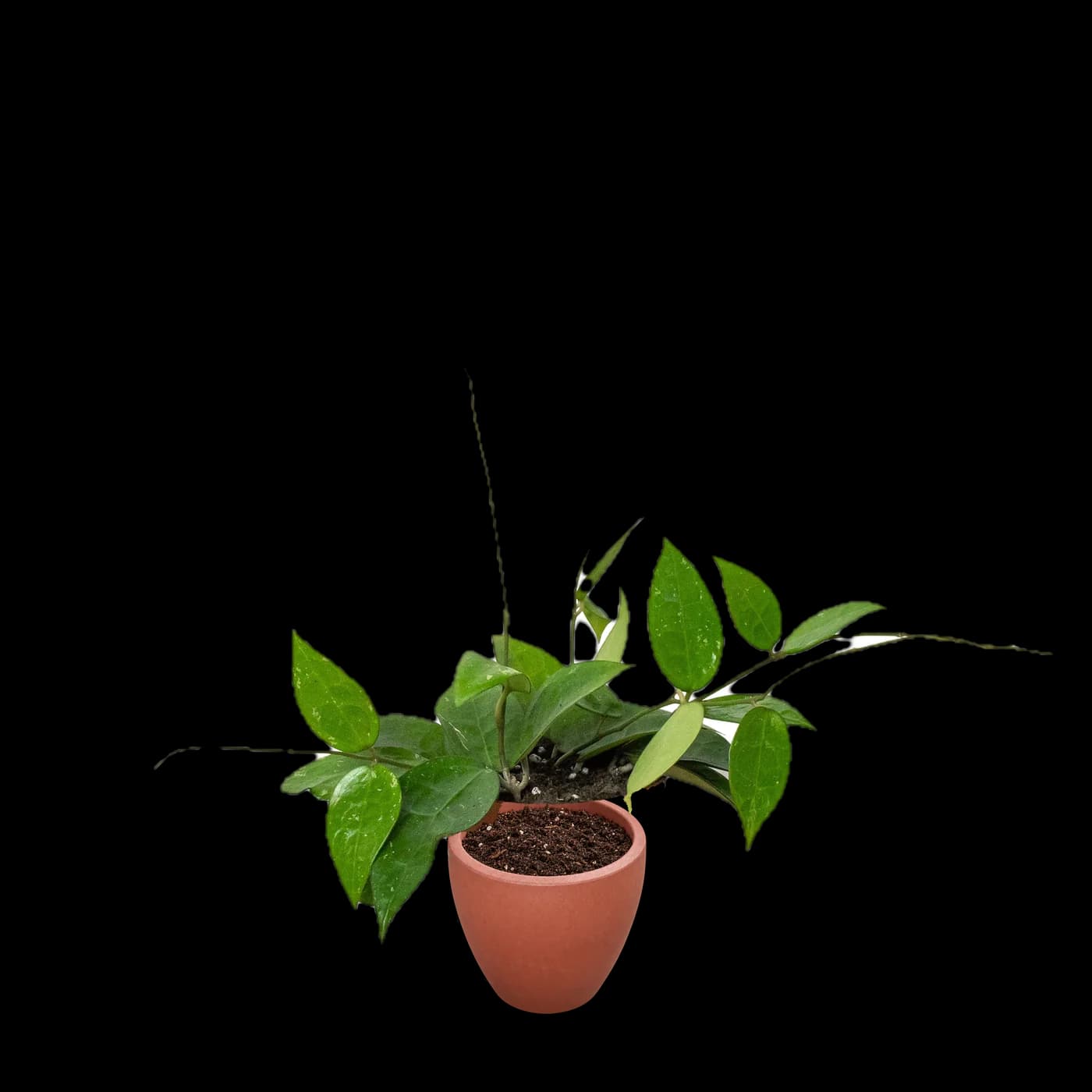
Hoya Black Margin is a trailing wax plant with thick, glossy leaves that taper to a point, often flecked with silver and named for the darker edge they can show. Like other hoyas, it grows on long, thin vines that trail from a shelf or climb a small support, and in time it can bloom in clusters of waxy, star-shaped flowers.
A note on the name. Black Margin is a trade name rather than a botanical one. It's usually sold as Hoya parasitica 'Black Margin' and sometimes as Hoya verticillata 'Black Margin', and both labels point to the same species: GBIF's backbone taxonomy and the Catalogue of Life treat Hoya parasitica as a synonym of Hoya verticillata, a climbing hoya native from India and southern China through Southeast Asia to the Philippines. We list ours simply as Hoya 'Black Margin'.
Hoyas belong to the dogbane family, and Iowa State Extension explains that in the wild they grow as epiphytes on tree branches. That shapes their care: their roots need air, so they want a chunky mix that dries out between drinks. The advice from NC State, Clemson, Iowa State and the RHS is written for hoyas in general or for Hoya carnosa, the common wax plant, so we've kept to the points they agree on.
Care comes down to three habits: bright indirect light, a fast-draining mix and letting it dry almost completely before you water again.
Is Hoya Black Margin a good houseplant for you?
It's one of our Rare Plants, collector plants grown in small batches that can sell out. It's also one of the less demanding ones:
- It drinks little. Clemson and Iowa State both say to let the mix dry out between waterings, which suits anyone who forgets now and then.
- It trails. Clemson notes that hoyas take on a cascading look in hanging baskets, and climbing types can be trained on a trellis.
- It copes with average indoor air. Iowa State says hoyas adapt to normal household humidity, ideally 40 to 60 percent.
- It may flower. Iowa State says hoyas bloom from persistent spurs that often flower again, though young plants can take several years to start.
- It fits a desk or shelf. Our Small comes in a 4 in pot and our Medium in a 6 in pot.
It has limits. It wants a bright spot: Iowa State says low light gives thin, stretched growth and little or no flowering, so a dim room is better suited to one of our low-light houseplants. It isn't on the ASPCA list, so we don't call it pet safe. And it rewards patience more than attention; Clemson calls overwatering the most common hoya problem.
Is Hoya Black Margin safe for cats and dogs?
It isn't on the ASPCA's plant list either way. When we checked the cat and dog lists in November 2026, the ASPCA listed three hoyas as non-toxic to cats and dogs: Hoya carnosa (filed under wax plant, honey plant, porcelain flower and Hindu rope plant), Hoya kerrii (sweetheart hoya) and Hoya pubicalyx (silver pink vine). Hoya verticillata, Hoya parasitica and Black Margin weren't on it under any name.
You'll often see hoyas called pet friendly as a group, but each ASPCA entry covers its own species, not the whole genus. The ASPCA also says its list isn't meant to be all-inclusive, so a missing entry tells you nothing either way. We don't call Black Margin pet safe.
There's one more reason for care: the RHS's hoya guide says to wear gloves when pruning because the sap is toxic and irritates skin. Keep it out of reach of a chewer, in a hanging pot or on a high shelf. If your pet eats some and seems unwell, call your vet or the ASPCA Animal Poison Control Center at (888) 426-4435. A consultation fee may apply. Our guide to pet-safe houseplants covers plants the ASPCA does list as non-toxic.
How much light does Hoya Black Margin need?
Bright, indirect light. Iowa State Extension says one of the brightest windows in the house is often best, as long as the plant is out of direct sun. NC State calls bright indirect light ideal year-round, and Clemson suggests a spot near an east-, west- or south-facing window.
Strong sun can burn it. The RHS says to shade hoyas from hot summer sun, and Clemson says a plant moving to a south window should be eased into direct sun to avoid leaf burn. Iowa State notes that light that's too bright can scorch the leaves or turn them red.
Too little light is the more common problem. Iowa State links low light to thin, stretched growth and little or no flowering, and Clemson says it can hold back blooms and reduce variegation. In a dim home, Clemson suggests an LED grow light.
Keep it warm. Iowa State says hoyas do best at 65 to 80°F with slightly cooler nights and don't tolerate temperatures below 55°F, so keep it off cold winter sills. The RHS adds that hoyas should be kept away from radiators, heaters and cold drafts.
How often should you water Hoya Black Margin?
Let the mix dry almost completely, then water thoroughly. Iowa State Extension calls this a wet-dry cycle, and Clemson goes further, saying to let the soil dry out completely between waterings. Clemson's test is the pot's weight: a dry pot feels noticeably light.
When it's time, water slowly at the base until water runs from the drainage hole, then tip out anything left in a saucer or cover pot. NC State recommends room-temperature water, since cold water can shock the plant.
Water less often in winter and in lower light, Iowa State says, but don't leave it bone dry for weeks on end. NC State notes that too much water and too little can both make the leaves drop.
Overwatering is the bigger risk. Clemson calls it the most common hoya problem and root rot the biggest threat, and the RHS says root rot is usually fatal. A Small in its 4 in pot dries out sooner than a Medium. More in how to water houseplants.
Will Hoya Black Margin flower?
It can, given time and light. Iowa State Extension describes hoya flowers as waxy, fragrant, star-shaped clusters, typically in summer. Clemson notes that how soon a hoya blooms depends on the species and isn't always predictable, and NC State says most wax plants don't flower until they're 2 or 3 years old.
Bright light is the main trigger, according to Iowa State, which adds that a slight drop in night temperature may help buds form. Clemson recommends a liquid fertilizer with an NPK ratio of 2:1:2 or 3:1:2 to support flowering.
Once buds appear, keep everything steady. The RHS says hoyas may drop their buds if the mix gets too wet or too dry or if the light changes, and its rule is not to move them while in bud. Iowa State names watering changes, temperature swings and moving the plant as the causes of bud blast.
Leave old flower stalks alone. Hoyas bloom from short, persistent spurs, also called peduncles, and new flowers come from the same spurs, so NC State, Iowa State and the RHS all say not to cut them off. Let spent flowers fall on their own.
Everyday care: mix, humidity, feeding, pruning and repotting
Use a chunky, fast-draining mix. Clemson suggests equal parts potting soil, orchid bark and perlite, and Iowa State a similar blend with perlite or pumice, because the roots need oxygen. The RHS uses equal parts orchid bark, multipurpose compost and coarse perlite.
Average indoor air is usually fine. Iowa State gives 40 to 60 percent humidity as ideal, and NC State and the RHS suggest a tray of damp pebbles if your air is very dry, with the water kept below the tops of the stones. Clemson notes that spider mites are more common in winter, when heated air is dry.
Feed lightly in spring and summer. Iowa State suggests an all-purpose fertilizer at half or quarter strength, skipping every second or third watering. Don't feed in winter. The RHS recommends flushing the pot with plain water every few months so fertilizer salts don't build up.
Prune lightly, if at all. The RHS suggests taking out overcrowded or weak shoots in late winter or early spring, cutting just above a side shoot or leaf. It says hoyas respond poorly to hard pruning. Never cut off flower spurs, and wear gloves. Cuttings root easily: Iowa State says stem cuttings with one or two nodes are the most reliable, and a leaf cutting without a node won't grow into a vine.
Repot rarely. Iowa State says hoyas often flower better when slightly potbound, and NC State says they tolerate it. When roots fill the pot or the mix breaks down, repot in spring into a pot no more than 2 inches wider; Clemson warns that a pot too big for the roots stays wet and invites root rot. Our care notes cover the routine every Patina plant shares.
What to do when your Hoya Black Margin arrives
It comes already potted at the greenhouse in a recycled eco pot, in terracotta or black, in one box. In the first week:
- Unpack it the day it arrives. Lift it out by the pot, gently free any vines and remove the packing, including any winter protection.
- Feel the soil and lift the pot. If the mix is dry and the pot feels light, water slowly and tip out the extra. If it's damp, wait a few days.
- Set it in bright, indirect light, away from vents, drafts and cold glass, and leave it there while it settles. If it arrives in bud, the RHS's advice not to move a hoya in bud applies.
- A yellow or creased leaf after the trip is normal. Snip it off at the stem, but leave any flower spurs in place.
- Leave it in its pot. Hoyas like a snug fit, and if it arrives in fall or winter, hold off on feeding until spring.
If it arrives damaged or declines in its first 30 days, we replace it. Delivery times are on our shipping page.
Common Hoya Black Margin problems and how to fix them
Most hoya problems come back to water or light, so start with the soil:
- Yellow leaves with wet soil: overwatering, Iowa State says. Let the mix dry out more between drinks and make sure the pot drains.
- Leaves dropping or blackening: usually waterlogged soil or cold, according to the RHS. Move it somewhere warmer and water less often. NC State adds that soil kept too dry can cause leaf drop too.
- Wilting and dying stems: often overwatering or overfeeding, the RHS says, since too much fertilizer leaves salts in the mix that stop the roots taking up water. If the roots have rotted, the RHS says the plant won't usually recover, so take cuttings from healthy stems straight away and root them.
- Thin, stretched stems and no flowers: not enough light. Move it closer to a bright window or add a grow light, as Clemson suggests.
- Red or scorched leaves: light that's too strong, Iowa State notes. Pull it back from the glass or add a sheer curtain.
- Buds dropping before they open: a change in watering, temperature or position, according to Iowa State and the RHS. Keep its care steady until it blooms.
- White, cottony clusters in leaf joints: mealybugs. Clemson suggests dabbing them with a cotton swab dipped in isopropyl alcohol or using insecticidal soap. Check for scale too, which Iowa State describes as small, immobile bumps.
- Fine webbing or speckled leaves: spider mites, more common in dry winter air, Clemson says. Rinse the leaves, raise the humidity and treat with insecticidal soap or neem oil.
- Small black flies around the soil: fungus gnats, which NC State says are drawn to overly wet mix. Let the mix dry out more between waterings.
Our Hoya Black Margin comes in a Small or Medium size, potted at the greenhouse in a recycled eco pot in terracotta or black, with our 30-day guarantee.
Questions
Is Hoya Black Margin safe for cats?
It isn't on the ASPCA's list either way, so we don't call it pet safe. The ASPCA lists Hoya carnosa, Hoya kerrii and Hoya pubicalyx as non-toxic to cats and dogs, but Black Margin is a different species, and the RHS warns that hoya sap irritates skin. Keep it out of reach of a chewer, and call your vet or the ASPCA Animal Poison Control Center at (888) 426-4435 if you're worried.
Is Hoya Black Margin the same as Hoya carnosa?
No. Hoya carnosa is the common wax plant. Black Margin is usually sold as Hoya parasitica, a name GBIF and the Catalogue of Life fold into Hoya verticillata, a separate species. Their care is much the same, but the ASPCA's non-toxic listing for Hoya carnosa doesn't cover it.
How often should I water Hoya Black Margin?
When the mix is almost completely dry, rather than on a schedule. Clemson Extension suggests lifting the pot: a dry one feels noticeably light. Water thoroughly, let it drain and water less often in winter.
Why isn't my hoya flowering?
Usually light or age. Iowa State says bright light is the main trigger and young plants can take several years to bloom, and NC State says most wax plants don't flower until they're 2 or 3 years old. Give it the brightest indirect light you have and don't cut off old flower spurs.
Should I cut off the flower stalks after blooming?
No. Hoyas bloom again from the same short spurs, so NC State, Iowa State and the RHS all advise leaving them in place. Let the spent flowers drop on their own.
Why are my hoya's leaves turning red?
Iowa State notes that hoya leaves can scorch or turn red when the light is too bright. If the color comes with crisp or bleached patches, move it a little farther from the window or filter the sun with a sheer curtain.
Sources
- ASPCA Toxic and Non-Toxic Plants: Honey Plant (Hoya carnosa)
- ASPCA Toxic and Non-Toxic Plants: Sweetheart Hoya (Hoya kerrii)
- ASPCA Toxic and Non-Toxic Plants: Silver Pink Vine (Hoya pubicalyx)
- ASPCA Animal Poison Control: Toxic and Non-Toxic Plants List
- NC State Extension Plant Toolbox: Hoya carnosa
- Clemson Cooperative Extension (HGIC 1460): Indoor Plants: Waxflowers (Hoya)
- Iowa State University Extension and Outreach: All About Hoyas
- Royal Horticultural Society: How to grow hoyas
- GBIF Backbone Taxonomy: Hoya verticillata (Vahl) G.Don, with Hoya parasitica as a synonym