- Guides
- Philodendron Burle Marx Albo
Plant guide
Philodendron Burle Marx Albo Care: Growing a Variegated Philodendron
A low, spreading philodendron with glossy, elongated heart-shaped leaves marbled in cream that wants bright, indirect light and water when the top inch of soil is dry, and that is toxic to cats and dogs.
What is Philodendron Burle Marx Albo?
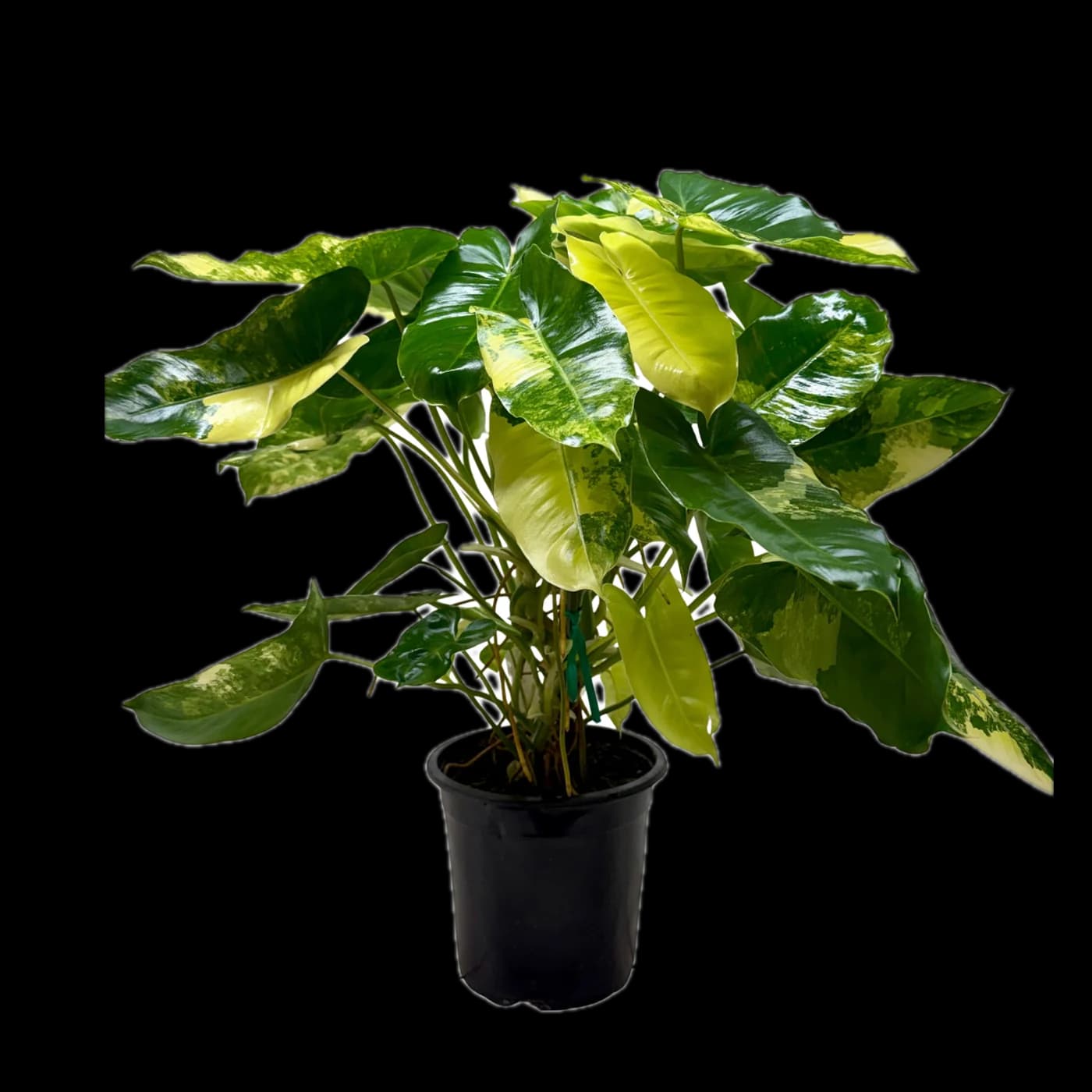
Philodendron 'Burle Marx Albo' is a variegated form of Philodendron 'Burle Marx', a low, spreading philodendron with glossy, elongated heart-shaped leaves on long stalks. On the Albo, the deep green is marbled and splashed with cream to pale yellow. Some leaves come out mostly cream and others mostly green, so no two look the same.
The plain green 'Burle Marx' is named for Roberto Burle Marx (1909 to 1994), the Brazilian landscape architect known for using native plants in modern gardens. It's often sold as Philodendron burle-marxii, but that's a different plant. Singapore's National Parks Board (NParks) says the houseplant is a cultivated form of Philodendron cordatum with smaller leaves and shorter internodes, while the true P. burle-marxii has long, narrow leaves with no notch at the base. Wikipedia draws the same line. That P. cordatum is a separate species, not the heartleaf philodendron that nurseries also sell as cordatum. 'Albo' is the name shops use for the variegated form; we haven't found it in a botanical register, so treat it as a trade name.
NParks says 'Burle Marx' was reportedly first collected on rocky coasts near Rio de Janeiro. It gives leaves about 8 inches long and 4 inches wide on stalks that can top 12 inches, and says the plant climbs by roots from its stem nodes or forms a thick mound without support. The Chicago Botanic Garden describes a low-growing shrub or vine that grows in clumps about 2 feet tall and 2 to 3 feet wide. In South Florida, Fairchild Tropical Botanic Garden says the green form is a popular groundcover that spreads quickly.
Care comes down to three habits: plenty of bright, indirect light for the cream, water when the top inch of soil is dry and cutting out any shoots that come in plain green. It's part of our Rare Plants collection, a collector plant grown in small batches that can sell out.
Why grow Philodendron Burle Marx Albo?
It's a collector plant, but a practical one:
- Every leaf is different. The cream marbling shifts from leaf to leaf, from a few flecks to whole half-leaves, so the plant keeps changing as it grows.
- It grows wide rather than tall. The Chicago Botanic Garden puts the plain form at about 2 feet tall, so it suits a low table, a plant stand or the floor beside a chair.
- It's tough underneath. NParks rates the green form as fast-growing and low maintenance, and Fairchild says it copes with poor soil and dry spells outdoors. The cream form has less chlorophyll to work with, and the RHS explains that on variegated plants, the greener shoots are the stronger growers because they have more chlorophyll.
- It climbs or sprawls, your choice. Give it a short moss pole, or let it mound and spread in a wide pot.
- It's easy to share. NParks lists stem cuttings and division, and Clemson Extension adds air layering.
Who should grow a Burle Marx Albo, and who shouldn't
It suits someone with a bright room who already keeps a philodendron or pothos happy and wants more color. It doesn't ask for fussy humidity: NC State Extension says philodendrons prefer high humidity but usually adapt to average home levels.
Skip it if your only spot is dim. Plain green philodendrons cope with low light, but variegated leaves need more, and NYBG says too little light is the most common reason variegation fades. Skip it too if you have a cat or dog that chews plants or a toddler at floor level, since every philodendron the ASPCA lists is toxic.
If you want an easy philodendron for a dim room, the heartleaf philodendron is a better fit. For creamy leaves on an upright plant, see Dieffenbachia 'Camille', and for something pet-safe, our guide to pet-safe houseplants.
Is Philodendron Burle Marx Albo safe for cats and dogs?
No. The ASPCA lists variegated philodendron (Philodendron spp.) as toxic to cats and dogs, and its Philodendron pertusum entry lists philodendrons as a group (Philodendron spp.) as toxic to cats, dogs and horses. It has no separate entry for 'Burle Marx', so we go by those two listings. Every philodendron on the ASPCA's cat and dog lists is marked toxic.
The toxic principle is insoluble calcium oxalate crystals. The ASPCA lists oral irritation, intense burning and irritation of the mouth, lips and tongue, heavy drooling, vomiting and difficulty swallowing as signs. NParks notes that the crystals are in the sap, which can also make skin itch, and NC State says the sap can cause skin irritation. Wear gloves when you prune and wash your hands afterward.
Clemson Extension says all parts of philodendrons are toxic if eaten and advises keeping them away from pets and young children that may eat plants. Set it where your animals can't reach it, and trim any stems that dangle low. If your pet chews it, call your vet or the ASPCA Animal Poison Control Center at (888) 426-4435. A consultation fee may apply.
How much light does a Burle Marx Albo need?
Bright, indirect light, and more of it than a plain green philodendron. NC State says philodendrons prefer bright indirect light, and Clemson says most prefer indirect or curtain-filtered sun. A spot a few feet back from an east- or west-facing window, or behind a sheer curtain at a south-facing one, suits it.
The cream is the reason. NYBG explains that variegated tissue lacks chlorophyll, and that in too little light the variegated parts often fade and revert to solid green as the plant tries to make more food. Leaves that have already faded usually won't regain their color, but new growth should show cream again once the light improves.
Don't swing to hot, direct sun, which NC State warns can scorch philodendron leaves. Gentle morning sun through an east window is fine; strong afternoon sun through a south or west window is not.
Keep it warm. NC State puts the ideal at 65 to 85°F and says philodendrons are very sensitive to cold, so keep it away from drafts, cold glass and air conditioning vents. Clemson suggests nights of 65 to 70°F and days of 75 to 85°F.
How often should you water a Burle Marx Albo?
Water when the top inch of soil feels dry. Clemson Extension says to keep philodendrons evenly moist but not soggy and never to let them stand in water, and NC State warns that overwatering causes root rot. Clemson's test works well here: push a finger into the soil to the first joint and water if it's dry at your fingertip.
When it's time, pour slowly around the base until water runs out of the drainage hole, then empty the saucer or cover pot. Clemson suggests water between 62 and 72°F and says to skip softened water, which adds sodium to the soil.
How often that works out to depends on the room. Clemson notes that warm, sunny spots and actively growing plants use more water while cool, dim spots use less. A large plant in a small pot also needs water more often. Expect longer gaps in winter, when growth slows.
Fairchild says the green form tolerates dry spells in a Florida garden, but a potted plant indoors is a different case. Clemson names too much or too little water as one of the main problems with philodendrons, so check the soil rather than testing its limits. More in how to water houseplants.
Burle Marx Albo care: humidity, feeding, pruning and repotting
Average home humidity is usually fine. NC State says philodendrons prefer high humidity but usually adapt, and suggests a humidifier or a tray of pebbles and water in very dry conditions. Keep the water below the tops of the pebbles so the pot never sits in it.
Feed while it's growing in spring and summer. Clemson suggests a dilute water-soluble houseplant fertilizer used regularly, or a time-release fertilizer. Don't overdo it: Clemson notes that too much fertilizer can make leaf tips curl and brown.
Watch for green shoots. A variegated plant can put out stems with plain green leaves, and the RHS explains that because these have more chlorophyll they're more vigorous and can eventually take over. The RHS advice is to prune reverted shoots out completely or cut back to growth that's still variegated. Mostly cream leaves are the opposite case: the RHS notes that all-pale shoots on variegated plants are weak and don't take over. Enjoy them, and trim them off if they brown.
It climbs or mounds, as NParks describes. If it starts to lean, give it a short moss pole or stake and tie the stems loosely; otherwise let it spread in a wide pot. Wear gloves when you prune.
Repot when roots crowd the pot, ideally in spring, as NC State suggests, into a pot one size larger with a drainage hole and a well-drained mix rich in organic matter. Clemson says root rot usually comes from a mix that drains slowly or from watering too often, so choose an airy mix. NParks notes it tolerates being rootbound, so there's no rush. If you take cuttings, choose stems with well-marked leaves.
What to do when your Burle Marx Albo arrives
It comes already potted at the greenhouse, in a recycled eco pot in terracotta or black, in one box. A few steps help it settle:
- Unpack it soon after delivery. Lift it by the pot, not the leaves, and remove all the packing, including any winter protection.
- Feel the soil. If the top inch is dry, water slowly until it runs from the drainage hole and empty the saucer. If it's still damp, check again in a few days.
- Choose its long-term spot: bright, out of strong direct sun and out of reach of pets. Then leave it there while it settles.
- Expect a yellow leaf or two after the trip. Cut them off at the base of the stalk, with gloves on, and don't water extra to compensate.
- Leave it in its pot through its first growing season, and hold off on feeding until spring if it arrives in fall or winter.
If it arrives damaged or declines in its first 30 days, we replace it. Delivery times are on our shipping page.
Burle Marx Albo problems and how to fix them
Most problems come back to light, water or green shoots. Find the symptom:
- New leaves coming in greener, with less cream: too little light, NYBG says. Move it somewhere brighter. Faded leaves won't recover, but new ones should show cream again.
- Whole stems of plain green leaves: reversion. Cut them out, as the RHS advises, before they crowd out the variegated growth.
- Yellow lower leaves and dying growing tips: too little light or overwatering, according to Clemson. Check the soil and the light before anything else.
- Leaf tips curling and turning brown: too much fertilizer, Clemson says. Feed less often and at lower strength.
- Scorched, crisp patches: direct sun. Pull it back from the window or add a sheer curtain.
- Soft stems and soil that stays wet: root rot, which NC State links to overwatering. Let the soil dry further, empty any standing water and repot into an airy mix if it doesn't improve.
- Spots on the leaves: NC State says good air circulation and dry leaves help prevent leaf spot, so water the soil, not the plant.
- A small sticky drop where a leaf stalk meets the stem: probably nectar. NParks notes the plant has nectar glands at the base of its leaf stalks. A sticky film spread across the leaves is more likely a pest.
- Cottony tufts, small brown bumps, tiny insects or fine webbing: mealybugs, scale, aphids, thrips or spider mites, all on NC State's list. Wipe or rinse them off, keep the plant away from your others and check weekly.
Burle Marx Albo is part of our Rare Plants collection, grown in small batches that can sell out. When it's in stock, you can get a Philodendron Burle Marx Albo potted at the greenhouse in terracotta or black, with our 30-day guarantee.
Questions
Is Philodendron Burle Marx Albo toxic to cats and dogs?
Yes. The ASPCA lists philodendrons, including variegated philodendron, as toxic to cats and dogs because of insoluble calcium oxalate crystals. It has no separate entry for 'Burle Marx', so we follow those listings. Keep it out of reach, and call your vet or the ASPCA Animal Poison Control Center at (888) 426-4435 if your pet chews it.
Is Philodendron 'Burle Marx' the same as Philodendron burle-marxii?
No. NParks and Wikipedia both say the houseplant is often mistaken for that species. The houseplant has shiny, elongated heart-shaped leaves with a deep notch at the base, while the true P. burle-marxii, a climber from Colombia, Ecuador and Brazil, has long, narrow leaves. Both are named for the landscape architect Roberto Burle Marx.
Why is my Burle Marx Albo turning green?
Usually not enough light. NYBG says insufficient light is the most common reason variegation fades in houseplants. Move it to brighter, indirect light. Faded leaves won't regain their cream, but new growth should. If whole stems come in plain green, cut them out, as the RHS advises for reverted shoots.
Will every leaf be variegated like the photos?
No two leaves match. Some carry a few flecks of cream, some are heavily marbled and some come out mostly cream or mostly green. That variation is part of the plant, so yours won't look exactly like any photo.
Does Burle Marx Albo need a moss pole?
Not necessarily. NParks says it climbs by roots when it has support and forms a thick mound without one, and the Chicago Botanic Garden describes it as a low-growing shrub or vine. Add a short pole if you'd like it taller; otherwise let it spread in a wide pot.
Sources
- ASPCA Toxic and Non-Toxic Plants: Variegated Philodendron (Scindapsus, Philodendron spp.)
- ASPCA Toxic and Non-Toxic Plants: Philodendron Pertusum (Philodendron spp.)
- ASPCA Animal Poison Control: Toxic and Non-Toxic Plants for Cats
- ASPCA Animal Poison Control: Toxic and Non-Toxic Plants for Dogs
- National Parks Board Singapore, Flora & Fauna Web: Philodendron 'Burle Marx'
- Chicago Botanic Garden Plant Finder: Philodendron 'Burle Marx'
- Fairchild Tropical Botanic Garden: Philodendron 'Burle Marx'
- NC State Extension Plant Toolbox: Philodendron
- Clemson Cooperative Extension (HGIC 1509): Philodendron
- Clemson Cooperative Extension (HGIC 1459): Indoor Plants: Watering
- New York Botanical Garden: Why is the variegation fading on the leaves of my houseplant?
- Royal Horticultural Society: Reversion
- Wikipedia: Philodendron burle-marxii (species vs the 'Burle Marx' cultivar)