- Guides
- Dieffenbachia Camille
Plant guide
Dieffenbachia 'Camille' Care: How to Grow a Dumb Cane Indoors
A bushy dumb cane with creamy yellow leaves edged in green that likes bright, indirect light and soil that dries an inch down, and is toxic to cats and dogs.
What is Dieffenbachia 'Camille'?
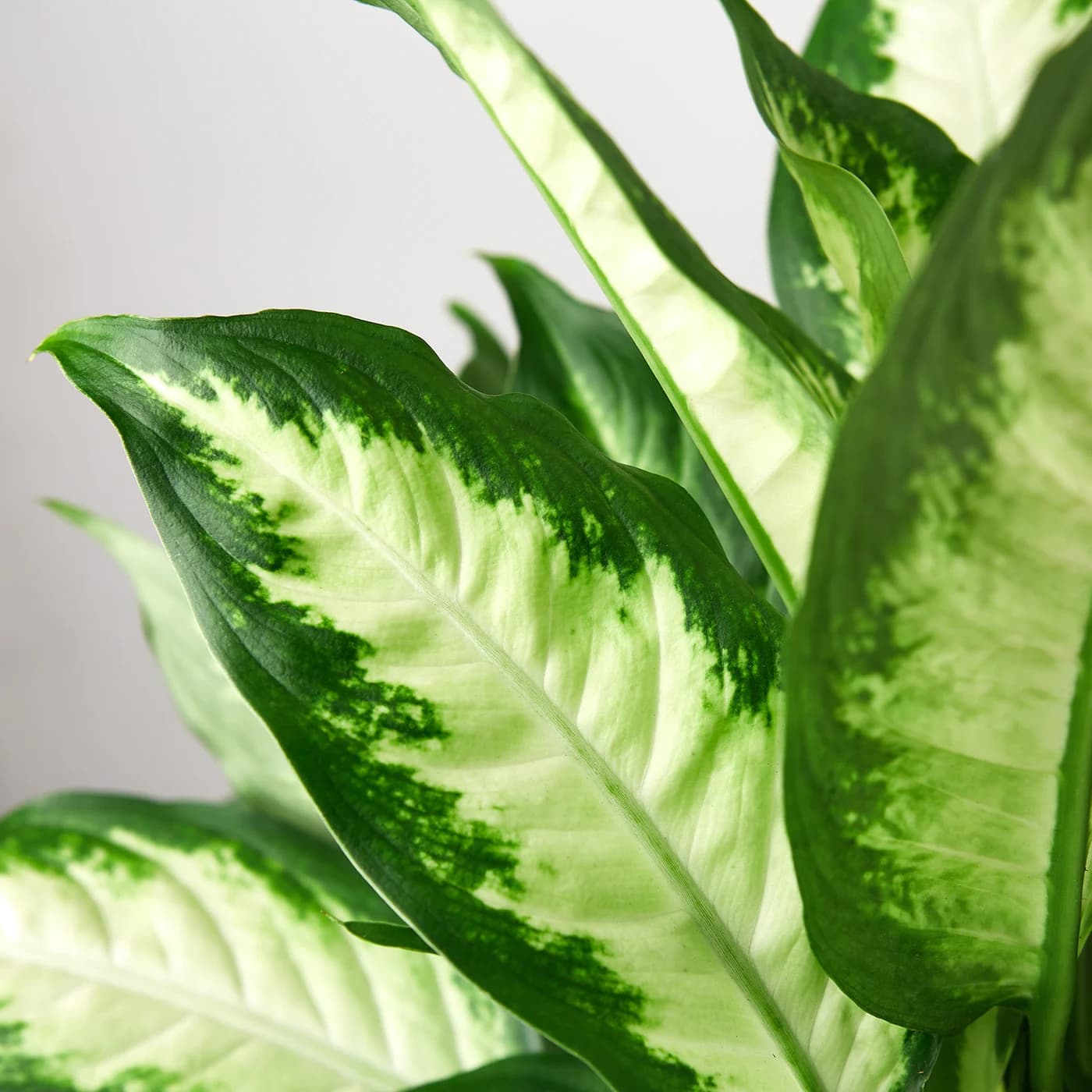
Dieffenbachia 'Camille' is a compact, bushy dumb cane with wide, glossy leaves that are creamy yellow in the middle and edged in rich green. Clemson Extension calls it one of the best-known dieffenbachia cultivars, with a full, lush habit and few problems.
It is a form of Dieffenbachia seguine, in the aroid family, sometimes sold under an older name, D. maculata. NC State Extension gives the species' home as the Caribbean and tropical South America and its height as 3 to 8 feet. 'Camille' stays smaller, up to about 3 feet. As it matures, the lower leaves drop to show a thick, cane-like stem.
The name dumb cane comes from its sap, which numbs and burns the mouth and throat if a leaf is chewed. That's why it's toxic to pets, belongs out of reach of small children, and calls for gloves when you prune.
Ours arrives already potted at the greenhouse in a Small or Medium eco pot, in terracotta or black.
Dieffenbachia benefits: what it does well, and what it doesn't
The main draw is the leaves. Few easy houseplants give you this much pale, creamy color, and Clemson describes dieffenbachias as easy houseplants that tolerate a wide range of conditions. It also does a few other things well:
- It grows upright and bushy rather than trailing, so it suits a tabletop, a dresser or a plant stand.
- It's comfortable at ordinary room temperatures. Clemson gives 60 to 75°F as ideal.
- It handles a missed watering better than soggy soil. NC State lists some drought tolerance, while Clemson says root rot usually comes from watering too often.
It rarely flowers as a houseplant, says NC State, so grow it for the foliage. And it won't noticeably clean the air in your home. That idea comes from studies in small sealed chambers, including a 1989 NASA report; a 2020 review by Cummings and Waring found that normal ventilation clears indoor VOCs far faster than any realistic number of potted plants. More in our look at whether houseplants clean the air.
Who should get a Dieffenbachia 'Camille', and who shouldn't
It suits beginners who want something bolder than a vine, bright rooms with a spot out of direct sun, and offices, where Clemson notes dieffenbachias are popular. Poison Control calls dieffenbachia a great houseplant for beginners, and also says to keep it away from children and pets.
Clemson Extension goes further and doesn't recommend dieffenbachias in homes with children or pets, so skip it if you have either, especially a cat or dog that chews plants or a toddler who puts leaves in their mouth. Our guide to pet-safe houseplants rounds up plants the ASPCA lists as non-toxic to cats and dogs.
It may also disappoint you in a dim room, where it survives but grows slowly. Our low light houseplants guide covers plants that handle dim rooms better.
Is dieffenbachia toxic to cats and dogs?
Yes. The ASPCA lists dieffenbachia, including the plants sold as dumb cane, as toxic to both cats and dogs. The toxic principles it names are insoluble calcium oxalates and a proteolytic enzyme.
Signs the ASPCA lists include oral irritation, intense burning and irritation of the mouth, tongue and lips, excessive drooling, vomiting and difficulty swallowing. If you think your pet has chewed it, call your veterinarian or the ASPCA Animal Poison Control Center at (888) 426-4435. A consultation fee may apply.
The calcium oxalate also explains the name dumb cane. It forms crystals that Poison Control calls raphides, tiny needles found in every part of the plant, which cause immediate pain and swelling when a leaf is chewed or sap gets on skin or in the eyes. In severe cases, the pain and swelling can lead to drooling, painful swallowing and loss of speech.
It helps to keep that in proportion. In Poison Control's case examples, a toddler who chewed a leaf was back to normal within an hour after a mouth rinse and something cold and creamy, and a woman who got sap on her hands felt fine after washing them well. A few habits keep everyone comfortable:
- Wear gloves when you prune or take cuttings, as NC State advises, and wash your hands afterward. Keep your hands away from your eyes and mouth while you work.
- Set the plant where pets and small children can't reach it, and pick up any leaves that fall.
- If sap gets on skin, Poison Control advises washing with soap and water for 15 minutes. If it gets in an eye, rinse with water for at least 15 minutes.
- If a person chews a leaf, have them rinse and spit, then suck on ice chips if the mouth still stings. Call 911 for heavy drooling, severe swelling, or trouble swallowing or breathing. Otherwise, Poison Control is free, 24 hours a day, at 1-800-222-1222.
How much light does Dieffenbachia 'Camille' need?
Give it bright, indirect light. Clemson says dumb canes thrive in bright filtered light from spring through fall, and NC State says to protect them from direct sunlight. A few feet back from an east- or west-facing window works well, as does a spot right beside a north-facing window.
It tolerates low light, but growth slows, says Clemson. UF/IFAS adds that a dieffenbachia that has nearly stopped growing probably isn't getting enough light. Clemson names other cultivars, such as 'Tropic Snow', as the dieffenbachias for dimmer spots, so treat 'Camille' as a plant for a reasonably bright room.
In winter, when the sun is weaker, Clemson suggests bright light, even some direct sun. It leans toward the window as it grows, so UF/IFAS suggests a quarter turn every few days.
How often should you water a Dieffenbachia 'Camille'?
Water when the top inch of soil is dry, not on a fixed day. NC State and Clemson both say to water thoroughly, then let the top inch dry before watering again, and NC State notes that this helps prevent root rot.
To check, push a finger into the soil up to the first knuckle. If it feels dry at your fingertip, it's time. If it still feels cool and damp, wait a few days and check again.
When you water, pour slowly around the base of the plant until the soil is evenly moist, then stop. Never leave the pot standing in water; if any collects in a saucer or a decorative cover pot, tip it out. UF/IFAS warns against letting dieffenbachia sit in water, and Clemson ties root rot to slow-draining soil and watering too often.
How often that works out to depends on light, warmth and pot size. As a rough guide, a Small in a bright, warm room in summer may want water about once a week, and a Medium a little less often. In winter the soil dries more slowly, so expect to water less. Keep a steady rhythm: UF/IFAS links brown leaf tips to uneven watering. Our guide to watering houseplants covers the basics.
Everyday dieffenbachia care: feeding, pruning and repotting
Feed from March through September, as Clemson suggests, with a liquid foliage houseplant fertilizer at half strength every two to four weeks. For a 4 or 6 inch pot, the longer interval is plenty. Skip winter. Too much fertilizer burns the leaf edges, Clemson warns.
Keep it between 60 and 75°F, the range Clemson and UF/IFAS both give, and away from cold drafts and sudden temperature swings. NC State says it likes fairly high humidity, but Clemson notes dieffenbachias tolerate a wide range of conditions, so ordinary room humidity usually works.
Pruning is mostly tidying. The lowest leaves yellow and drop one at a time as the plant grows, which UF/IFAS calls normal. Snip them off at the stem with gloves on. If, after a few years, the cane gets tall and bare, Clemson says you can cut it back to about 6 inches and it will regrow below the cut.
The piece you cut off can start a new plant. Clemson lists cane cuttings, stem tip cuttings and air layering, done in spring or early summer.
Your plant arrives potted, so there's nothing to repot this season. If it fills its pot later, Clemson suggests repotting in early spring, and UF/IFAS says any good-quality, well-drained potting mix works. A Small can move up to a 6 inch pot. Wear gloves: NC State lists the roots and stems, not just the leaves, as poisonous.
What to do when your dieffenbachia arrives
Your dieffenbachia leaves the greenhouse already potted, in one box, so there's no setup. It usually reaches you in about 3 to 8 business days, with extra protection packed in cold weather; our shipping page has the details. Open the box the day it arrives. For the first week:
- Lift it out by the pot, not the leaves, and set it where it will live: bright, indirect light, away from cold drafts and out of reach of pets and small children.
- Check the soil with a finger. If it's dry an inch down, water slowly until it's evenly moist and tip out anything that collects in a saucer or cover pot. If it's damp, leave it a few days.
- Expect a yellow or creased leaf or two after several days in a dark box. Put on gloves and snip them off where the leaf stalk meets the stem.
- If the leaves droop and the soil is dry, it got thirsty on the way, so give it a drink. If they droop and the soil is wet, hold off on water and keep it warm.
- Leave it in its pot, and don't feed it while it settles in.
The pot is our grower's recycled eco pot, which they describe as recycled plastic blended with stone powder and wood dust. If your plant arrives damaged or declines in its first 30 days, we'll replace it.
Common dieffenbachia problems and how to fix them
Most dieffenbachia problems come back to water, light or temperature:
- One lower leaf yellowing and dropping now and then: normal. Clemson and UF/IFAS both say the lower leaves fall as the plant matures. Snip them off.
- Several leaves yellowing while the soil stays wet: too much water, the usual route to root rot. Let the top inch dry before you water again, tip out any water under the pot, and move it somewhere brighter.
- Drooping leaves with dry soil: it's thirsty. Water well, as UF/IFAS suggests, and check the soil sooner next time.
- Leaves that droop and fall without yellowing first: probably too cold, says UF/IFAS. Move it somewhere that stays above 55°F, away from drafty doors and windows.
- Brown leaf tips: often uneven watering, says UF/IFAS. Keep a steadier rhythm and never let the pot sit in water.
- Brown, burned leaf edges or curled leaves: often too much fertilizer, say Clemson and UF/IFAS. Feed less often and follow the label rate.
- Smaller, paler new leaves and little growth: too little light, says UF/IFAS, or too little food, says Clemson. Move it somewhere brighter and feed in spring and summer.
- White, cottony clumps or sticky leaves: mealybugs or aphids, which Clemson says leave sticky honeydew. Wipe them off with gloves on. For more than a few, UF/IFAS suggests a product labeled for the pest.
- Pale leaves with fine webbing underneath: spider mites. UF/IFAS suggests isolating the plant and hosing it down outside with a strong spray of water, then a labeled product if they persist.
Every Dieffenbachia 'Camille' from our shop arrives potted in a Small or Medium eco pot in terracotta or black, and comes with our 30-day guarantee.
Questions
Why is it called dumb cane?
Because chewing it can make it hard to talk. Every part of the plant contains needle-like calcium oxalate crystals, and Clemson Extension says eating them numbs and burns the mouth and throat. NC State says the name refers to that effect on the vocal cords. Clemson doesn't recommend dieffenbachias in homes with children or pets.
Is dieffenbachia poisonous to touch?
The problem is mainly the sap. Clemson says some people get a skin rash from it, and NC State suggests gloves when handling the plant. Wear gloves to prune, repot or take cuttings, wash your hands afterward, and keep your hands away from your eyes. If sap gets on your skin, Poison Control advises washing with soap and water for 15 minutes.
What should I do if my cat or dog chews a dieffenbachia?
Call your veterinarian or the ASPCA Animal Poison Control Center at (888) 426-4435; a consultation fee may apply. Signs the ASPCA lists include burning and irritation of the mouth, tongue and lips, excessive drooling, vomiting and difficulty swallowing. Then move the plant somewhere your pet can't reach.
How big does Dieffenbachia 'Camille' get?
NC State lists 'Camille' at up to about 3 feet tall, smaller than many dieffenbachias, which Clemson says commonly reach 3 to 6 feet. Clemson describes it as bushy and full. It grows quickly in good conditions and barely at all in low light, so how fast a Small fills out depends mostly on light.
Can I put my dieffenbachia outside?
It's a tropical plant and happiest indoors. Clemson gives 60 to 75°F as ideal, and UF/IFAS says leaves can droop and drop when it gets colder than 55°F. If you live in Florida, note that a UF/IFAS assessment predicts dieffenbachia could become invasive there, so keep it in its pot and don't plant it or its cuttings in the garden.
Sources
- ASPCA Animal Poison Control: Dieffenbachia
- NC State Extension Plant Toolbox: Dieffenbachia seguine
- Clemson Cooperative Extension HGIC 1503: Dieffenbachia
- UF/IFAS Gardening Solutions: Dieffenbachia
- Poison Control (National Capital Poison Center): Dieffenbachia and Philodendron, Popular but Poisonous
- Cummings & Waring (2020), Potted plants do not improve indoor air quality, J. Expo. Sci. Environ. Epidemiol.