- Guides
- Calathea White Fusion
Plant guide
Calathea White Fusion Care: How to Grow the Marbled Calathea
A compact calathea with leaves marbled in white, green and purple that needs bright, indirect light, humid air, steady warmth and evenly moist soil.
What is Calathea White Fusion?
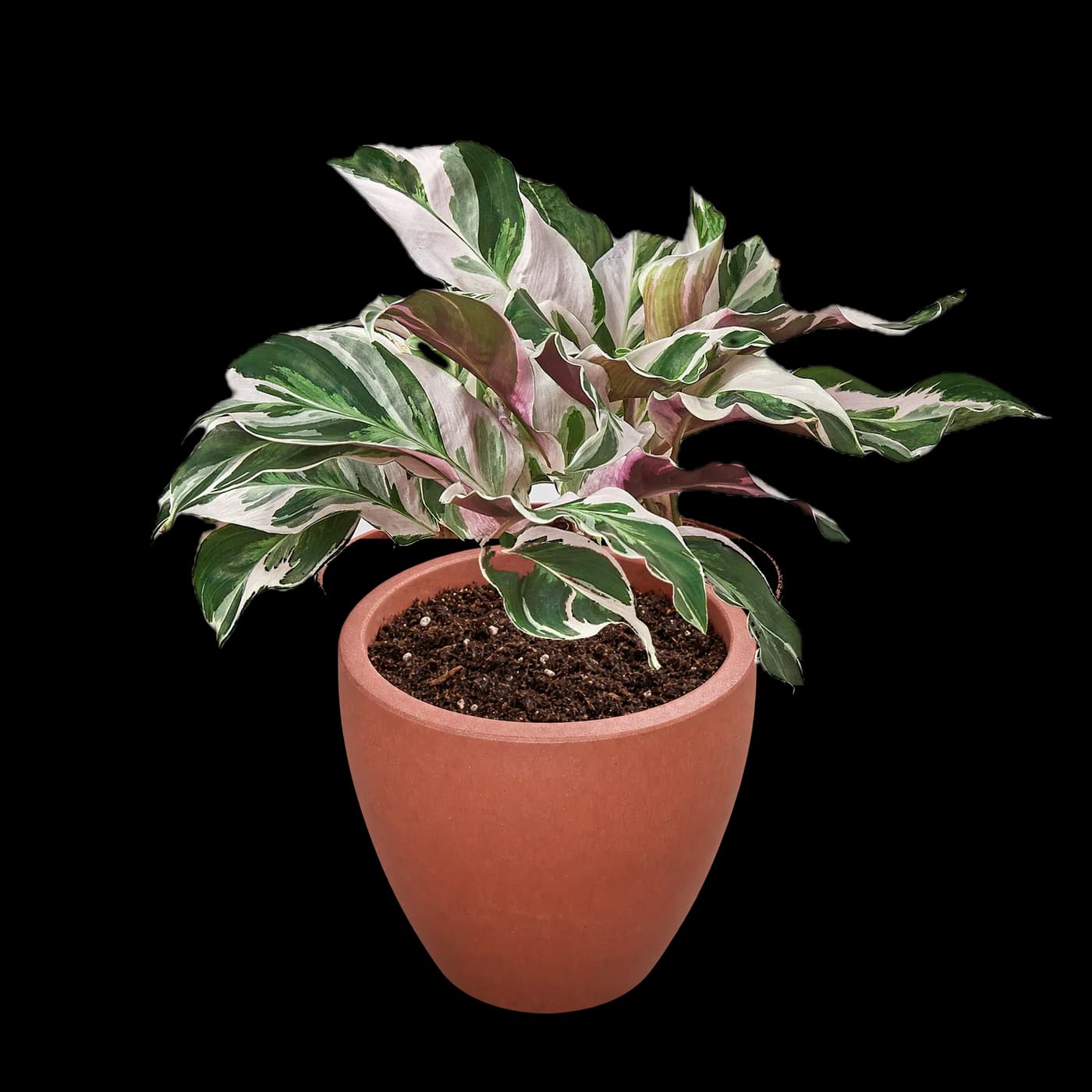
Calathea White Fusion is a compact calathea grown for its leaves. The Royal Horticultural Society (RHS) describes them as marbled white, light green and dark green on top and lightly flushed pink and purple underneath, and NC State Extension notes that every leaf is variegated in its own pattern. The leaves are oblong with wavy edges and sit on long, slender stalks.
Botanically it's a cultivar of Goeppertia lietzei, a clump-forming species native to eastern Brazil that used to be called Calathea lietzei. NC State says the species is named after a Mr. Lietz of Brazil, who helped the Belgian nursery that first brought it to Europe. The RHS records the cultivar as Goeppertia lietzei 'Fusion White', with Calathea 'Fusion White' as a synonym, while NC State lists it as 'White Fusion'. Shops use both, usually with the old genus name; the RHS advises looking for plants labeled calathea until the new names catch on.
Like its relatives in the prayer plant family, it folds its leaves up at night and opens them again at sunrise, NC State says. The species can flower, but NC State and the RHS both say it rarely does as a houseplant.
It's part of our Rare Plants collection: collector plants grown in small batches that can sell out. Care comes down to light, humidity, warmth and water: bright, indirect light, humid air, a steady temperature and evenly moist soil watered with distilled, filtered or rainwater. NC State is frank that it can be challenging, because you're trying to recreate its native tropical conditions indoors.
Is Calathea White Fusion a good houseplant for you?
It suits someone who enjoys a small routine and has a bright room to offer. Its strengths:
- No two leaves alike. NC State says each leaf has its own pattern, similar to a peacock feather.
- A compact size. NC State puts the species at up to 16 in tall and wide, so it fits a desk or shelf or a side table. Our Small comes in a 4 in pot and our Medium in a 6 in pot.
- Daily movement. The leaves lift at night and lower again in the morning, which shows off their pink and purple undersides.
- No direct sun needed. It wants bright light, but not sun on its leaves.
It has real limits. NC State calls it challenging and asks for humidity above 60 percent and temperatures of 65 to 75°F. It dislikes cold drafts and sudden temperature changes, and NC State says its colors fade when the light is too low. If you've never kept a houseplant, one of our easy houseplants for beginners is a gentler start, or try our rattlesnake plant, a calathea that copes with lower light.
Skip it if your only spot is a dim corner, a hot sunny sill or a shelf above a radiator, or if you don't want to run a humidifier or keep a pebble tray topped up. It does best in a bright room that stays warm and steady all year.
Is Calathea White Fusion safe for cats and dogs?
It isn't on the ASPCA's plant lists by name. When we checked the ASPCA's cat and dog lists in November 2026, there was no entry for Goeppertia lietzei, Calathea lietzei or the cultivar White Fusion.
The lists do include a general entry titled Calathea, with the scientific name Calathea spp. and no species named, marked non-toxic to dogs, cats and horses. They also list a few named calatheas, such as Calathea insignis, our rattlesnake plant, as non-toxic, and NC State tags Goeppertia lietzei as non-toxic for cats and dogs. None of these is an ASPCA entry for this plant, and we only call a plant pet safe when the ASPCA lists the plant itself, so we show White Fusion as not on the list.
Common names won't settle it either. Calatheas sometimes go by peacock plant or zebra plant, and the ASPCA lists both as names for Calathea insignis, but on its lists those names also point to a ginger (Kaempferia) and a bromeliad (Cryptanthus zonatus). Check any plant by its botanical name.
NC State adds a note for people: the sap may irritate skin, so wear gloves when you trim or divide it. Keep the plant out of reach of a pet that chews, and if your pet eats some and seems unwell, call your veterinarian or the ASPCA Animal Poison Control Center at (888) 426-4435. A consultation fee may apply. Our guide to pet-safe houseplants covers the plants the ASPCA does list as non-toxic.
How much light does Calathea White Fusion need?
Bright, indirect light. NC State recommends bright, indirect sunlight, and the RHS suggests bright indirect light or light shade. In summer the RHS suggests a spot near a north- or east-facing window for calatheas. Keep direct sun off the leaves: NC State warns that direct sunlight can scorch calathea leaves.
Light matters more for a variegated plant. The New York Botanical Garden (NYBG) plant information service explains that the pale parts of a variegated leaf lack chlorophyll and can't make food, and it names too little light as the most common reason variegation fades in houseplants. NC State says the same of this plant: its colors fade when the light is insufficient. Leaves that have already faded usually stay that way, NYBG says, but new growth should show its pattern again once the plant gets more light.
Low light also means weak growth. The RHS lists poor, weak growth from low light as a common calathea problem, especially in Goeppertia. If your home runs dark, the plants in our low-light houseplants guide will be happier.
Keep it warm and steady. NC State suggests 65 to 75°F, and the RHS a constant temperature above 16°C (61°F). UF/IFAS Extension warns that temperatures below 55°F can cause chilling injury in calatheas, so keep it away from cold glass, drafty doors and heating or air conditioning vents.
How often should you water Calathea White Fusion?
Water when the surface of the soil just starts to dry, not on a schedule. NC State asks for consistent moisture, and the RHS says to water moderately in spring and summer, keeping the soil evenly moist. UF/IFAS, writing about calatheas indoors, suggests letting the surface dry slightly before watering. In fall and winter, the RHS advice is to let the surface dry before watering again, without ever letting the pot dry out completely. A Small in its 4 in pot dries out sooner than a Medium.
When it's time, water like this:
- Pour slowly at the base, keeping water off the leaves. NC State says keeping the foliage dry lowers the chance of fungal or bacterial infections, and the RHS also says to avoid wetting the leaves.
- Water thoroughly, until the soil is evenly moist all the way down. Clemson Extension points out that most roots sit in the bottom two-thirds of the pot.
- Tip out any water left in a saucer or cover pot. Clemson warns that roots surrounded by water can't take up oxygen and may rot.
- Use room-temperature water. Clemson suggests 62 to 72°F.
Water quality matters with this plant. NC State recommends filtered or distilled water, because fluoride in tap water can brown leaf edges and tips, and UF/IFAS names fluoride as the cause of dead spots near calathea leaf margins. The RHS says calatheas tolerate tap water left to stand for 24 hours so the chlorine can escape; that step deals with chlorine, not fluoride. Skip softened water, which Clemson says adds sodium and chloride to the soil.
Wilting doesn't always mean thirst. Clemson notes that overwatering and underwatering cause similar symptoms, and that a plant with rotting roots wilts because it can't take up water, so more water makes it worse. Feel the soil before you reach for the watering can. More in how to water houseplants.
Everyday care: humidity, feeding, cleaning and repotting
Humidity is the main challenge. NC State asks for humidity above 60 percent, and UF/IFAS says calatheas keep their looks best indoors at 40 to 60 percent. NC State suggests a humidifier or a tray of wet pebbles under the pot; keep the water below the tops of the pebbles so the roots never sit in it. The RHS adds grouping it with other plants or keeping it in a bathroom, where the air is moister; choose one with a window. Go easy on misting, since NC State advises keeping the foliage dry.
Feed once a month in spring and summer. The RHS suggests a balanced liquid fertilizer monthly from April to September and none from October to March, and NC State's notes on the genus suggest half strength. More isn't better: UF/IFAS links excess fertilizer to brown leaf tips and edges.
Dust the leaves now and then with a soft, damp cloth. NC State says dust on the leaves can get in the way of photosynthesis. The RHS says it needs no pruning; just snip off any brown or faded leaves at the base of the stalk.
There's no rush to repot. The RHS says a new plant can usually stay in its pot through its first growing season, then be repotted every few years once the clump fills the pot, in spring or summer, into a pot one or two sizes larger. NC State suggests a moist, well-drained mix with perlite or vermiculite. Late spring is the time to divide it, the RHS says: cut the clump into sections that each have several leaves, and keep them warm and humid until they grow again. Wear gloves, since NC State says the sap can irritate skin.
What to do when your Calathea White Fusion arrives
It comes already potted at the greenhouse in a recycled eco pot, in terracotta or black, so there's nothing to assemble. A few steps help it settle:
- Open the box the day it arrives. Lift the plant by its pot rather than its leaves, and remove all the packing, including any winter protection.
- Feel the soil. If the surface is dry, water until the soil is evenly moist and tip out any extra. If it's still damp, check again in a day or two.
- Put it straight into its long-term spot, in bright, indirect light and away from vents, drafts and cold glass. NC State says it dislikes sudden temperature changes, so try not to move it around while it settles.
- Give it a few days. After a trip in a dark box, some leaves may be curled or creased. Cut off any leaf that's torn or badly bent at the base of its stalk.
- Leave the pot alone. It can stay in the pot it came in through its first growing season, and if it arrives in fall or winter it won't need feeding until April.
If it arrives damaged or declines in its first 30 days, we replace it. Delivery times are on our shipping page.
Calathea White Fusion problems and how to fix them
Most problems come back to dry air, water or light. Find the symptom:
- Brown, crispy edges and tips: dry air or fluoride in tap water, NC State says. Raise the humidity and switch to distilled, filtered or rainwater. Brown edges won't recover, so judge progress by the next new leaf.
- Dead spots near the leaf margins: fluoride, according to UF/IFAS. Avoid water and fertilizer that contain it.
- Curling leaves: thirst or dry air, NC State says. Feel the soil, water if the surface is dry and add humidity.
- Faded pattern or greener new leaves: too little light, according to NC State and NYBG. Move it somewhere brighter but still out of direct sun.
- Scorched or bleached patches: direct sun. Move it back from the glass or add a sheer curtain.
- Yellow leaves: UF/IFAS lists too little fertilizer, too much water and too much light as causes. Check the soil first, then the light, then when you last fed it.
- Limp stems and soggy soil: root rot from overwatering, which NC State warns about. Let the surface dry before you water again and never leave the pot standing in water.
- Patchy, water-soaked areas on the leaves in winter: edema, which the RHS links to soil kept too wet in winter. Water less often until spring.
- Fine webbing, pale speckles or cottony clusters: spider mites or mealybugs, both on NC State's watch list along with aphids and scale. The RHS adds whitefly. Wipe or rinse the pests off and keep checking every week.
If you'd like one of your own, Calathea White Fusion comes in Small or Medium, potted at the greenhouse in terracotta or black, with our 30-day guarantee. It's part of our Rare Plants collection, grown in small batches, so sizes can sell out.
Questions
Is Calathea White Fusion safe for cats and dogs?
It isn't on the ASPCA's lists by name, so we don't call it pet safe. The ASPCA does list a general Calathea entry (Calathea spp.) and the rattlesnake plant (Calathea insignis) as non-toxic to cats and dogs, but neither names this plant. Keep it out of reach of a chewer, and call your vet or the ASPCA Animal Poison Control Center at (888) 426-4435 if you're worried.
Is White Fusion the same as Fusion White?
Yes, they're two names for the same plant. The RHS records it as Goeppertia lietzei 'Fusion White', with Calathea 'Fusion White' as a synonym, and NC State lists it as 'White Fusion'. Both describe the same marbled white, green and purple calathea.
Why is my White Fusion turning brown at the edges?
Usually dry air or the water. NC State links brown edges and tips to low humidity and to fluoride in tap water. Raise the humidity, switch to distilled, filtered or rainwater and make sure it isn't sitting in direct sun.
Why is my White Fusion losing its white?
Most likely too little light. NYBG says insufficient light is the most common reason variegation fades in houseplants, and NC State says this plant's colors fade in low light. Move it somewhere brighter, out of direct sun. Faded leaves usually stay faded, but new ones should show more white.
Why do the leaves fold up at night?
It's a member of the prayer plant family. NC State says its leaves fold up at night and open again at sunrise. It's normal daily movement, not a sign of trouble.
Does Calathea White Fusion flower?
Rarely indoors. NC State says the species bears small, greenish-white flowers in late spring in the wild, and the RHS says the cultivar sometimes flowers in summer but rarely does in cultivation. The leaves are the reason to grow it.
Sources
- ASPCA Toxic and Non-Toxic Plants: Calathea (Calathea spp.)
- ASPCA Toxic and Non-Toxic Plants: Caeroba (Calathea insignis, Rattle Snake Plant)
- ASPCA Animal Poison Control: Toxic and Non-Toxic Plants for Cats
- ASPCA Animal Poison Control: Toxic and Non-Toxic Plants for Dogs
- ASPCA Animal Poison Control Center
- NC State Extension Plant Toolbox: Goeppertia lietzei (including 'White Fusion')
- NC State Extension Plant Toolbox: Goeppertia (genus)
- Royal Horticultural Society: Goeppertia lietzei 'Fusion White'
- Royal Horticultural Society: How to grow calatheas
- UF/IFAS Extension (EDIS ENH1030): Cultural Guidelines for Commercial Production of Interiorscape Calathea
- Clemson Cooperative Extension (HGIC 1459): Indoor Plants: Watering
- New York Botanical Garden Plant Information: Why is the variegation fading on my houseplant?