- Guides
- Calathea Beauty Star
Plant guide
Calathea Beauty Star Care: How to Grow a Pinstriped Calathea
A dark green calathea traced with fine pink and silver lines that wants soft light, evenly moist soil, low-mineral water and humid air.
What is Calathea Beauty Star?
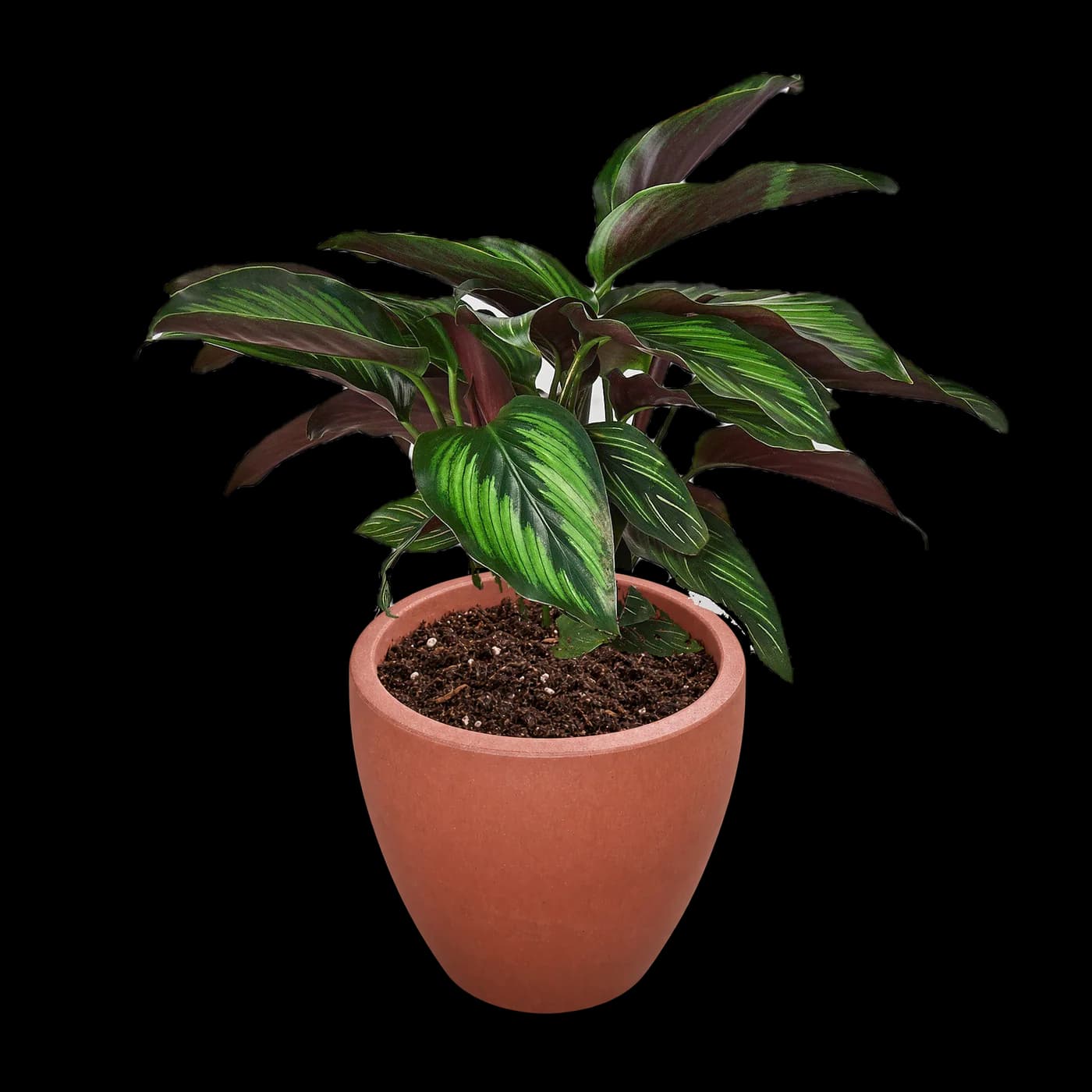
Calathea Beauty Star is a compact, clumping calathea grown for its leaves. Each long, oval leaf is dark green, brushed with lighter green along both sides of the center vein and traced with fine pink and silver lines, and the undersides are reddish purple. The Royal Horticultural Society (RHS) puts it at around 40 cm, about 16 in, and NC State Extension says up to 2 feet tall.
A note on the name. The RHS explains that plants sold as calatheas have been renamed and split among three genera, Ctenanthe, Goeppertia and Stromanthe, and it lists this one as Goeppertia 'Beautystar', with calathea 'Beautystar' as its common name. NC State lists 'Beauty Star' as a cultivar of Goeppertia ornata, the pinstripe calathea, while the RHS gives no species and marks the name as unresolved. Shops, ours included, still sell it as a calathea, and the RHS suggests looking for that label when you buy.
It belongs to the prayer plant family, the Marantaceae, and shares the family habit: NC State notes that the pinstripe calathea folds its leaves at night and opens them again at sunrise.
Care comes down to four things: soft light, evenly moist soil, clean water and humid air. Get those right and the pattern stays crisp.
Is Calathea Beauty Star a good houseplant for you?
Beauty Star is one of our Rare Plants: a collector plant grown in small batches, so it can sell out. It earns its place in a few ways:
- It stays compact. At around 16 in tall it suits a desk or shelf. Our Small comes in a 4 in pot and our Medium in a 6 in pot.
- It doesn't need sun. UF/IFAS Extension says calatheas tolerate quite low indoor light, and NC State lists direct sun as one cause of brown leaves.
- It tells you when something's off. NC State says curled leaves usually mean it's thirsty, and the RHS says brown tips usually mean the air is too dry.
- It's easy to share. Once the clump fills its pot, the RHS says you can divide it in late spring.
It has limits. Like most calatheas it's fussier than a pothos. It wants humid air, steady warmth and water low in minerals, and its leaf edges brown when it doesn't get them. If you've never kept a houseplant, one of our easy houseplants for beginners is a gentler start.
Skip it if your only spot is a sunny sill in summer, next to a radiator or by a drafty door, or if your home drops below about 61°F in winter. Skip it too if your winter air is very dry and you don't want to run a humidifier, or if you're often away for more than a week with no one to check the soil.
Is Calathea Beauty Star safe for cats and dogs?
It isn't on the ASPCA's plant lists by name. When we checked the ASPCA's cat and dog lists in November 2026, there was no entry for Beauty Star or for the pinstripe calathea NC State lists it under, whether as Goeppertia ornata or Calathea ornata.
The lists do include a general entry titled Calathea, with the scientific name Calathea spp. and no species named, marked non-toxic to dogs, cats and horses. They also list a few named calatheas, such as Calathea insignis, our rattlesnake plant, as non-toxic, and NC State tags the pinstripe calathea as non-toxic for cats and dogs. None of these is an ASPCA entry for this plant, and we only call a plant pet safe when the ASPCA lists the plant itself, so we show Beauty Star as not on the list.
Keep it out of reach of a chewer either way. Chewing any plant can upset a pet's stomach, and a cat that nibbles the leaves will spoil the pattern too. If your pet eats some and seems unwell, call your veterinarian or the ASPCA Animal Poison Control Center at (888) 426-4435. A consultation fee may apply.
If pets are your main concern, the rattlesnake plant is a calathea the ASPCA does list by name as non-toxic, and our guide to pet-safe houseplants covers the others in our range.
How much light does Calathea Beauty Star need?
Soft, indirect light. The RHS says calatheas grow best in a bright spot out of direct sunlight, and suggests a north- or east-facing window in summer and a south-facing windowsill in winter, when the sun is weaker. NC State recommends bright, indirect light or partial shade.
It copes with less. UF/IFAS says calatheas tolerate quite low indoor light but keep their looks best with a little more, which is why we list Beauty Star as low to medium light. The RHS adds that weak, slow growth is a sign of too little light, especially in Goeppertia, and suggests a brighter spot or a grow light.
Keep it out of direct sun. NC State lists too much direct sun as one cause of brown leaves, and UF/IFAS lists light that's too strong as one cause of yellowing. A sheer curtain helps in a sunny room.
If your whole home runs dark, our low light houseplants guide compares the plants that cope best.
How often should you water Calathea Beauty Star?
Water by feel, not by the calendar. The RHS says to keep the compost evenly moist through spring and summer, and NC State warns against both overwatering and letting the soil dry out. UF/IFAS suggests letting the surface dry slightly before you water. In practice, feel the soil every few days and water when the surface is just dry. A Small in its 4 in pot dries out sooner than a Medium.
When it's time, water like this:
- Pour slowly at the base and keep the water off the leaves, as the RHS advises for this plant. NC State links leaf spots to wet leaves and poor air circulation.
- Keep going until water runs out of the bottom of the pot, then empty the saucer or cover pot. Clemson Extension says never to let a pot sit in the water that drains out.
- Use water between 62 and 72°F, the range Clemson recommends, rather than very cold water.
In fall and winter, let the surface dry a little more before you water, but never let the soil dry out completely. The RHS says careful winter watering helps prevent edema, patchy, water-soaked areas on the leaves.
Water quality matters with calatheas. UF/IFAS links dead spots near the leaf edges to fluoride in water and fertilizer. The RHS prefers rainwater, and says distilled water or tap water left to stand for at least 24 hours will do. Letting water stand won't remove fluoride, though, so if your tap water marks the leaves, switch to rainwater or distilled water. Skip softened water: Clemson says it adds sodium and chloride to the soil.
Too much water and too little can look alike. Clemson calls overwatering the main cause of death in potted plants, and notes that wilting doesn't always mean a plant needs water. Feel the soil before you reach for the watering can. Our guide to watering houseplants covers the basics for every plant.
Everyday care: humidity, warmth, feeding and repotting
Humidity is the main challenge. NC State suggests around 60 percent, and UF/IFAS says calatheas keep their looks best between 40 and 60 percent. The RHS suggests a bright bathroom or kitchen. Elsewhere, stand the pot on a tray of gravel with water kept just below the surface, group it with other plants or run a humidifier in winter when the heat is on.
Keep it warm and steady. NC State suggests 65 to 75°F, and the RHS says to keep it above 61°F, away from drafts and radiators, without sudden swings. UF/IFAS warns that temperatures below 55°F can cause chilling injury.
Feed once a month from April to September with a balanced liquid houseplant fertilizer, as the RHS and NC State suggest, and stop from October to March. More isn't better: UF/IFAS links excess fertilizer to brown leaf tips and edges.
Wipe the leaves now and then with a soft, damp cloth. NC State notes that dust can interfere with photosynthesis. Cut off fully brown leaves just above the soil; the RHS says no other pruning is needed.
Repot every few years, in spring or summer, once the clump has filled its pot, the RHS says, going up just one or two pot sizes. Use a mix that drains freely but holds moisture, such as one made for African violets, which NC State suggests. Late spring is also the time to divide it: ease the clump apart so each piece has several leaves, then keep the new pots warm, humid and moist until they grow again.
What to do when your Calathea Beauty Star arrives
It arrives already potted at the greenhouse, in a recycled eco pot in terracotta or black, so there's nothing to assemble. A few small steps in the first week help it settle:
- Open the box the day it arrives. Lift the plant out by its pot rather than its leaves, and take away all the packing, including any winter protection added for a cold-weather trip.
- Feel the soil. If the surface is dry, water at the base until it runs through and tip out the extra. If it's still damp, check again in a day or two.
- Put it straight into its long-term spot, in soft indirect light and away from vents, drafts and cold glass. Calatheas dislike sudden changes, so try not to move it around while it settles.
- Give folded leaves time. After days in a dark box, some leaves may be held upright or curled, much as they fold at night, and they should open out once they're back in the light. Cut off any leaf that's torn or badly creased at the base of its stalk.
- Leave the pot alone. It can stay in the pot it came in through its first growing season, and if it arrives in fall or winter it won't need feeding until April.
If it arrives damaged or declines in its first 30 days, we replace it. Our shipping page explains delivery times and the guarantee.
Calathea Beauty Star problems and how to fix them
Most problems trace back to water, dry air or light. Find the symptom:
- Curling leaves: usually thirst, NC State says. Feel the soil and water if the surface is dry, then check the humidity.
- Brown tips and edges: most often dry air, according to the RHS. NC State adds cold drafts and too much direct sun. Raise the humidity and move it away from vents. Damaged edges won't turn green again, so judge progress by the next new leaf.
- Dead spots near the leaf edges: fluoride, according to UF/IFAS, which also links brown edges to too much fertilizer. Switch to rainwater or distilled water and feed less.
- Yellow leaves: UF/IFAS lists too little fertilizer, overwatering and light that's too strong. An old lower leaf yellowing now and then is normal.
- Limp leaves on wet soil: root rot from overwatering, NC State says. UF/IFAS notes that wilting can also come from drought or root disease, so check the soil first. Let the surface dry before you water again and make sure the pot never sits in water.
- Patchy, water-soaked areas in winter: edema, from soil kept too wet while growth is slow, the RHS says. Water less often until spring.
- Spots on the leaves: leaf spot disease, which NC State ties to wet leaves and poor air circulation. Water the soil, not the plant, and give it a little space.
- Speckled, silvery or yellowing leaves with fine webbing: spider mites, the RHS says. Sticky leaves or black sooty mold point to mealybugs or soft scale, and NC State also lists thrips and whiteflies. Rinse the leaves in the shower, wipe off any insects and check again weekly.
If you'd like one of your own, every Calathea Beauty Star from our shop comes potted at the greenhouse in a recycled eco pot in terracotta or black, in a Small or Medium size, with our 30-day guarantee. As a collector plant grown in small batches, it can sell out.
Questions
Is Calathea Beauty Star safe for cats?
It isn't on the ASPCA's lists by name, so we don't call it pet safe. The ASPCA does list a general Calathea entry (Calathea spp.) and the rattlesnake plant (Calathea insignis) as non-toxic to cats and dogs, but neither names this plant. Keep it out of reach of a chewer, and call your vet or the ASPCA Animal Poison Control Center at (888) 426-4435 if you're worried.
Is Beauty Star the same as the pinstripe calathea?
Close, but not quite. NC State lists 'Beauty Star' as a cultivar of Goeppertia ornata, the pinstripe calathea, which has dark green leaves with thin pinkish-white stripes. The RHS lists it as Goeppertia 'Beautystar' without naming a species. Beauty Star adds wide, lighter green brush strokes along the center of each leaf, and the care is the same.
Why does my Calathea Beauty Star fold its leaves at night?
It's in the prayer plant family, and these plants move their leaves on a daily rhythm. NC State notes that the pinstripe calathea folds its leaves at night and opens them again at sunrise. It's normal, not a sign of a problem.
Can I use tap water for Calathea Beauty Star?
You can, but it isn't ideal. The RHS says tap water left to stand for at least 24 hours will do and prefers rainwater. Standing won't remove fluoride, which UF/IFAS links to dead spots near the leaf edges. Rainwater or distilled water is the safer everyday choice, and Clemson Extension advises against softened water.
Why are the edges of my calathea's leaves turning brown?
Usually dry air, according to the RHS. NC State adds cold drafts and too much direct sun, and UF/IFAS adds fluoride and too much fertilizer. Raise the humidity, keep it away from vents and switch to rainwater or distilled water. Brown edges won't recover, so judge progress by new leaves.
Does Calathea Beauty Star flower?
Rarely. The RHS says it seldom flowers in cultivation and is grown for its leaves. NC State says the pinstripe calathea bears small white flowers in late spring and early summer in its native forests, but houseplants rarely bloom.
Sources
- ASPCA Toxic and Non-Toxic Plants: Calathea (Calathea spp.)
- ASPCA Toxic and Non-Toxic Plants: Caeroba (Calathea insignis, Rattle Snake Plant)
- ASPCA Animal Poison Control: Toxic and Non-Toxic Plants for Cats
- ASPCA Animal Poison Control: Toxic and Non-Toxic Plants for Dogs
- NC State Extension Plant Toolbox: Goeppertia ornata (including 'Beauty Star')
- Royal Horticultural Society: Goeppertia 'Beautystar'
- Royal Horticultural Society: How to grow calatheas
- UF/IFAS Extension (EDIS ENH1030): Cultural Guidelines for Commercial Production of Interiorscape Calathea
- Clemson Cooperative Extension (HGIC 1459): Indoor Plants: Watering