- Guides
- Kalanchoe Flaming Katy
Plant guide
Kalanchoe Flaming Katy Care: How to Grow a Flowering Succulent
A compact succulent with clusters of orange flowers that last for weeks, that wants bright light and soil that dries out between drinks, and that the ASPCA lists as toxic to cats and dogs.
What is a flaming Katy kalanchoe?
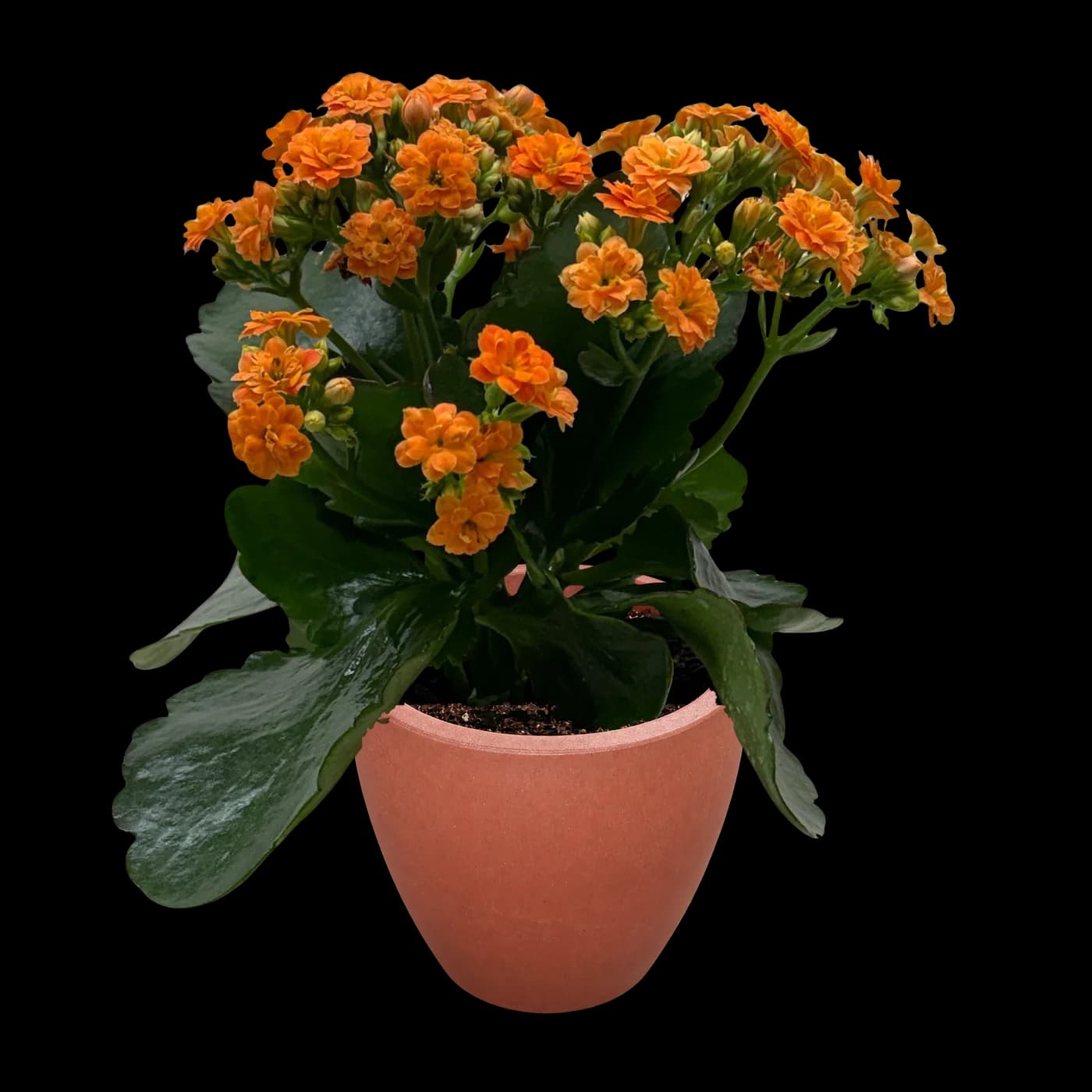
Flaming Katy is a compact, bushy succulent grown for its flowers. NC State Extension describes tiny, long-lasting flowers in large clusters, held above thick, fleshy, glossy leaves with scalloped edges. The flowers come in red, orange, yellow, pink or white, and ours are orange.
Its botanical name is Kalanchoe blossfeldiana, and it belongs to the stonecrop family, Crassulaceae. The Royal Horticultural Society (RHS) gives flaming Katy as its common name, and NC State lists Christmas kalanchoe, florist kalanchoe and Madagascar widow's thrill among its others. NC State also lists a cultivar named 'Flaming Katy' with bright red flowers, so the name can mean the species or that one red form. Ours is an orange-flowered plant of the species, and we list it simply as Kalanchoe Flaming Katy.
NC State gives its home as northeast Madagascar and says it's named for Robert Blossfeld, a German nurseryman who brought it to Europe. It puts the plant at 6 to 18 inches tall and 6 to 12 inches wide, and rates it slow growing and low maintenance.
It isn't a short-lived plant. NC State and the RHS both describe it as a perennial, so it doesn't die after flowering, and it keeps its glossy leaves between blooms. Clemson Extension notes that it's usually sold in late winter and spring as a flowering potted plant, and the New York Botanical Garden (NYBG) says many people keep it only as a seasonal decoration. You don't have to: with bright light and some planning, it can flower again, as the reblooming section explains.
What it does well, and where it asks more of you:
- Its flowers last. NC State says they're long lasting, about four weeks, and Clemson says cool nights make them last longer.
- It needs little water. It's a succulent that NC State calls drought tolerant, so it forgives a missed watering.
- It wants a bright spot. Clemson says it gets spindly in low light, so it isn't a plant for a dim room.
- A second bloom takes planning. It needs about six weeks of long, unbroken nights to set new buds, so reblooming is an optional project.
- It's toxic to cats and dogs, according to the ASPCA.
- It's small. It comes in our Small only, a 4 in pot, and fits a sunny windowsill.
If you have a cat or dog, choose a plant we call pet safe instead. For color, the Red Prayer Plant, which the ASPCA lists as non-toxic, has red-veined leaves all year.
Is a kalanchoe safe for cats and dogs?
No. The ASPCA lists kalanchoe as toxic to both dogs and cats. Its entry covers the whole genus, Kalanchoe spp., so it includes flaming Katy, and its other names there include mother-in-law plant, devil's backbone, chandelier plant and mother of millions. When we checked in November 2026, it was on the ASPCA's toxic lists for both cats and dogs.
The ASPCA names the toxins as bufadienolides, and the signs it lists are vomiting, diarrhea and, rarely, an abnormal heart rhythm. Bufadienolides are cardiac glycosides, compounds that act on the heart: a toxicology brief by Geof Smith of NC State's College of Veterinary Medicine describes them as similar to digitalis, and notes that the flowers contain a much higher concentration than the stems, leaves or roots.
NC State Extension's plant page rates its poison severity as medium, lists the flowers, leaves and stems as poisonous and warns that eating it can be fatal to pets, causing an abnormal heart rate, seizures and death. It says to keep the plant out of reach of children, dogs and cats. The RHS also marks it as harmful to pets if eaten.
Succulent doesn't mean safe. The ASPCA lists some succulents, such as burro's tail and hens and chickens, as non-toxic, but kalanchoe isn't one of them. Keep it in a room your pets don't use, and pick up dropped flowers when you deadhead. If your pet chews it, call your veterinarian or the ASPCA Animal Poison Control Center at (888) 426-4435 straight away, even if it seems fine. A consultation fee may apply. Our guide to pet-safe houseplants covers the plants we do call pet safe.
How much light does a kalanchoe need?
Plenty. Clemson says kalanchoe grows best in full sun and tolerates bright indoor light well, but gets spindly in low light. NYBG suggests at least four hours of direct sun a day to keep it compact, ideally a foot or two from a south-facing window, though a sunny east- or west-facing window can work too. NC State says it needs 6 to 8 hours of bright light a day to bloom.
Watch the hottest sun, though. NC State says prolonged direct sun can scorch the leaves and recommends afternoon shade. In practice, that means a sunny window with some protection from strong afternoon sun in summer, such as a sheer curtain or a spot a little back from the glass.
Keep it cool but never cold. Clemson and Iowa State Extension give ideal temperatures of 45 to 65°F at night and 50 to 70°F by day, and Clemson says cool nights make the flowers last longer. NC State says it's intolerant of frost and should come indoors before temperatures drop to 45°F, so in winter keep it off frosty glass and away from cold drafts. Keep it away from heaters too: Clemson says night temperatures above 80°F can hold back new buds.
If your rooms run dim, our low light houseplants guide has plants better suited to them.
How often should you water a kalanchoe?
Only once the soil has dried out. NC State says it's drought tolerant and that it's best to let the soil dry out between waterings, then water deeply. Iowa State says to let the soil dry between waterings but not to the point of wilting, and Clemson warns that overwatering can damage it.
There's no fixed schedule. NYBG's advice is to water thoroughly once the top few inches of soil feel dry, and if you're unsure, to wait. A Small in its 4 in pot dries out faster in a warm, sunny window than in a cool one, so feel the soil every week or so rather than going by the calendar.
When it's time, water like this:
- Pour slowly at the base until the soil is evenly moist. If the pot has a drainage hole, a little water running out is the sign it's had enough.
- Tip out any extra. NYBG suggests emptying the saucer after 15 minutes, and Iowa State says never to leave the pot sitting in water, since good drainage is essential.
- Leave it until the soil is dry again. Push a finger into the soil, and if it feels cool or damp, wait.
Water a little less after it flowers. NYBG suggests letting it dry out between waterings for about a month after blooming, while it rests. Our guide to watering houseplants covers the basics for every plant.
How long do kalanchoe flowers last?
Weeks. NC State calls the flowers showy and long lasting, about four weeks, and says the blooms can last for several weeks. Each flower is less than half an inch across, but they open in large clusters above the leaves.
Cool, bright conditions make them last longest. Clemson says cool night temperatures prolong flower life, and NYBG suggests cool temperatures and full sun to extend blooming.
Deadhead as they fade. NC State says removing spent flowers encourages more blooms. Snip each faded cluster off where it meets the stem, and once the whole plant has finished, cut the old flower stems back, as Clemson suggests.
It may arrive in bud, in flower or somewhere in between, and we can't promise which. If it arrives with buds showing, they don't need dark nights to open: Clemson says that once buds are large enough to be seen above the leaves, day length no longer matters. Set it in bright light and let them open.
How to get a kalanchoe to flower again
This is optional. The plant lives on after flowering either way, as a compact succulent with glossy leaves. Iowa State says it can be forced to rebloom, though the process is difficult for some home gardeners, and NYBG notes that many people treat it as a seasonal plant. If you'd like a second round of flowers, here's what the extension guides recommend.
Kalanchoe is a short-day plant: like a poinsettia, Clemson explains, it needs long nights to form flower buds. NC State says it needs total darkness for 14 hours a day for at least 6 weeks in fall and winter, and Iowa State gives the same six weeks of 14-hour nights. The routine:
- After it flowers, cut back tall growth and the old flower stems, as Clemson suggests, and give it a rest of about a month with less water and no fertilizer, as NYBG suggests.
- Through spring and summer, grow it on in your sunniest window, and feed it monthly while it's actively growing, as Clemson suggests. Clemson says it can also spend summer outdoors in a bright, lightly shaded spot once frost is past, if you ease it into the brighter light gradually. Bring it back in before the first frost, or before nights drop to 45°F, NC State's cutoff.
- From October, give it long, unbroken nights. Clemson says natural day lengths between October 1 and March 1 let buds form, as long as the plant sits in a room where no lights are turned on during the naturally dark hours. A spare room with no evening lamps works. Clemson's other option is to put it in a closet in the late afternoon and bring it back to bright light each morning.
- Keep it bright by day and not too warm at night. NC State says it needs 6 to 8 hours of bright light a day to bloom, and Clemson says nights warmer than 80°F during this period can delay the buds. Iowa State suggests 60 to 65°F at night.
- Keep it up for about six weeks. Clemson says it takes about six weeks of natural winter day lengths, which give a 14- to 16-hour night, for buds to form. Once the buds are large enough to see above the leaves, it says, you can put the plant anywhere, whatever the lighting.
Then expect a wait for the flowers themselves. Clemson says a plant given naturally long nights from early October should begin flowering by January, about 12 weeks after the long nights start. If no buds form, light at night is the usual culprit: NC State says a plant that fails to bloom may not be getting the darkness it needs to reset its bloom cycle.
Everyday kalanchoe care: potting mix, feeding, pruning and cuttings
Use a fast-draining mix. NC State recommends a well-drained potting mix suited to cactus or succulents, and Clemson suggests a well-aerated blend such as 60 percent peat moss and 40 percent perlite. NYBG says kalanchoe needs a pot with a drainage hole, so if yours has none, move it to one that does when you repot.
Repot after flowering, not before. Clemson suggests moving it to a slightly larger pot once it has finished blooming, and NYBG suggests going up one pot size in spring.
Feed it while it grows. Clemson suggests any houseplant fertilizer once a month for an actively growing plant, and the RHS suggests a balanced liquid fertilizer 2 or 3 times in the growing season. Skip it while the plant rests after flowering.
Skip the humidity fuss. NYBG says it's well adapted to dry winter air and doesn't need misting. What it does need is good air circulation, which NC State and Clemson both recommend to prevent powdery mildew.
Prune for shape, if you like. The RHS says no pruning is required, but NYBG suggests pruning and shaping after flowering to encourage branching, which gives it more stem tips to flower from.
Cuttings root easily. Clemson suggests 2 to 3 in tip cuttings from non-flowering shoots in spring or early summer, each with two pairs of leaves. Take off the bottom leaves, let the cut end dry for several days, then push it into a mix of half peat moss and half perlite, kept in bright, indirect light inside a clear plastic bag. Clemson says they should be ready to transplant in 14 to 21 days. Wash your hands afterward, since NC State lists the plant as poisonous if eaten. Our care notes cover the routine every Patina plant shares.
What to do when your kalanchoe arrives
It comes already potted at the greenhouse in a recycled eco pot, in terracotta or black, in one box. It isn't frost hardy, so bring the box inside as soon as it's delivered. In the first week:
- Unpack it the day it arrives. Lift it out by the pot rather than the stems, and remove all the packing, including any winter protection added for a cold-weather trip.
- Feel the soil before you water. If it's dry, water slowly until it's evenly moist and tip out any extra. If it's still damp, leave it. With a succulent, a missed watering is safer than an extra one.
- Check the flowers. It may arrive in bud, in flower or with some flowers past their best. Snip off any clusters that are bruised or browned, and let the buds open in bright light.
- Set it in your brightest window, out of hot afternoon sun and away from heaters, drafts and frosty glass.
- Leave it in its pot until it has finished flowering, and if it arrives in fall or winter, hold off on feeding until it's growing again in spring.
If it arrives damaged or declines in its first 30 days, we replace it. Delivery times are on our shipping page.
Common kalanchoe problems and how to fix them
Most kalanchoe problems come back to water or light. Find the symptom:
- Soft, dark or collapsing stems at the soil line, with soil that stays damp: root or stem rot from overwatering, which NC State and Clemson both warn about. Clemson says rot usually comes from a mix that drains slowly or from watering too often. Let it dry out fully. If the stems are mushy, take cuttings from the healthy tops and root them.
- Limp, wilting leaves with bone-dry soil: it went too long between drinks. Iowa State says to let the soil dry between waterings, but not to the point of wilting. Water thoroughly and check a little sooner next time.
- Long, leggy stems with gaps between the leaves: too little light. Clemson says it gets spindly in low light. Move it to a sunnier window and cut it back after flowering.
- Scorched or brown patches on the leaves: prolonged direct sun, which NC State says can scorch them. Give it shade from hot afternoon sun.
- No new flowers: not enough darkness at night. NC State says a kalanchoe that fails to bloom may not be getting the long nights it needs, and Clemson says nights above 80°F can delay buds. See the reblooming steps above.
- Fine webbing, mottled leaves or yellow spots: possibly powdery mildew, which Clemson says is hard to recognize on kalanchoe because it may show only as fine webbing. Give it more air circulation. Check for spider mites too, which NC State lists among its pests.
- White, cottony clusters, small brown bumps or clusters of tiny insects: mealybugs, brown scale or aphids, which Clemson names as its most common pests. Clemson suggests wiping mealybugs off with a cotton swab dipped in alcohol, scraping scale off and removing aphids by hand.
Our Kalanchoe Flaming Katy comes in our Small size only, a 4 in pot, potted at the greenhouse in a recycled eco pot in terracotta or black, with our 30-day guarantee.
Questions
Is kalanchoe toxic to cats and dogs?
Yes. The ASPCA lists kalanchoe (Kalanchoe spp.) as toxic to cats and dogs. It names the toxins as bufadienolides, which are cardiac glycosides, and lists vomiting, diarrhea and, rarely, an abnormal heart rhythm as signs. NC State warns that eating it can be fatal to pets. Keep it in a room your pets don't use, and if one chews it, call your vet or the ASPCA Animal Poison Control Center at (888) 426-4435.
Does a kalanchoe die after it flowers?
No. NC State and the RHS both describe it as a perennial, and it keeps its glossy leaves after the flowers fade. NYBG notes that many people treat it as a seasonal plant, but with bright light it carries on as a compact succulent, and with a darkness routine in fall it can flower again.
How do I get my kalanchoe to bloom again?
Give it long, unbroken nights. Clemson says about six weeks of natural winter day lengths, with 14- to 16-hour nights, let buds form, as long as no lights go on during the dark hours. NC State says 14 hours of total darkness a day for at least 6 weeks. Clemson says a plant that starts its long nights in early October should begin flowering by about January.
How long do kalanchoe flowers last?
About four weeks, NC State says. Cool nights make them last longer, according to Clemson, and NC State says deadheading spent flowers encourages more blooms.
How often should I water a kalanchoe?
Only once the soil has dried out. NC State says to let it dry out between waterings, then water deeply, and NYBG says that if you're unsure, it's better to wait. Never leave the pot standing in water, since Clemson says root rot usually comes from a mix that drains slowly or from watering too often.
Is flaming Katy the same as kalanchoe?
It's one kind. Kalanchoe is a genus of succulents, and flaming Katy is the common name the RHS gives one species, Kalanchoe blossfeldiana, the flowering kalanchoe sold in pots. NC State also lists a red-flowered cultivar named 'Flaming Katy'. Ours has orange flowers. Whatever the name, the ASPCA lists the whole genus as toxic to cats and dogs.
Sources
- ASPCA Animal Poison Control: Kalanchoe (Kalanchoe spp.)
- ASPCA Animal Poison Control: Toxic and Non-Toxic Plants for Cats
- ASPCA Animal Poison Control: Toxic and Non-Toxic Plants for Dogs
- NC State Extension Plant Toolbox: Kalanchoe blossfeldiana
- Clemson Cooperative Extension (HGIC 1563): Kalanchoe
- Iowa State University Extension and Outreach: How do I care for Kalanchoe?
- New York Botanical Garden: Kalanchoe (Kalanchoe blossfeldiana) cultivars, Houseplant Care
- RHS Plants: Kalanchoe blossfeldiana (flaming Katy)
- Geof Smith, NC State College of Veterinary Medicine (2004): Toxicology Brief: Kalanchoe species poisoning in pets